The Plain Record

Neutral daily news — clear headlines, complete facts.

National

Ancient Wall Found Beneath Paris Hotel May Confirm City's Origins

Archaeologists discovered a 65-foot Gallo-Roman wall beneath a Paris hotel, providing evidence that could confirm the city's original settlement was on the Île de la Cité.

Published September 24, 2026 at 5:06 AM EDT

The short answer

Archaeologists discovered a 65-foot Gallo-Roman wall beneath a Paris hotel, providing evidence that could confirm the city's original settlement was on the Île de la Cité.

Ancient Wall Found Beneath Paris Hotel May Confirm City's Origins

The Facts

Who
France's Culture Ministry and Culture Minister Catherine Pegard
What
discovery of a Gallo-Roman wall beneath a hotel
When
announced Wednesday, discovered this summer (excavation visited Sept 22, 2026 per photo caption)
Where
Hotel-Dieu, Île de la Cité, Paris, France
Why
The find provides evidence that Lutetia (ancient Paris) was located on the island rather than in a suburb, and traces of fire align with accounts of the Battle of Lutetia in 52 B.C.

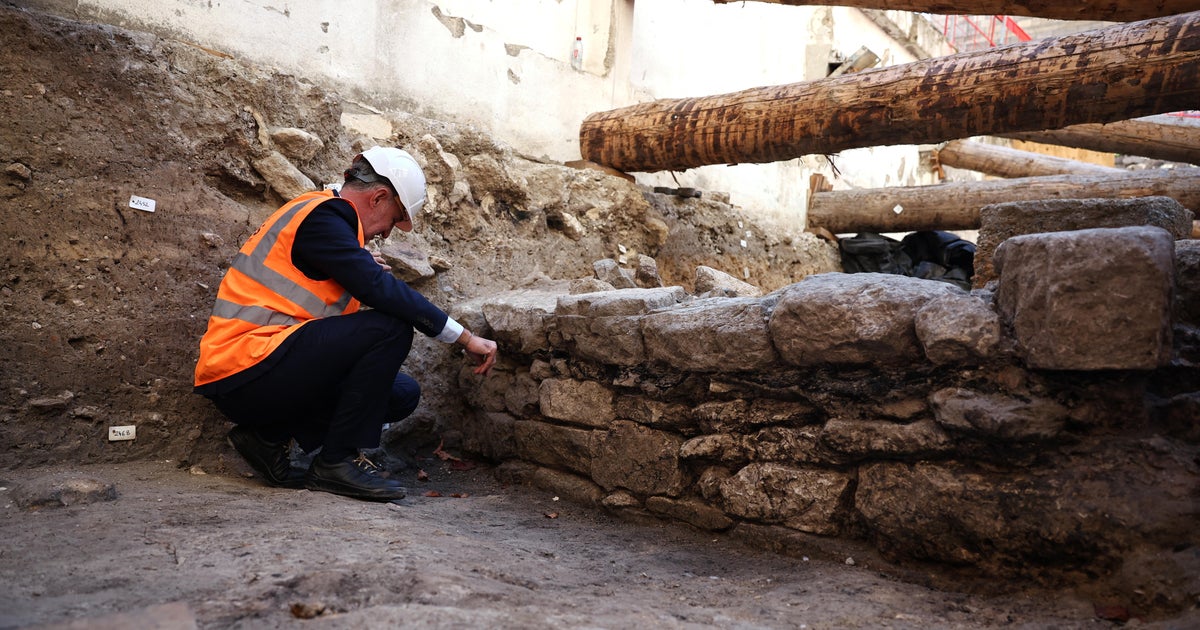
The French culture ministry announced on Wednesday that archaeologists discovered a roughly 65-foot ancient wall beneath a hotel in central Paris. The stone-and-wood structure, dating from the Gallo-Roman period, was found this summer beneath the Hotel-Dieu on the Île de la Cité, near Notre Dame Cathedral. Officials stated the find could confirm the location of the city's original settlement, known as Lutetia.

The discovery addresses a long-standing debate regarding the origins of Paris. While the Île de la Cité has traditionally been considered the center of Lutetia, a rival theory supported by some archaeological research suggests the original settlement was located in the suburb of Nanterre to the west. Culture Minister Catherine Pegard said in a statement that the remains may be among the most important ever found for understanding the Gallic period of the city, though she noted that scientific caution requires further verification of its function and chronology.

The wall shows traces of fire, which may correspond to accounts in Julius Caesar's \"Gallic Wars.\" In the text, Caesar wrote that the Gauls set fire to their town before the Battle of Lutetia against the Romans. Carbon dating of the charred evidence places the wall's origin between 10 B.C. and 200 B.C., a period that encompasses the conflict in 52 B.C. The wall is believed to be a fragment of ramparts built by the Parisii, a Gallic tribe that lived along the Seine during the Iron Age.

The discovery provides physical evidence to a dispute over where Paris began. The identification of a defensive structure links the modern center to the Parisii tribe and a documented Roman conflict involving Julius Caesar.

The find adds to a recent series of archaeological recoveries in the vicinity of Notre Dame. These include a 4th-century coin and inscriptions found recently, and 14th-century tombs and a sarcophagus discovered in 2022.

Continued archaeological activity is expected at the site as experts work to verify the wall's exact age and purpose. What happens next involves further scientific testing by the culture ministry to finalize the chronology. No specific deadline for the completion of the study or a date for public display of the artifacts has been announced.

Timeline of what happened

Key dates and decisions, in the order they occurred.

  1. 2022

    Tombs and sarcophagus discovered at Notre Dame

  2. June 2026

    Fourth-century coin and inscriptions found at cathedral

  3. September 22, 2026

    Paris Mayor Emmanuel Gregoire visits the archaeological site

Summaries are written by The Plain Record to state the facts of a story plainly and without political slant. Drafted with AI assistance and checked against the source record before publication. See how we report, or report a correction.

← Back to the front page

Questions readers ask

What happened: Ancient Wall Found Beneath Paris Hotel May Confirm City's Origins?

The French culture ministry announced on Wednesday that archaeologists discovered a roughly 65-foot ancient wall beneath a hotel in central Paris. The stone-and-wood structure, dating from the Gallo-Roman period, was found this summer beneath the Hotel-Dieu on the Île de la Cité, near Notre Dame Cathedral.

Who is involved?

France's Culture Ministry and Culture Minister Catherine Pegard

When did this happen?

announced Wednesday, discovered this summer (excavation visited Sept 22, 2026 per photo caption)

Where did this happen?

Hotel-Dieu, Île de la Cité, Paris, France

Why does this matter?

The find provides evidence that Lutetia (ancient Paris) was located on the island rather than in a suburb, and traces of fire align with accounts of the Battle of Lutetia in 52 B.C.