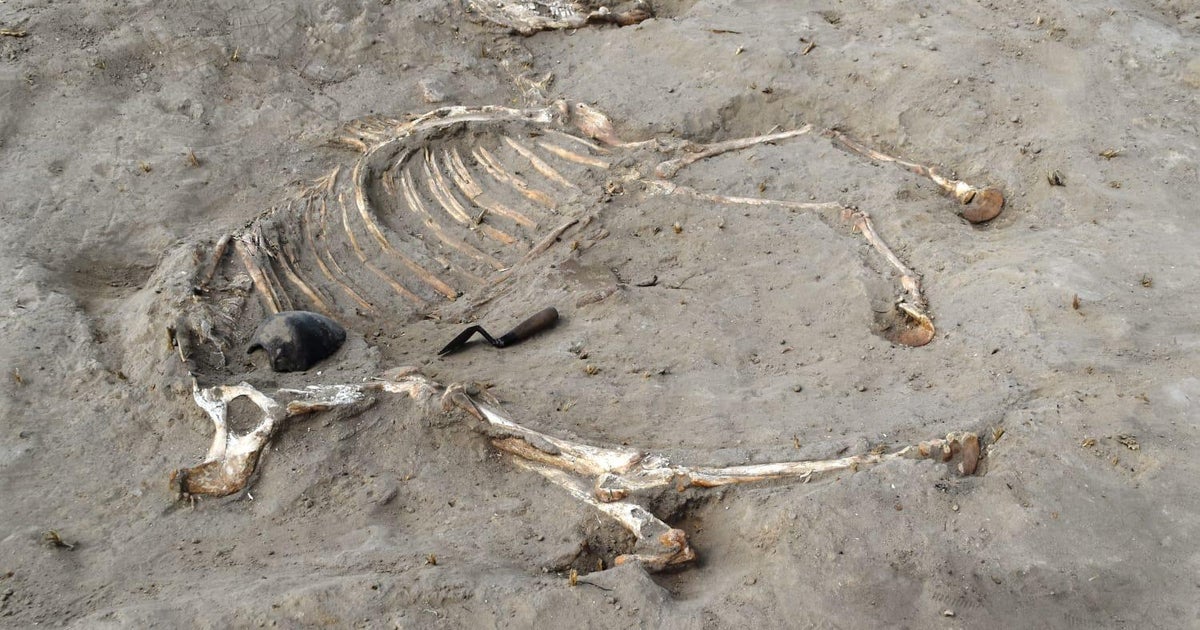
Archaeologists in Egypt have discovered the complete remains of a horse, estimated to be approximately 3,000 years old, which appears to have been given an honorific burial. The Egypt Ministry of Tourism and Antiquities announced on a Wednesday that the discovery occurred at Tell Al-Abqain in the northern Beheira province. Researchers stated the animal was a young male from a breed known for speed and agility, suggesting it was likely used for military purposes such as pulling war chariots.
The site dates back to the New Kingdom period, which spanned from 1570 to 1069 B.C. During this era, the fortress at Tell Al-Abqain was established to defend Egypt against incursions by Libyan tribes from the west. The location served as a strategic military outpost in the Nile Delta, housing both soldiers and resources necessary for regional defense.
Excavations at the site also revealed a mudbrick residential complex featuring planned streets, grain-storage silos, and pottery ovens. According to Dr. Hisham El-Leithy, secretary general of the Supreme Council of Antiquities, the layout indicates a high level of urban planning and resource management. Other finds included limestone and alabaster pieces believed to be part of a chariot harness and a limestone stela, or slab, depicting a bound Libyan prisoner in a submissive posture.
For the general public and those interested in cultural heritage, the find illustrates the day-to-day operations of a defensive outpost. The scale of the discovery includes an entire residential complex and various specialized rooms for food preparation and storage. A visitor or researcher looking at these remains would see evidence of a self-sustaining community, including cylindrical ovens for cooking and jars for storing perfumes and oils. This level of detail helps quantify the resources—such as grain and pottery—required to maintain a military presence in the Nile Delta thousands of years ago.
The find establishes a precedent for understanding the "honorific" treatment of military animals in the New Kingdom, potentially influencing how future equine remains found at similar sites are interpreted. It also clarifies the historical interactions between Egypt and Libyan tribes through the discovery of the prisoner stela and protective amulets. The Ministry has not yet reported a specific date for when these artifacts will be moved to a museum or if the site will be open to the public, but preliminary studies of the horse remains and other artifacts are ongoing.