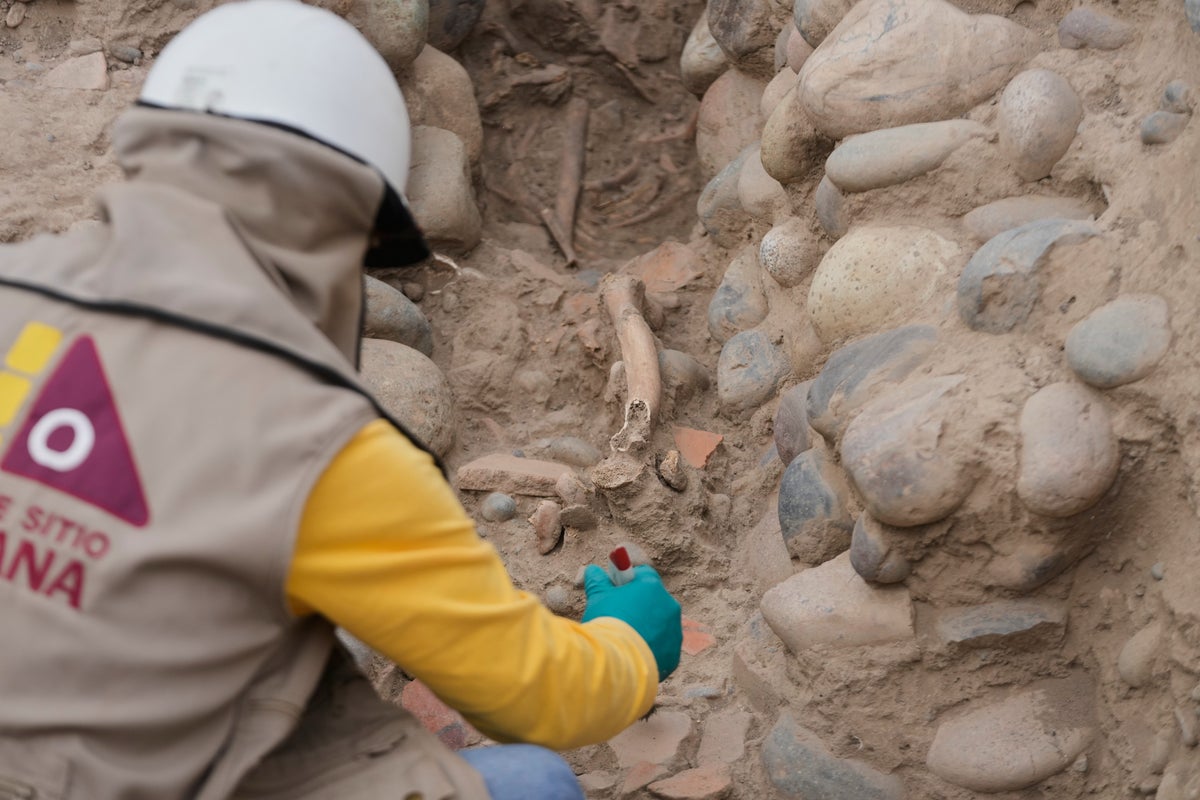
Archaeologists in Lima, Peru, have discovered the skeletal remains of an adult human, believed to be a male, at the base of the Huaca Pucllana pyramid. Researchers stated that the individual appears to have been buried as a ritual offering during the sealing of a canal connected to a ceremonial pool. The body was discovered interred inside the canal, positioned on its left side with the skull oriented toward both the pyramid and the Pacific Ocean.
The Huaca Pucllana site, constructed of adobe, served as a primary administrative and religious center for the Lima civilization. This society occupied Peru’s central coast from the 1st through the 7th century. The Lima culture dissolved several hundred years before the Spanish established the city of Lima in 1535 and predated the Inca Empire by approximately 700 years. The archaeological monument is currently situated within the modern residential districts of Miraflores and San Isidro.
Gladys Paz, the lead archaeologist for the excavation, stated that the discovery will help experts understand the rituals of the Lima culture and reconstruct ceremonies from centuries ago. According to Pieter Van Dalen, an archaeology professor at the National University of San Marcos who was not involved in this specific dig, such discoveries are relatively frequent along the coast. He noted that remains are often found during infrastructure projects, such as a 1,000-year-old mummy uncovered by utility workers in 2025.
For the general public and students, the find translates to a more detailed understanding of the pre-Inca history of the region. A person visiting or living near the Miraflores and San Isidro districts would notice these archaeological sites integrated into daily life, situated alongside parks and residential buildings. The presence of these sites influences local tourism and land use, as state law and construction protocols must account for the high probability of encountering human remains or artifacts during routine gas pipeline or utility work.
The discovery sets a precedent for how modern Lima manages its extensive archaeological heritage while maintaining a functioning capital. It highlights the ongoing scientific effort to differentiate between natural desert mummification and cultural mummification practices, such as remains found in seated positions with hands covering faces. Next steps for the research team include further analysis of the skeleton to gain deeper insights into Lima culture rituals. No specific dates for the conclusion of this analysis or future excavations were reported.