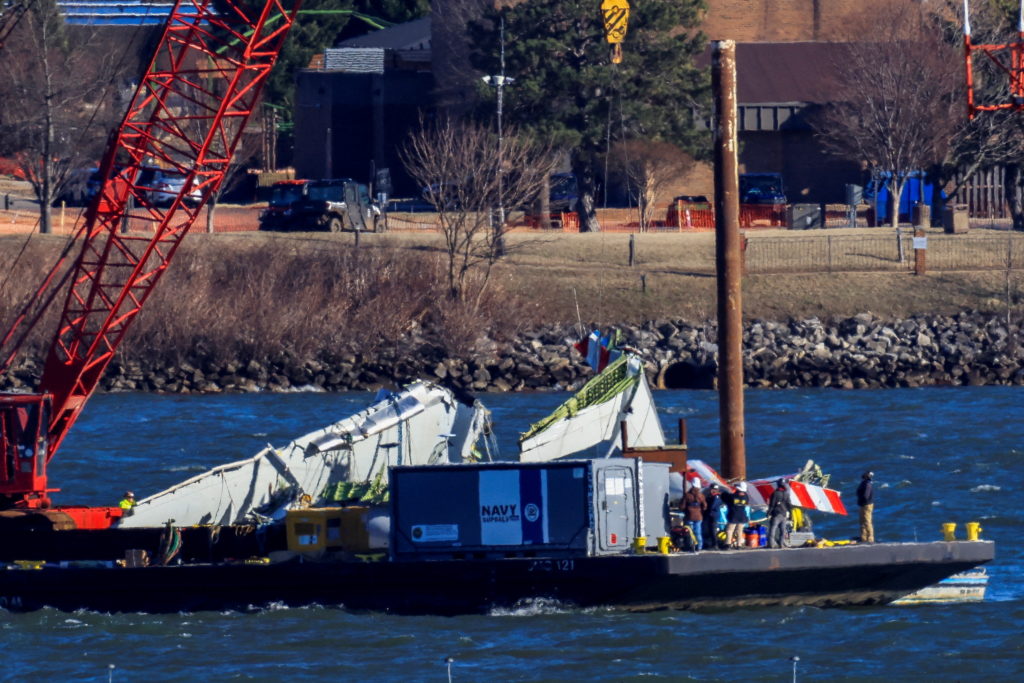
The U.S. Army released a report on Thursday, October 8, 2026, identifying systemic safety breakdowns as the cause of a midair collision between an American Airlines jet and a Black Hawk helicopter near Washington, D.C., last year. The report, which was completed in May 2026, cited failures in air traffic control, helicopter flight routes, pilot training, and safety monitoring. The crash killed 67 people, making it the deadliest aviation accident in the United States in more than two decades.
The collision occurred when the helicopter and the descending airliner crashed into the Potomac River near Ronald Reagan Washington National Airport. The Army released the findings publicly after months of pressure from the victims' families, who received the report late last week. The findings largely reinforce previous conclusions by the National Transportation Safety Board (NTSB), an independent government agency that investigates civil transportation accidents, though the NTSB's broader investigation also highlighted missed warnings by the Federal Aviation Administration (FAA).
Army investigators identified several specific factors, including two failed radio transmissions that prevented the helicopter crew from identifying the jet. The report also noted that the military pilots' night-vision goggles restricted their view of the approaching plane. Additionally, the designated helicopter route provided only 75 feet of vertical separation from planes landing on the secondary runway, a margin the report found insufficient to account for instrument errors. The NTSB confirmed the Black Hawk's altimeter was reading nearly 100 feet lower than the helicopter's actual altitude.
The report also faulted the air traffic controller at Reagan National for failing to provide the helicopter crew with specific location details for the jet and for not warning the jet's pilot about the helicopter. Since the accident, the FAA has prohibited controllers from relying on pilots to maintain visual separation in busy airspace. The Army stated it has already strengthened crew training and completed inspections and reconfigurations of 3,585 helicopters after discovering that the crashed Black Hawk's ADS-B Out system—a technology that broadcasts aircraft location—was inoperable.
For the public and flight crews, the Army’s ongoing review now extends to helicopter operations in other major metropolitan areas, including Los Angeles and the Seattle-Tacoma region. The goal of this review is to determine if similar route design risks exist in other busy airspaces. The NTSB indicated last week that the Army has made progress on seven of its eight safety recommendations, whereas the FAA has yet to implement approximately one-third of the recommendations directed at its operations.
The report’s release provides families with a formal accounting of the event, though some, like former Army pilot Tim Lilley, noted that parts of the document were redacted and responsibility was assigned to the institution rather than specific individuals. The Army stated on Thursday that it remains committed to transparency. The next steps for safety reform now rest with Congress as lawmakers attempt to reconcile aviation safety legislation, though no specific date for a final vote was reported.