Astronomers announced Wednesday the discovery of a new class of cosmic object dubbed a "black hole star," which may explain the presence of mysterious "little red dots" observed in the early universe. The object, named MoM-BH*-1, appears to be the size of a solar system but generates approximately 100 billion times more energy than a typical star. A U.S.-led research team identified the object using the James Webb Space Telescope (JWST) and published their findings in the journal Nature.
The discovery originated from a study of the early universe, specifically a period 660 million years after the Big Bang. Researchers were investigating why the JWST has frequently detected bright galaxies in the universe's infancy, a time when current models suggested such large structures should not yet exist. During this survey, the team identified a "little red dot" that exhibited unusual light patterns, prompting further investigation into its composition and energy source.
While astronomers often attribute the red color of distant objects to cosmic dust, researchers found that MoM-BH*-1's light disappeared at specific wavelengths, indicating the presence of hydrogen gas rather than dust. Lead author Rohan Naidu of the University of Hawaii stated that nuclear fusion, the process that powers standard stars, could not produce the energy levels observed. Modeling simulations suggests the object consists of a central black hole encased in a gas cocoon, which causes it to resemble a star while producing energy levels characteristic of a black hole.
For the general public and students of science, this discovery clarifies the nature of objects dating back to 660 million years after the Big Bang. Instead of these objects being impossibly large early galaxies, they appear to be individual black holes whose light is so intense that they outshine their entire host galaxies. This distinction shifts the understanding of what a person sees in deep-space imagery from the JWST, moving from a view of distant starlight to "pure black hole star light." The scale of energy involved—100 billion times that of a star—illustrates the extreme physical conditions present at the dawn of the universe.
The research also carries implications for how astronomers track the evolution of the cosmos and the resilience of matter near supermassive black holes. A separate study released Tuesday by the University of Cologne confirmed that stars near the Milky Way's central black hole, Sagittarius A*, continue to produce dust and water despite harsh conditions. These combined findings set a precedent for using the JWST's mid-infrared capabilities to detect chemical signatures like oxygen-rich silicate and water in extreme environments. Moving forward, the naming of MoM-BH*-1 implies that astronomers will be searching for additional examples to confirm if this phenomenon is widespread throughout the early universe.
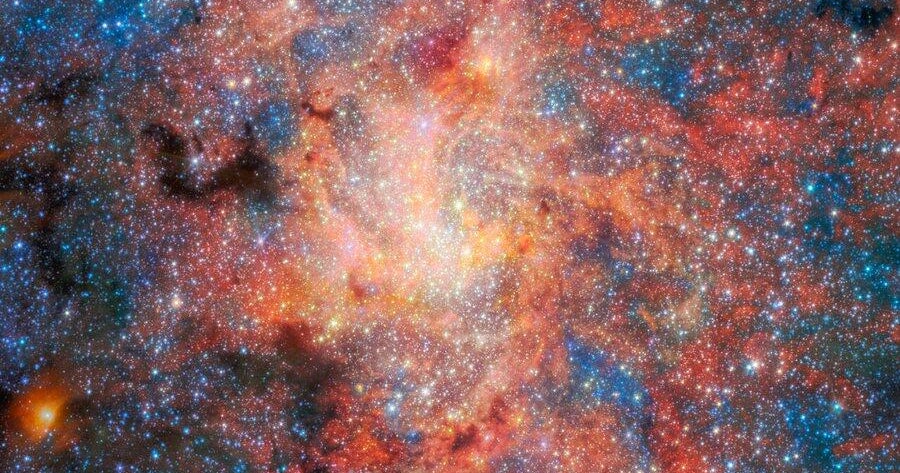
In a separate announcement on Tuesday, a different team using the Webb telescope reported the detection of dust and water in the envelope of the star IRS 3. This star is located 0.55 light-years from Sagittarius A*, the supermassive black hole at the center of the Milky Way. Researchers from the University of Cologne said these observations demonstrate that stars can continue to produce materials necessary for future star formation even in extreme environments near black holes.