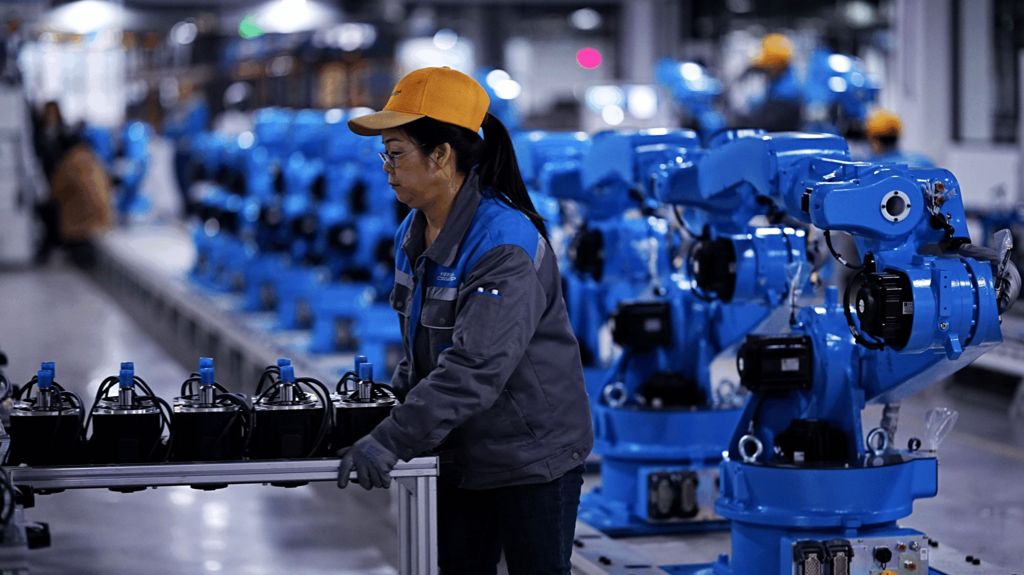
China has deployed more than two million industrial robots across its manufacturing sector, the highest number of any nation, as part of a state-led effort to automate its economy. The initiative is supported by a $20 billion (£14.7 billion) innovation plan overseen by President Xi Jinping, aimed at positioning the country as a global leader in technology. This shift includes the rapid scaling of machines that weld, paint, and assemble products around the clock, alongside the development of vocational schools to train a tech-savvy workforce.
The push toward automation comes as China faces significant demographic shifts, including a shrinking population and an aging workforce. Official estimates indicate that by 2035, more than one-third of the Chinese population will be over the age of 60. Projections also suggest the country could lose approximately 60 million people over the next decade. Industry leaders, such as Pang Kai of CRP Technology, stated that these robots are necessary to fill labor gaps that are expected to emerge within the next 10 years.
While automation is intended to offset labor shortages, it also poses risks to the current manufacturing workforce, which currently employs approximately 120 million people. Companies like Leapmotor, an electric vehicle manufacturer, have already achieved near 100% automation in processes such as stamping, welding, and painting. Cao Li, vice-president of Leapmotor, noted that while human workers currently perform final checks on vehicles, it is "entirely possible" that these roles could be automated in the near future.
On a broader scale, the $20 billion investment impacts global trade and the technological competition between the U.S. and China. More than half of the world's industrial robots are now manufactured in China, and in hubs like Shenzhen, the established ecosystem allows firms to source robot components in less than one hour, compared to up to a week in Europe. While the U.S. currently leads in developing the artificial intelligence "brains" for these machines, Chinese firms such as DeepSeek and Moonshot are releasing new AI models to close the gap. This competition sets a precedent for how global manufacturing power will be distributed based on who can successfully integrate AI into physical machinery.
What happens next depends on the speed of the transition and the stability of the broader Chinese economy. The government is attempting to use "new productive forces" to address sluggish economic growth and high youth unemployment, which currently sees one in five young people struggling to find work. However, China continues to face a property crisis, high local government debt, and low consumption. Whether the rise of robotics will create new forms of prosperity or exacerbate job losses remains a central question as the government continues to push for full automation in industrial workshops.