New court filings have provided detailed plans for the ongoing renovations at the John F. Kennedy Memorial Center for the Performing Arts and the construction of a new White House ballroom. The documents describe a new proposal to include President Donald J. Trump’s name on the Kennedy Center's facade and reveal that the White House project involves fortified underground facilities and specialized materials, including columns carved in Italy.
These projects have been the subject of ongoing litigation. In March, a federal judge issued a preliminary injunction to halt above-ground construction of the White House ballroom following a challenge by the National Trust for Historic Preservation. At the Kennedy Center, a judge previously ruled that the board of trustees acted unlawfully when it initially renamed the building last year, leading to the removal of the president's name from the facade in June.
At the Kennedy Center, the board of trustees voted last week on a resolution to reinstate the president's name. The proposed inscription would read: "The John F. Kennedy Memorial Center for the Performing Arts Restored and Renovated by President Donald J. Trump." A second stage of the plan would expand the text to include "Endowed by the Trump Kennedy Center Fund" once that fund reaches $100 million. The resolution also designates the grounds as "President Donald J. Trump Plaza." The board stated these changes will not be implemented until September 8 at the earliest.
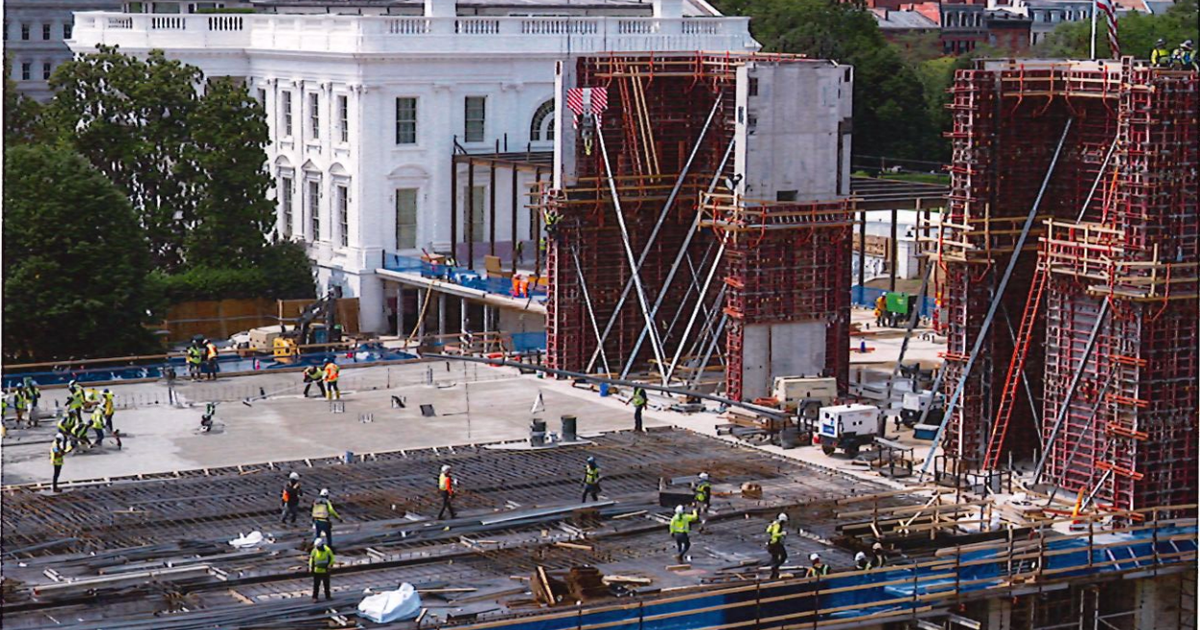
Regarding the White House ballroom, the Justice Department has asked the Supreme Court to freeze an injunction that would otherwise halt construction this Friday. A declaration from Joshua Fisher, director for White House Management and Administration, states the $400 million project is 65% complete and funded by private donors. The facility features a 50,000-square-foot footprint, Indiana limestone columns, and security features including bomb shelters, medical facilities, and a drone port. Fisher reported that a 250-person crew is working 20 hours a day to meet a November completion date for the main structure.
The White House ballroom project involves significant private capital and federal resources, with $355 million of the $400 million budget already raised from private donors. At the scale of 50,000 square feet and 70 feet in height, the project represents a major expansion of the executive mansion's footprint. If the Supreme Court does not intervene by Friday, the D.C. Circuit’s ruling—which found the project lacked necessary congressional authorization—will take effect, potentially idling a 250-person construction crew and stalling a project that has already used 18,000 cubic yards of concrete and 6.4 million pounds of rebar.
Beyond the immediate construction, the White House project introduces permanent new infrastructure for the executive branch, including top-secret military facilities and medical clinics. These changes would alter how the White House functions as a secure site for future administrations. A person living or working in the District would notice the continued presence of a 70-foot superstructure and ongoing 20-hour-a-day work cycles through August 2028, when the project is expected to be fully finished. The immediate next step depends on the Supreme Court, which must decide whether to grant emergency relief before the Friday deadline.