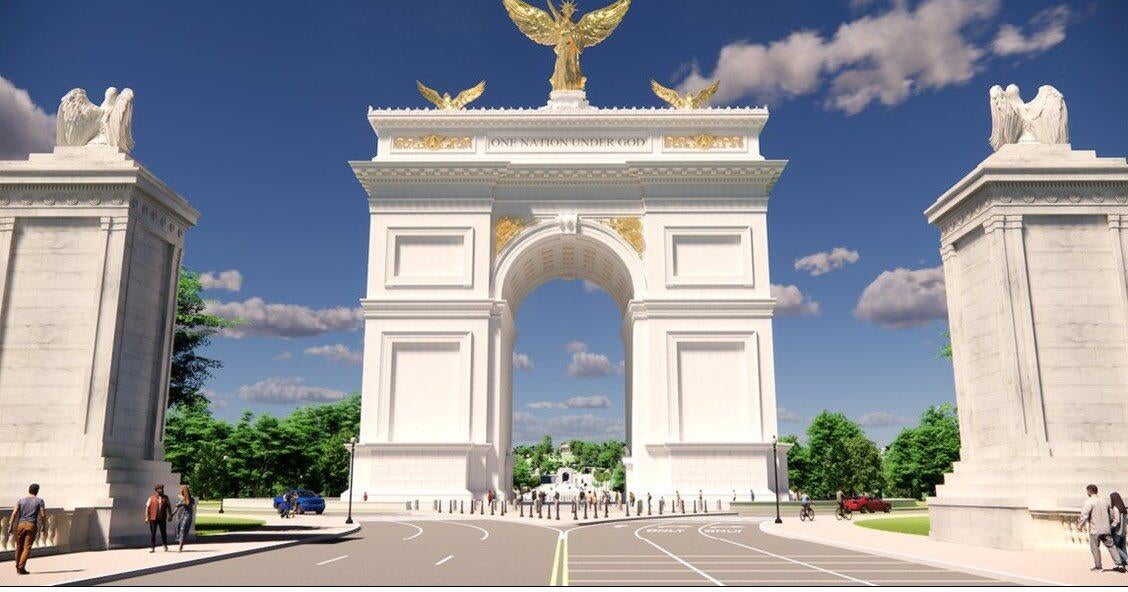
The federal government plans to begin excavation for a 250-foot-tall triumphal arch near Washington, D.C., within the next two weeks, Secretary of the Interior Doug Burgum said Thursday. The monument, which is scheduled to be built near Arlington Memorial Cemetery and across the Potomac River from the Lincoln Memorial, is intended to commemorate the 250th anniversary of the signing of the Declaration of Independence.
The project is part of a broader series of architectural changes proposed by President Donald Trump for the nation's capital, including modifications to the White House campus and the Lincoln Memorial Reflecting Pool. Construction at the site is expected to take two to three years. The National Park Service stated that work will proceed on a year-round schedule of 20 hours per day.
The proposed design features a granite-clad arch topped by an observation deck and three golden statues. Secretary Burgum stated the monument would honor the history of Arlington Cemetery and befitting the capital's significance. During a House committee hearing in May 2026, Burgum testified the arch is being built for the American people, though President Trump told a reporter in October that the arch was for himself.
While the U.S. Commission of Fine Arts and the National Capital Planning Commission have provided approvals for the design, the project faces ongoing regulatory and legal challenges. The Federal Aviation Administration (FAA) is currently studying the impact of the structure on the airspace of Ronald Reagan Washington National Airport, which is located just south of the site. An initial FAA study suggested the arch would require red obstruction lights to ensure aviation safety.
The project's final cost has not been disclosed, and the pending lawsuit by veterans, which alleges the administration lacks congressional authority for the construction, remains in federal court. If excavation begins as scheduled in September 2026, the work timeline could lead to completion by the end of President Trump's second term. The administration has positioned the project as part of the 2026 semiquincentennial celebrations, which are expected to include events across the country.