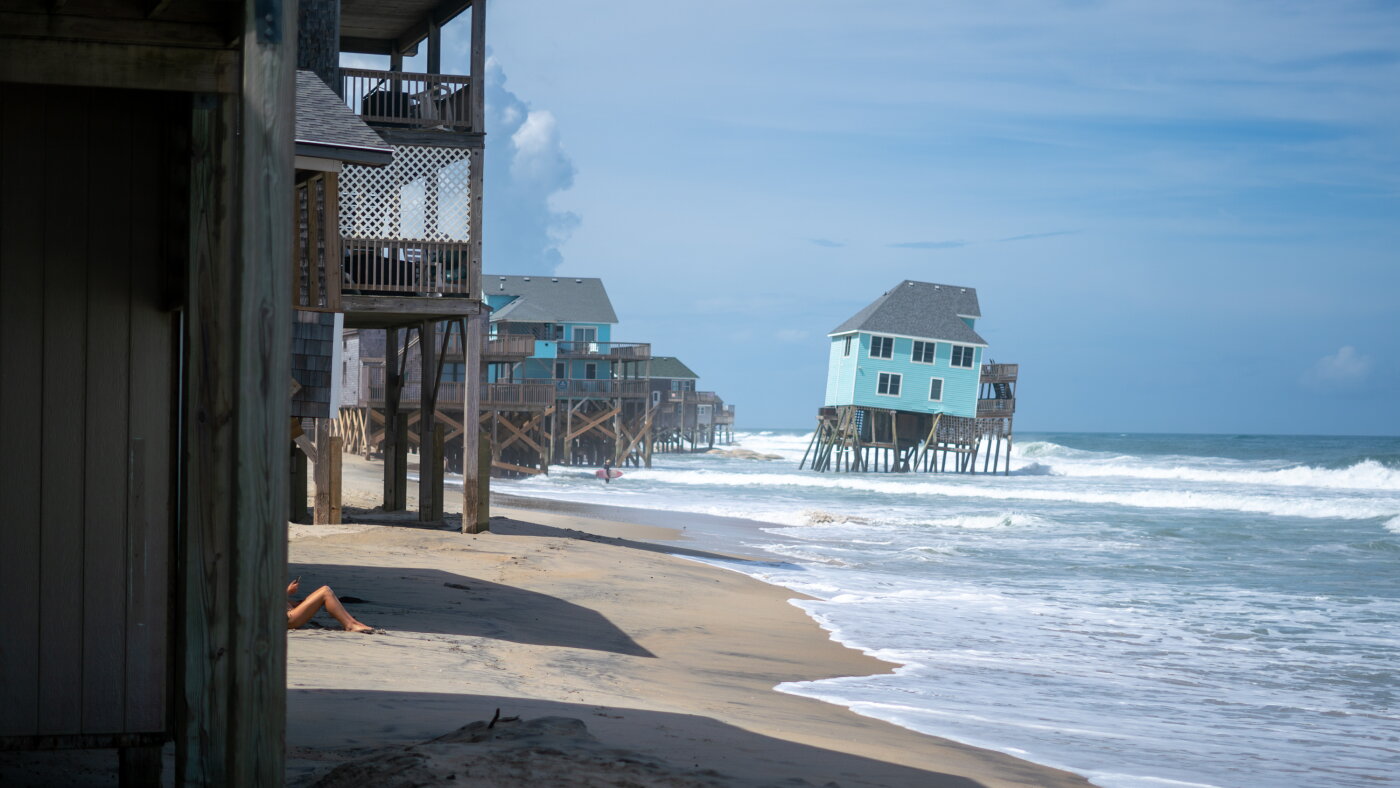
The Federal Emergency Management Agency (FEMA) currently provides insurance payouts for homes lost to coastal erosion only after they collapse, a policy that local officials and residents say discourages the preemptive removal of structures. According to the National Park Service, more than 30 homes have collapsed in Dare County, North Carolina, since 2020. An additional 100 homes on the state's barrier islands are projected to be at risk from erosion and rising sea levels over the next decade.
Coastal erosion, which is the natural removal of sand and rock by waves, is being accelerated by sea-level rise. In North Carolina's Outer Banks, scientists report that sea levels are rising faster than the global average. While homeowners like Richard Foreman and Michael McDaniel have expressed a desire to demolish their uninhabitable, stranded homes to prevent debris from polluting the ocean, they stated they cannot afford the estimated $30,000 to $100,000 cost of demolition or relocation without an insurance settlement.
FEMA, which manages the National Flood Insurance Program, stated it cannot change rules for threatened properties without an act of Congress. A bipartisan bill was introduced in 2025 to allow homeowners to access payouts before a collapse occurs, but the legislation is currently stalled in the House of Representatives. Representative Chellie Pingree (D-ME), a co-sponsor of the bill, argued that the current system is an impractical way to address climate change, as it forces owners to wait for total destruction.
The federal government previously attempted a similar solution through the Upton-Jones Amendment, which was active from 1988 until its repeal in 1994. During that period, more than 400 homes in 27 states were moved or demolished using insurance funds. However, Congress repealed the law after reports indicated some owners delayed action to collect extra rent, and officials feared the payouts could bankrupt the insurance program. FEMA has not conducted a full analysis to determine the long-term cost-effectiveness of that program.
The environmental and economic consequences are substantial for coastal communities and the National Park Service. When a house collapses during a storm, debris can be scattered for miles; the Park Service reported collecting 480 tons of home wreckage in just 18 months. Beyond the pollution, federal and county governments have spent over $500,000 on cleanup costs in North Carolina since 2020. This forces local governments to fund temporary measures, such as beach nourishment projects.
What happens next depends on the stalled federal legislation. The proposed bill seeks to fix previous issues by reducing payouts for owners who fail to act before a collapse and simplifying the process for determining if a home is in "imminent danger." However, the source reports that efforts to reduce FEMA’s budget and workforce have slowed the bill's progress. Without a change in federal law or a drop in demolition costs, homeowners in erosion zones remain in a "waiting game" for their properties to fall into the sea before they can settle their insurance claims.