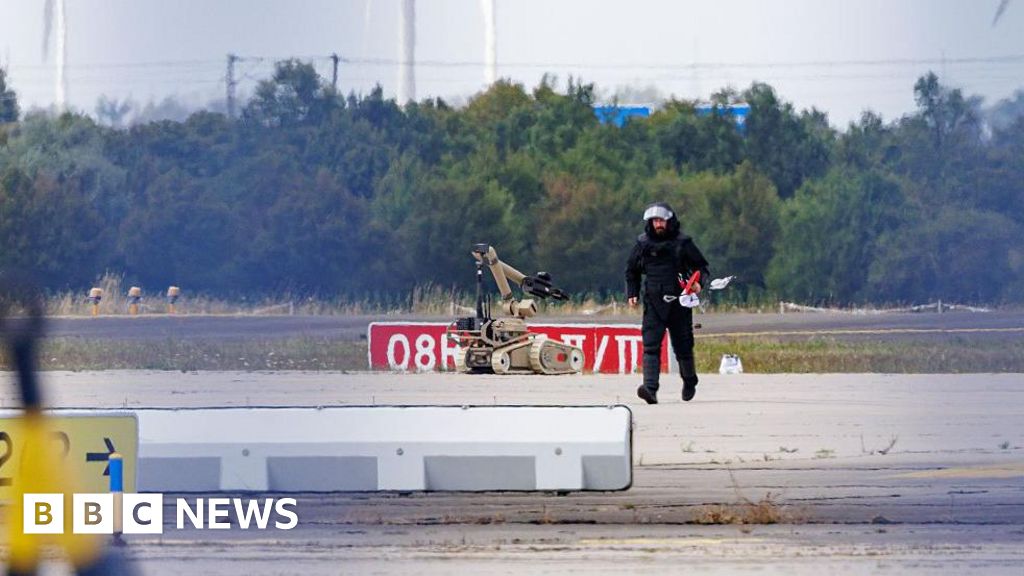
German authorities are investigating the discovery of an explosive-laden drone at Leipzig/Halle Airport on Tuesday night. The quadcopter was found on a runway near several Ukrainian Antonov cargo planes, prompting a partial lockdown and the deployment of a bomb disposal robot to remove the detonator. A DHL cargo plane reportedly collided with an unidentified object during takeoff around the same time, though investigators have not confirmed if that object was a second drone.
The incident occurred as German officials warned of increased threats involving foreign actors. Germany's interior minister stated the event represents a "new level of danger" that may involve foreign powers. While investigators have not established a direct link to a specific nation, the BBC reported that Russian-linked proxies were previously implicated in a 2024 plot involving explosives and drones delivered to Germany. Russia has denied any involvement in the current incident.
In the 2024 case cited by investigators, parcels containing incendiary devices ignited at the Leipzig DHL hub and other locations in the UK and Poland. Lithuanian and Polish prosecutors have charged nearly two dozen suspects, alleging they were part of a network recruited by Russian military intelligence. Case documents indicate these individuals transported RDX explosives hidden in food cans and drone components to various European locations, including a hostel in Dusseldorf.
For the average citizen or logistics worker, the scale of such incidents involves significant security risks and potential economic disruption. In the 2024 plot mentioned as context, investigators seized explosives equivalent to 6kg of TNT, a volume prosecutors said was intended for terrorist attacks. A Ukrainian suspect in that case, Vladyslav D., reported being paid more than $2,000 in cryptocurrency for transporting components. Readers would notice the impact through increased security screenings, potential flight delays, and heightened police presence at international transit points.
The long-term effects involve the heightening of "hybrid war" concerns across NATO member states. John Lough of the New Eurasian Strategies (NEST) Centre stated that such activities are intended to undermine support for Ukraine by highlighting the risks of escalation. Because Germany is one of Ukraine's largest military aid providers, security experts expect a sharp increase in similar activity. German authorities are currently working to trace the launch site of the Leipzig drone and determine the intended target, while NATO officials continue to monitor the ongoing investigation.