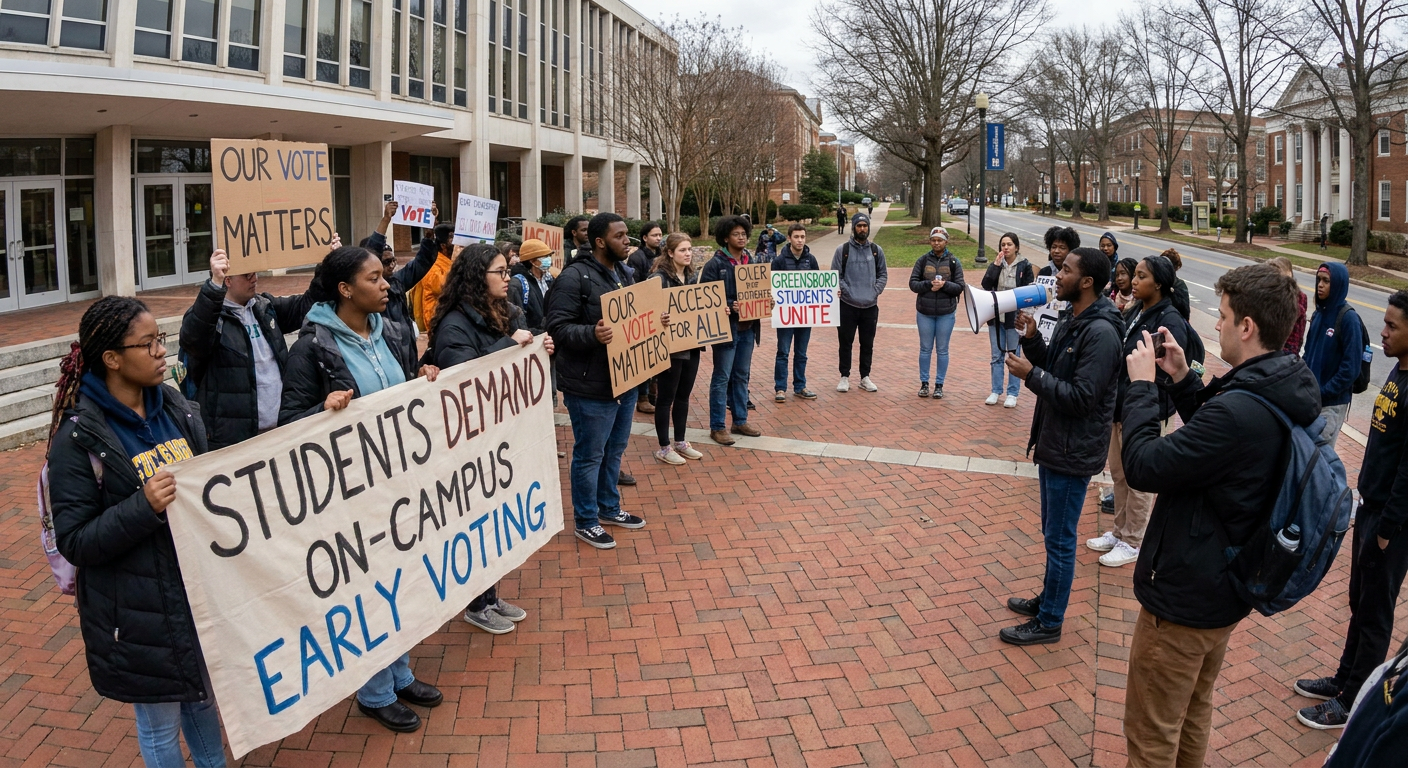
Students from two large universities in Greensboro, North Carolina, conducted a march to the polls on the first day of early voting to protest the absence of on-campus voting sites. The protest involved hundreds of students from North Carolina A&T University, the nation’s largest historically Black university (HBCU), and the University of North Carolina at Greensboro (UNCG). The march took place on Thursday of last week, marking the start of the early voting period in the state.
Shia Rozier, a senior at North Carolina A&T and co-founder of the student organization Protect Ours NC, stated that the lack of on-campus sites creates barriers for students who do not have personal transportation. Rozier noted that North Carolina A&T's policy prohibits first-year students from having cars on campus, which requires them to use ride-sharing services or find alternative transportation during a period of high gas prices. The march to the nearest off-campus polling site took over 45 minutes and involved crossing railroad tracks.
Rozier said the local board of elections has argued that a site has never been provided for midterm elections. Rozier argued that using 2022 voting plans for current students is insufficient and claimed board members who voted against the site have not met with students to address specific concerns regarding parking or location logistics. She also noted that a new polling site was granted to another local area that had not been actively requesting one.
Similar issues regarding polling site accessibility have been reported at other North Carolina institutions. According to Rozier, Western Carolina University had its site removed during the primaries, and North Carolina State University moved its site from the student union to a less accessible location. Elizabeth City State University has also faced challenges regarding campus voting access.
The shift in polling locations changes the day-to-day experience of student voters by requiring significant time commitments—nearly an hour each way for a walk—rather than the minutes required to visit a student union site. These changes are immediate as early voting is currently underway. This situation sets a precedent for how local boards of elections prioritize resources between residential neighborhoods and student populations, particularly at HBCUs, during non-presidential election cycles.
The long-term impact involves the potential for lower voter turnout among young adults if transportation barriers remain unresolved. Students and advocacy groups like Protect Ours NC have indicated they will continue to demand meetings with election officials to establish permanent on-campus sites for future elections. Currently, students must continue using off-campus locations or arranging private transportation through the remainder of the early voting period and on Election Day, which is scheduled for roughly two weeks from now.