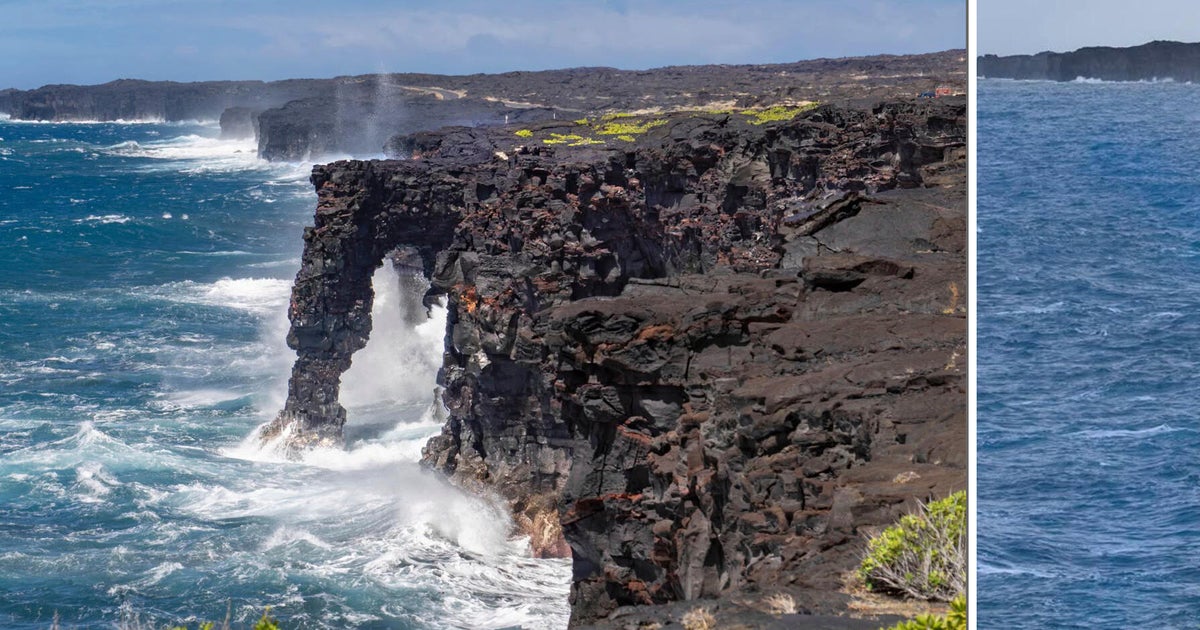
The Hōlei Sea Arch, a 90-foot-tall natural rock formation in Hawaii Volcanoes National Park, has collapsed into the Pacific Ocean. The National Park Service (NPS) confirmed the collapse on Friday, October 2, 2026. The arch was located on the southern coast of the Big Island and had been a prominent landmark for visitors.
Park officials reported that the arch was still standing on Wednesday, September 23, when the park was temporarily closed due to Tropical Storm Nolo. By Sunday night, September 27, the formation had disappeared. The exact moment of the collapse remains unknown, though officials noted the area was subjected to heavy rain and high surf during the storm, which reached maximum wind speeds of 155 mph.
The Hōlei Sea Arch formed approximately 550 years ago through differential erosion, a process where ocean waves wore away softer rock along cracks in ancient lava flows. Geologists and park staff had long expected the collapse, as the surrounding cliffs had shown signs of instability. In 2018, earthquakes during the Kīlauea volcanic eruption damaged the area, and in 2020, high surf from Tropical Storm Darby broke off a portion of the arch’s lower section.
The loss of the Hōlei Sea Arch affects one of the most recognizable natural landmarks in the Hawaii Volcanoes National Park. The collapse follows a series of severe weather events in 2026. Tropical Storm Lala in August washed away roughly 100 homes and caused widespread power outages, while Hurricane Lowell in early September further disrupted the state's infrastructure. These storms led to a federal emergency declaration, approved by the Trump administration, to provide recovery resources to the state following Tropical Storm Nolo.
For visitors to the Big Island, the immediate change is the removal of a primary viewing destination along the southern coastline. The National Park Service has issued warnings to travelers to stay away from the now-unstable cliff edges where the arch once stood. Officials stated that people entering the closed area put themselves and first responders at risk of falling or drowning. The NPS noted that while this specific formation was temporary, differential erosion is a continuous process that will eventually create new arches as the coastline migrates inland.
Meteorologists attributed the high frequency of storms to an El Niño pattern. As recovery efforts for the previous storms continue, park officials have urged visitors to keep their distance from the unstable cliff edges. The NPS noted that while the collapse was not unexpected, it marks the latest transformation of the park's coastline.