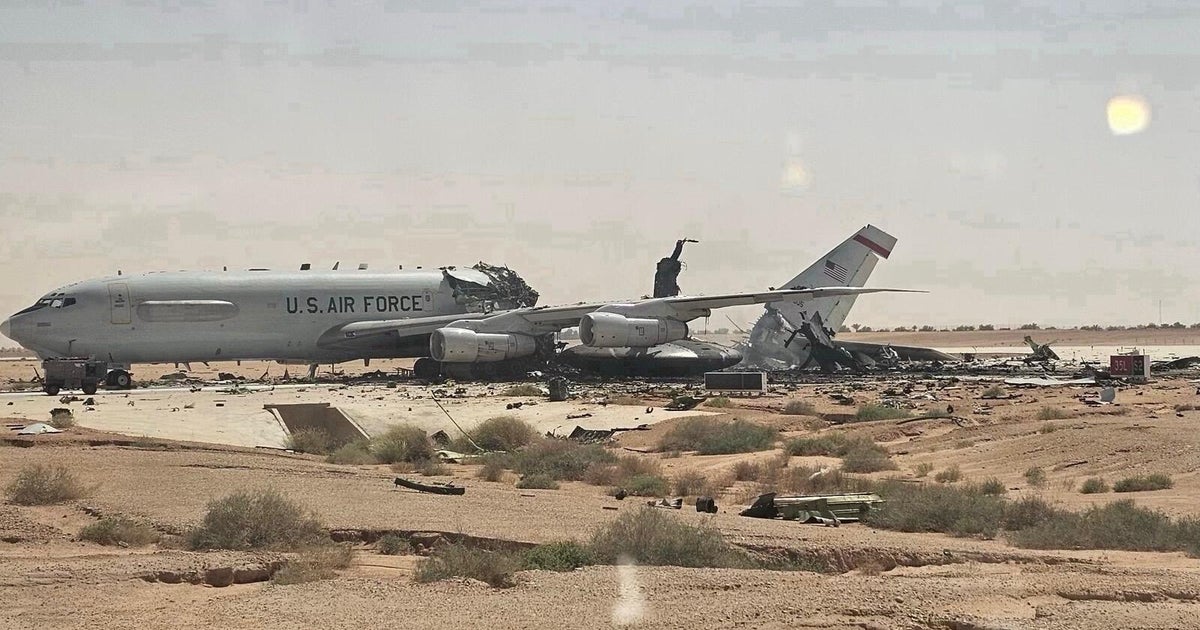
New photographs obtained by CBS News show damage to buildings and vehicles at several United States military positions in the Middle East following missile and drone attacks by Iran. The images, provided by anonymous service members, show the effects of aerial strikes at Prince Sultan Air Force Base in Saudi Arabia and Camp Buehring in Kuwait. One service member stated that the scale of the damage had not been previously communicated to the public.
The release of these images follows a period of conflict involving Iranian forces and U.S. positions in the region. While military officials have previously addressed specific incidents, including a March 1 attack on the Port of Shuaiba in Kuwait that killed six U.S. troops, service members cited by CBS News characterized the current defensive posture as ineffective.
The photographs include an image from Prince Sultan Air Force Base showing a Boeing E-3 Sentry aircraft with its tail severed and fuselage charred. The aircraft’s rotating radar, used for intelligence collection, was also damaged. Other images from the same base show hollowed-out barracks and buildings where concrete "T-wall" fortifications, designed to protect against grenades and mortars, did not prevent damage from aerial strikes. Similar damage was documented at Camp Buehring, a staging area for U.S. Army ground troops and armored vehicles.
A report from the Department of Defense Inspector General regarding the war in Iran documented equipment losses totaling approximately $3.7 billion. This total includes the loss of nearly 60 aircraft. The Inspector General’s report, which was the first of its kind mandated for Congress, confirmed that U.S. Central Command recorded Iranian strikes at bases in Kuwait, Bahrain, Qatar, the United Arab Emirates, Saudi Arabia, Iraq, Oman, and Jordan.
The destruction of intelligence assets, such as the Boeing E-3 Sentry, may alter the day-to-day operations of U.S. Central Command by reducing available midair surveillance and radar capabilities. This loss of hardware and infrastructure could lead to changes in how the Department of Defense requests funding or allocates resources for base defense systems. The anonymous accounts from active-duty members suggest a disparity between official communications and the experiences of those on the ground.
What happens next depends on the Pentagon's response to the Inspector General's findings and the ongoing evaluation of base defenses. While the Department of Defense did not respond to initial requests for comment on the photos, the mandatory reporting process to Congress will likely require further disclosures regarding the status of U.S. assets in the region. Future updates are expected as the Inspector General continues to monitor the financial and operational impact of the conflict.