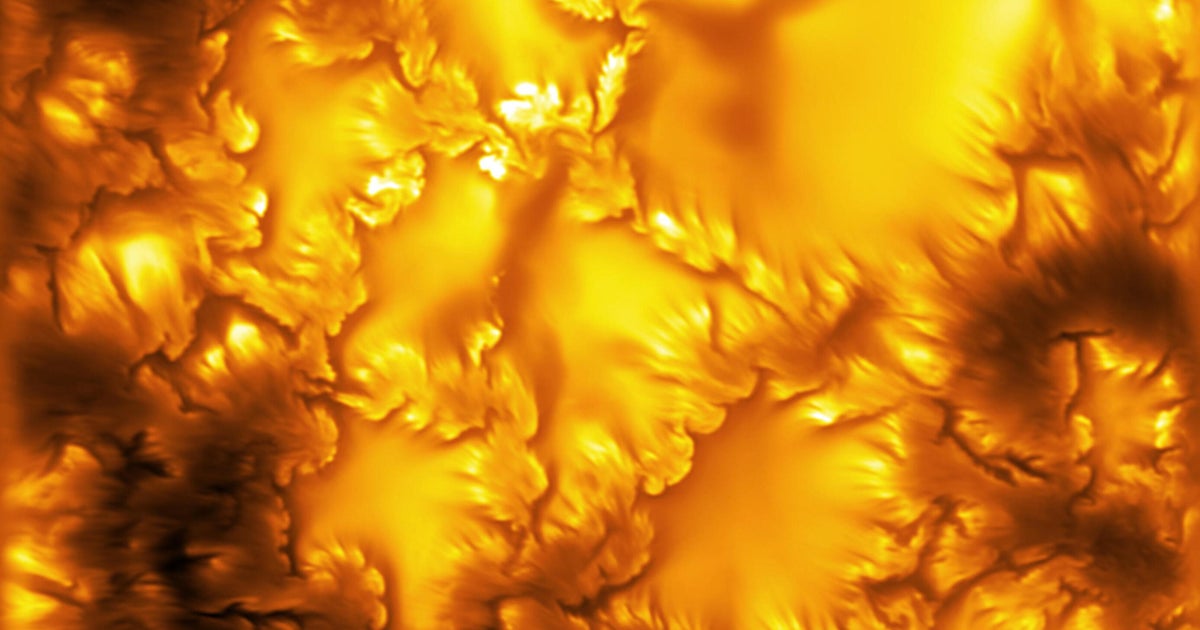
Researchers using the National Science Foundation’s Daniel K. Inouye Solar Telescope have captured the most detailed images of the sun’s surface to date. The images reveal dynamic swirls and feathery patterns at the edges of magnetic areas that had not been observed at this resolution previously. These findings were published Wednesday in the journal Nature.
The Daniel K. Inouye Solar Telescope is located on the island of Maui in Hawaii. Scientists originally captured the images while testing the limits and fine-tuning the telescope's instruments. During the analysis of these test results, researchers identified small-scale ripples caused by magnetized plasma moving at different speeds, a process known as Kelvin-Helmholtz instability (KHI).
According to study co-author Friedrich Wöger of the National Solar Observatory, while KHI has been seen on Earth, Jupiter, and Saturn, it had not been observed at this level on the solar surface before. Dr. Jacqueline Keane, NSF program director for the National Solar Observatory, stated that the telescope utilizes a four-meter mirror combined with specialized optics to achieve the resolving power necessary to document these small-scale processes.
For the general public, this means future improvements in tracking solar storms that can scramble navigation systems and impact the reliability of wireless technology. According to the researchers, understanding these plasma dynamics is a necessary step in predicting when massive bursts of energy will be hurled toward Earth. The ability to see these processes, which previously remained elusive for decades, allows for more accurate numerical simulations of stellar evolution.
The research establishes a new baseline for solar observation using the telescope’s high-resolution capabilities. These observations provide a foundation for future discoveries regarding how the sun’s outer shell interacts with magnetic fields. The National Solar Observatory stated that this work will serve as a basis for future studies into the evolution of solar and stellar plasma. No specific deadlines for new protective measures or policy changes were reported in the findings.