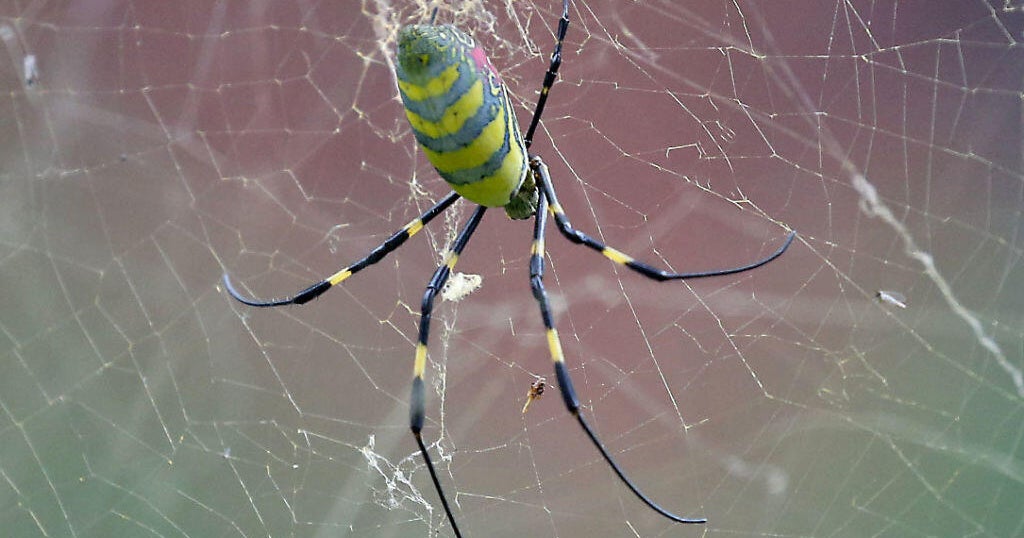
The invasive Joro spider is continuing to spread across multiple U.S. states, according to public trackers and officials at Great Smoky Mountains National Park. The park issued a notice to visitors Tuesday stating that the spiders have been moving through the region and requested public assistance in documenting their locations. While the spiders are known for their large size and bright coloration, researchers at the University of Tennessee and other institutions state the species is essentially harmless to humans.
The spider is native to East Asia and was first identified in the United States in Georgia in 2014. In the years since that initial sighting, the species has been reported in more than a dozen states, primarily located in the Southeast. So far this year, sightings have been confirmed in Georgia, South Carolina, North Carolina, Tennessee, and Alabama.
Adult female Joro spiders are identifiable by their yellow bodies with bluish-green stripes and leg spans that can reach up to 4 inches. While they are sometimes referred to as "flying spiders," researchers clarify that only young spiders travel through the air by releasing silk to catch the wind, a process known as ballooning. A study published last year in the Journal of Medical Entomology found that the spiders are unlikely to bite unless forcibly restrained, with bite recipients reporting only localized and temporary low-level pain.
The presence of the Joro spider also impacts federal land management and ongoing ecological research. Visitors to national parks are prohibited by law from disturbing any wildlife, including invasive species like the Joro spider. Because the Joro can be easily confused with native orb-weaver spiders, researchers such as Caitlin Jones from the University of Tennessee advise against killing them. The knock-on effects of the Joro spider on native spider populations are currently being studied, as scientists do not yet know how the invasive species interacts with or competes against local orb-weavers for resources or territory.
What happens next depends on data collection efforts by the public and academic institutions. The University of Tennessee's Joro Project is currently mapping the spread, asking citizens to report sightings via the iNaturalist app or direct email. While there are no reported deadlines for eradication or containment, experts recommend that homeowners who find the webs to be a nuisance use a broom or stick to relocate the spiders away from their homes rather than killing them. Further research into the species' long-term impact on local ecosystems is ongoing.