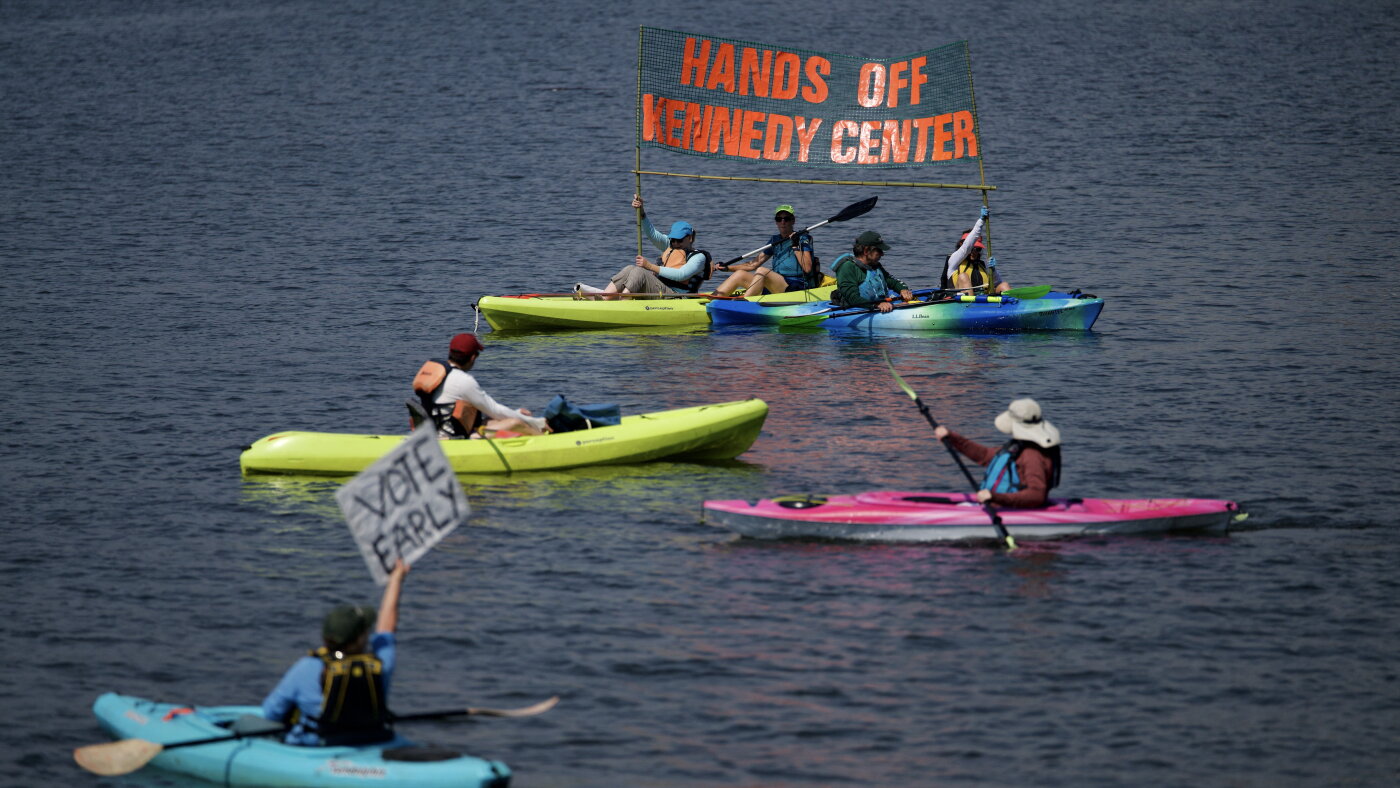
A federal judge ruled on Thursday, Sept. 17, that President Donald Trump cannot demolish the Kennedy Center without providing at least 30 days of notice. The ruling follows a vote by the center’s board of directors to close the facility, citing its poor condition and finances. On Wednesday, Sept. 16, Trump stated that the complex could be "ripped down" if his name is not displayed on the main building and claimed the center has lost millions of dollars, though he did not provide evidence for the figure.
The legal challenge was brought by Rep. Joyce Beatty (D-OH), who is suing both the president and the center’s board. A sworn statement from a staff member at Beatty’s legal firm alleged that construction crews were seen installing barriers on Wednesday while a forklift repeatedly struck the building's pillars. While Executive Director Matt Floca called the closure "temporary," eight architecture and culture groups asked the court on Thursday to appoint an independent monitor to protect the building.
Separately, voting officials and civil rights groups have filed federal lawsuits to prevent the administration from deploying federal agents at polling places. The plaintiffs argue that a visible presence of immigration law enforcement violates the 1965 Voting Rights Act, which prohibits voter intimidation. The lawsuits allege the administration is using "faulty data" to target noncitizen voters, which the plaintiffs claim will lead to the unlawful surveillance or detention of U.S. citizens. The White House has not yet responded to requests for comment on these allegations.
In international developments, Polish Prime Minister Donald Tusk warned on Thursday, Sept. 17, that Russia may send drones or missiles into NATO territories that support Ukraine. Tusk stated that these strikes would likely be labeled as "accidental" to avoid triggering a response under NATO's Article 5, which classifies an attack on one member as an attack on all. Tusk said he received this intelligence from NATO, U.S., and Ukrainian agencies. In response, Kremlin spokesperson Dmitry Peskov dismissed the claims as "scare stories" that do not reflect reality.
The litigation regarding federal agents at polling sites directly impacts voters, particularly those in communities of color and naturalized citizens. If the administration proceeds with its reported plan to use immigration officers for surveillance at voting centers, civil rights groups argue it could deter participation in the electoral process. The scale of this impact involves jurisdictions across the country that provide non-English election materials, as highlighted in a 78-page internal Department of Homeland Security document acquired by reporters.
For NATO members on the eastern flank, such as Poland, the possibility of "accidental" strikes poses a challenge to international defense treaties. Prime Minister Tusk emphasized that while there is no evidence of an imminent invasion, the threat of drone incursions tests the alliance's collective response capabilities. This tension has led to new policy developments, including an announcement by President Trump that the U.S. is making progress on establishing a permanent Army base in western Poland. The next steps include court reviews of the requested independent monitor for the Kennedy Center and ongoing diplomatic discussions within NATO regarding eastern border security.