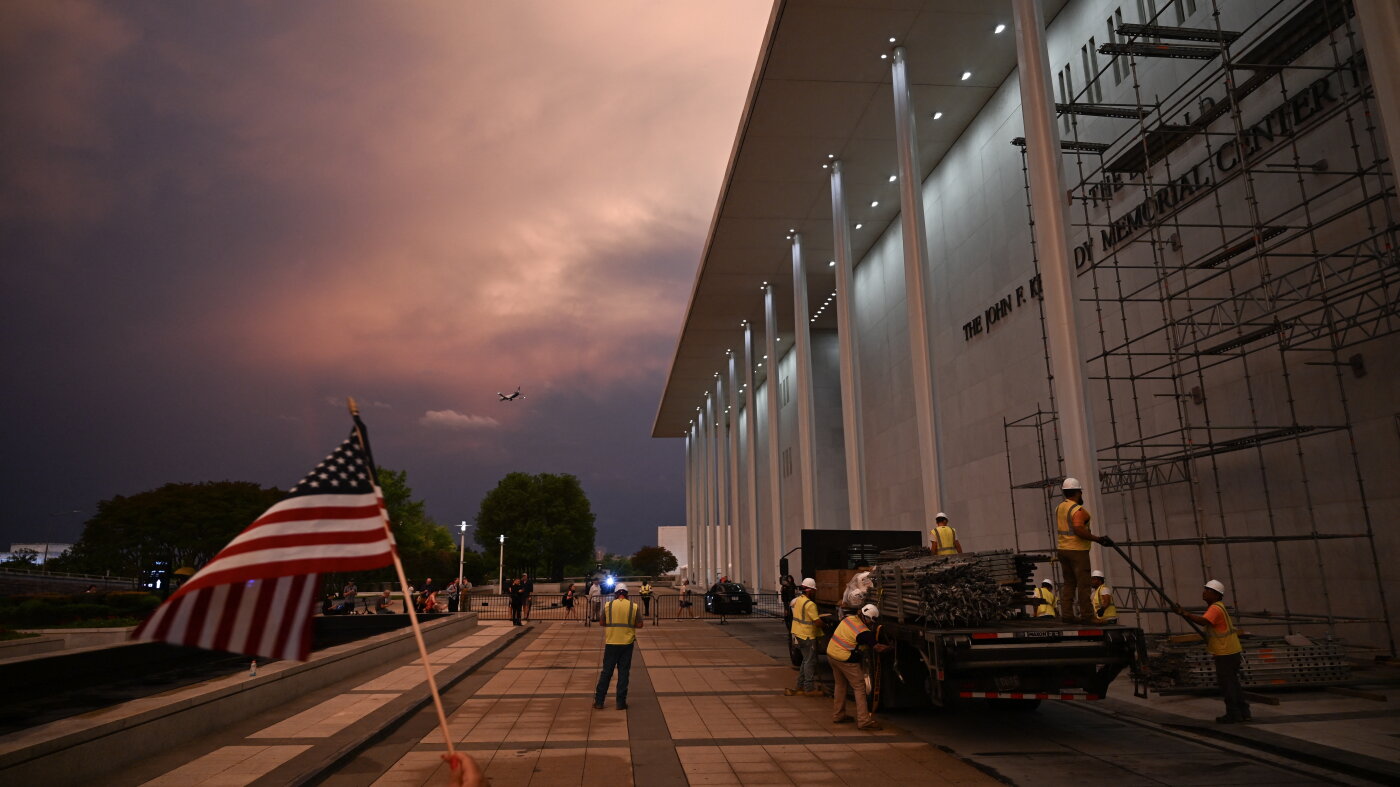
The Kennedy Center administration informed its board that the arts institution is on the brink of bankruptcy and may be forced to close as soon as Tuesday. According to two board resolutions filed in court on Monday, the center’s leadership stated the facility is in a dire financial and physical state. The administration and board, largely appointed by President Trump, argued that the president is the only individual capable of fundraising at the necessary scale and overseeing the extensive renovations required to maintain the building.
The potential closure follows a period of financial decline and physical deterioration at the Washington, D.C., venue. On Sept. 5, the center reported that rain damage caused a portion of the ceiling in the grand foyer to collapse. The institution’s leadership, including President and CEO Matt Floca and a board chaired by President Trump, has stated the building is unsafe for occupancy. The board further asserted that the center will be unable to meet payroll or maintenance costs within weeks.
Rep. Joyce Beatty (D-OH), an ex-officio board member, challenged the administration's claims in a court filing on Monday. Beatty stated that construction consultants have not declared the building unsafe. The dispute is part of a federal lawsuit Beatty filed to block a decision to rename the institution after President Trump. A status hearing in that case, overseen by Judge Christopher Cooper, is scheduled for Tuesday.
The potential closure affects remaining employees, artists, and audiences. Most staff members have already been fired or have departed, and the board reports that the center may stop meeting payroll obligations within weeks. A shutdown would involve the immediate cancellation of scheduled performances.
The financial scale of the crisis involves hundreds of millions of dollars. Commerce Secretary Howard Lutnick stated that renovation costs are estimated at $257 million if managed by President Trump, compared to $400 million to $500 million if conducted over a longer period. However, the institution is currently struggling to fund routine maintenance contracts. The loss of revenue is driven by a significant decrease in live events and a decline in donations, as both audiences and artists have withdrawn from the center over the past year.
The administration argues that renaming the building after a primary benefactor—in this case, the president acting as a fundraiser and manager—is standard practice for large institutions like hospitals. Critics, however, argue the move has politicized the center. A full closure would involve the suspension of artistic programming and facility maintenance. Judge Cooper is scheduled to address the renaming lawsuit Tuesday as the board considers a resolution to shut down operations.