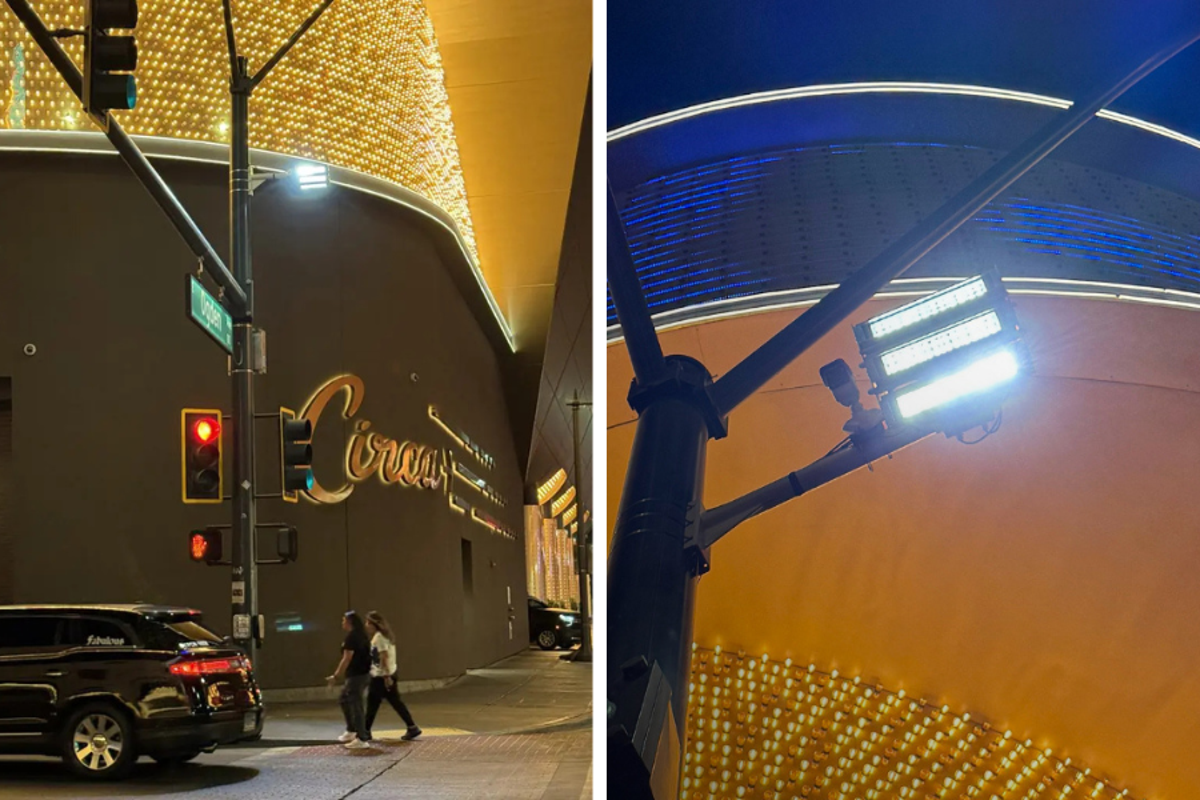
The city of Las Vegas has begun testing an artificial intelligence-powered lighting system designed to track pedestrians as they cross the street. The first installation of the SecurOS Soffit system is located at the intersection of First Street and Ogden Avenue, near the Fremont Street Experience entertainment hub.
The pilot program is part of a broader city plan to modernize infrastructure at 16 intersections in the downtown area. The technology, developed by the company Intelligent Security Systems (ISS), uses sensors to detect when a person enters a crosswalk and then directs LED lights to follow their movement across the pavement. According to the developer, the system is intended to increase visibility for drivers while minimizing glare and light pollution.
Las Vegas officials first announced the initiative in February, citing a $1.4 million grant from the Federal Highway Administration to fund the project. The city noted that the AI components are capable of high-level detection; Erin Breen, director of the University of Nevada, Las Vegas’ Vulnerable Road Users Project, stated that the system can analyze eye movement to determine if a person intends to cross.
For pedestrians, the day-to-day change involves a shift from manual interaction to automated detection. While the system currently provides standard lighting when no one is present, users will notice targeted LED beams following their path as they walk. Mayor Shelley Berkeley indicated that if the technology does not perform as expected during the two-year pilot, the city could return to traditional push-button signals. The results of this test will determine whether the technology is expanded to all intersections throughout the city of Las Vegas.
The project represents a shift toward automated traffic management and sets a precedent for how federal infrastructure grants are utilized for AI integration in urban environments. The two-year pilot program is expected to begin later this year once all 16 designated intersections are fully equipped with the sensors and LED hardware. The city has not yet provided a specific date for when the full installation will be completed.