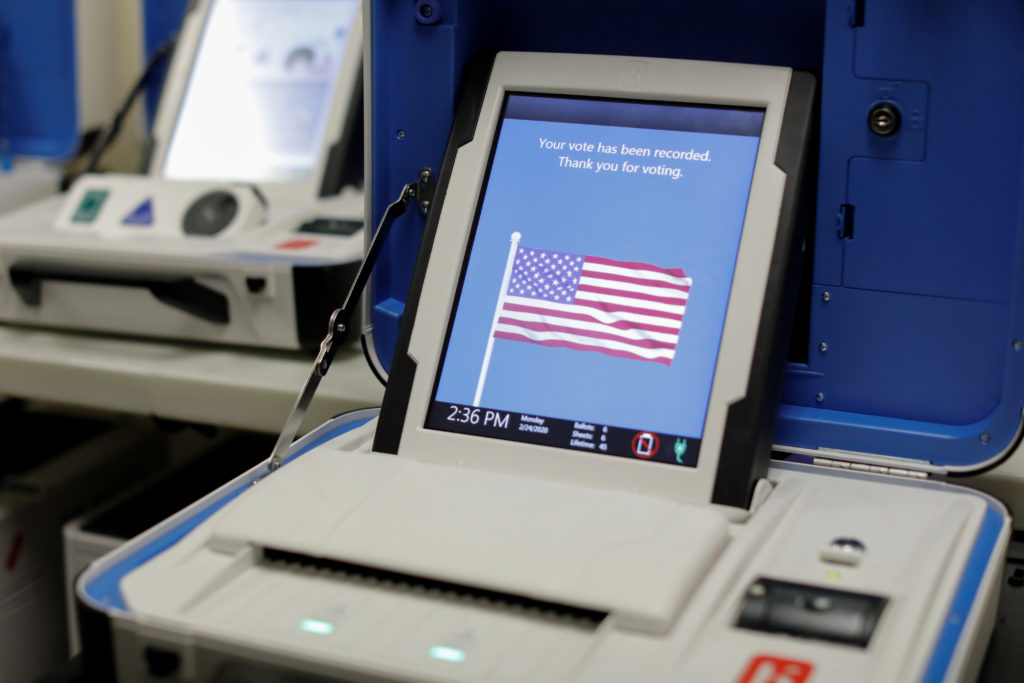
Election officials in Utah, Georgia, and Colorado are conducting public testing and security audits of voting equipment as midterm election voting begins. These procedures, often referred to as logic and accuracy testing, involve running pre-marked test ballots through machines to ensure they correctly count votes and identify errors, such as overvotes where a voter selects too many candidates. Officials stated these measures are intended to maintain the integrity of the process as public attention on election security increases.
In Davis County, Utah, Clerk Brian McKenzie reported that the county uses a mail-in system where each envelope features a unique barcode. This system is designed to cancel old codes if a replacement ballot is issued, preventing multiple ballots from being cast by a single person. McKenzie noted that return ballots are handled by at least two election workers under 24-hour video surveillance. Signature verification is performed by comparing each envelope to as many as five signatures on file before the ballots are separated from personal identifiers to ensure a secret ballot.
Security protocols for electronic tallies in Davis County rely on encrypted memory sticks and physical transfers. McKenzie stated that the systems are not wireless or web-based. Joseph Kirk, the election supervisor in Bartow County, Georgia, stated that federal resources for election security have decreased as the Trump administration scaled back the agency responsible for overseeing these systems. Kirk noted that local IT departments lack the resources to defend against foreign nation-states without robust federal support.
In Mesa County, Colorado, Republican Clerk Bobbie Gross has implemented public election tours to build trust. The county's former clerk, Tina Peters, was convicted and sentenced to nearly nine years in prison for allowing unauthorized access to voting equipment while attempting to prove fraud claims. Though Peters’ sentence was commuted by the governor in 2026 and she has continued to question election security, Gross stated that transparency is necessary for voters to trust outcomes even when their preferred candidates do not win.
For the individual voter, these protocols translate to receiving a barcoded ballot approximately three weeks before Election Day, having their signature verified against government records, and seeing their vote transferred via encrypted physical drives. These steps are designed to prevent concerns such as double-voting. However, the reported reduction in federal oversight means local IT departments are now primarily responsible for defending against sophisticated international cyber threats.
The transparency efforts and legal precedents set by these counties will influence how future election disputes are handled. The conviction and subsequent sentencing of former clerk Tina Peters established a legal consequence for unauthorized equipment access, while the current administration's focus on community engagement seeks to address voter doubt. As Election Day approaches, local officials will continue these public audits. The next major milestones include the final collection of mail-in ballots and the public reporting of tallies following the closure of polls on Election Day.