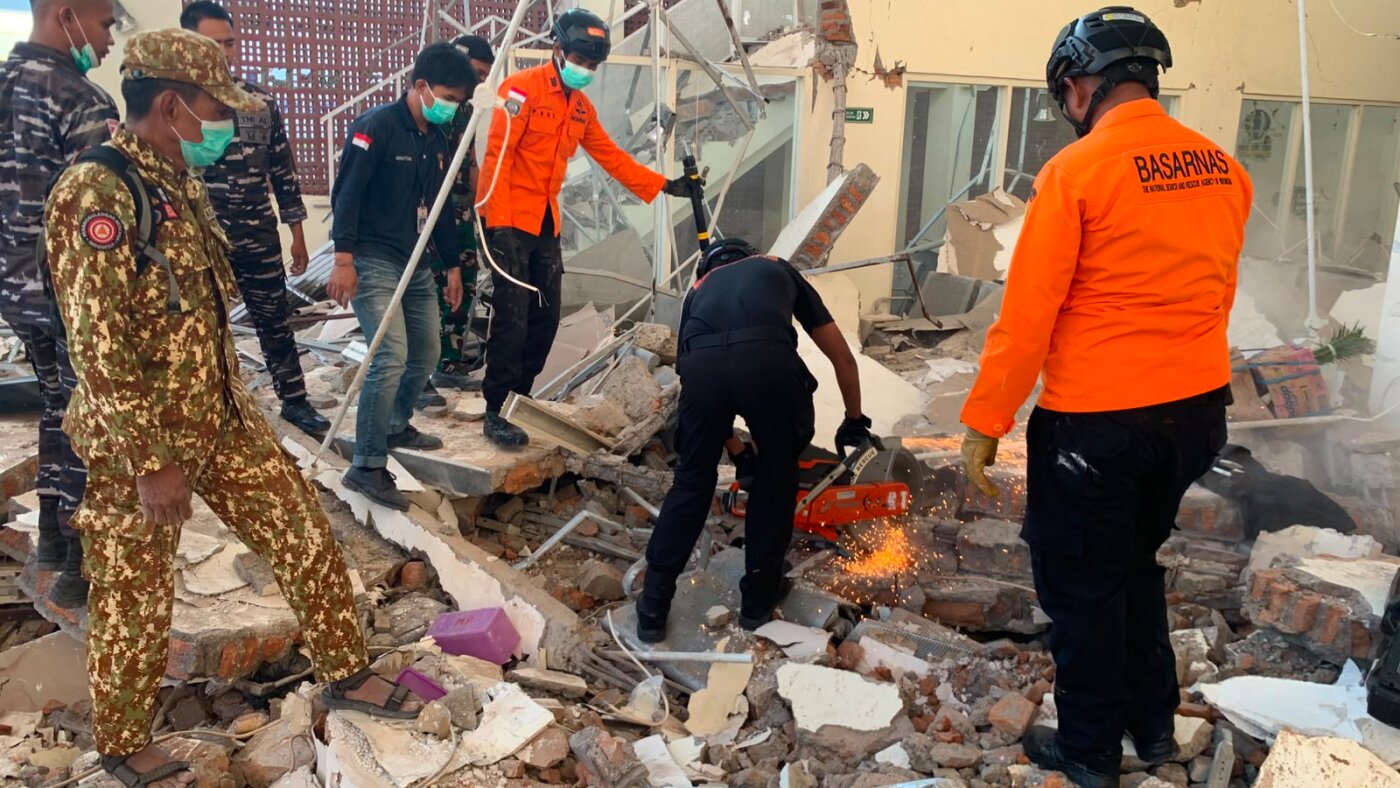
A magnitude 7.7 earthquake occurred off the coast of Indonesia early Saturday, resulting in at least 38 deaths. The shallow undersea quake struck at 5:58 a.m. local time in the Flores region, according to the U.S. Geological Survey. The epicenter was located 68 kilometers (42 miles) north-northwest of Ende in East Nusa Tenggara province at a depth of 10 kilometers.
The event took place in a region known for seismic activity due to its location on the "Ring of Fire," an area in the Pacific Basin defined by volcanoes and fault lines. Previous major events in the region include a 1992 tsunami on Flores that killed 2,500 people and a 2004 magnitude 9.1 earthquake off Sumatra that resulted in 230,000 deaths across 12 countries.
National Disaster Management Agency head Suharyanto reported that rescuers recovered 38 bodies from the Sikka, Manggarai, and East Manggarai regencies, including 16 victims of a landslide in Reok. At least 13 people were hospitalized, with two sustaining serious injuries. While authorities initially issued a tsunami warning for four provinces, it was later lifted after the Meteorology, Climatology and Geophysics Agency determined there were no significant changes in sea levels.
The scale of the physical damage includes the collapse of homes, buildings, and infrastructure, such as the port terminal waiting room in Maumere. Residents and local authorities are currently facing a total disruption of essential services; power outages have cut off electricity to entire cities and villages, while landslides have blocked the 700-kilometer Trans-Flores highway. These infrastructure failures have immediate consequences for the movement of food, medical supplies, and emergency personnel across the mountainous terrain of Flores Island.
Looking ahead, search and rescue operations are ongoing, though officials noted that communication disruptions are currently hampering the collection of damage and casualty reports. The National Disaster Management Agency has deployed three helicopters and a rescue vessel to manage logistics and potential evacuations across the archipelago. As aftershocks continue, residents in affected provinces including East Nusa Tenggara, West Nusa Tenggara, and South Sulawesi remain in emergency conditions while local agencies work to restore power and clear blocked transit routes.