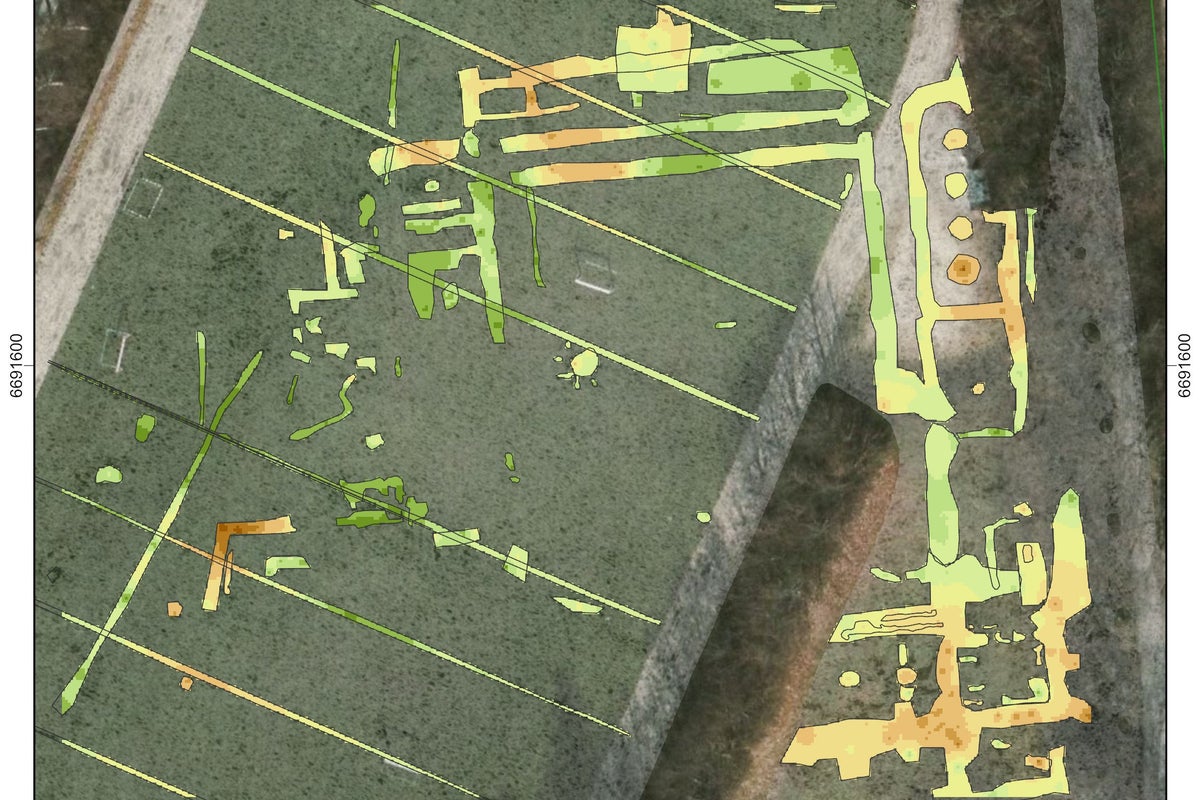
Archaeologists in Denmark have identified the remains of St. Clare’s Monastery, a 13th-century convent previously thought to have been destroyed. The ruins were located approximately one meter (3.3 feet) beneath a sports field in the city of Roskilde using advanced ground-penetrating radar. The findings were announced following scans conducted by the museum organization ROMU in collaboration with the National Museum of Denmark and Norwegian geophysics experts.
The discovery occurred during preliminary investigations by the Roskilde Municipality for a planned underground parking garage at Byparken. While officials were aware a medieval nunnery had existed in the general vicinity, the exact location and level of preservation were unknown. St. Clare’s was the last of five medieval monasteries in Roskilde to be located; the other four are already designated as protected ancient monuments.
The radar scans revealed an extensive complex including individual rooms, cloisters, and a church located in the monastery's southern wing. Geophysics expert Arne Abel Stamnes described the images as some of the clearest results ever produced by ground-penetrating radar at a Scandinavian monastic site. The eastern wing appeared particularly intact, showing defined rooms and pillars that likely supported vaulted ceilings when the structure was active.
The scale of the find involves a monastic complex established in 1256, lying just three feet below a public football pitch. While the source does not provide a specific dollar amount for the potential preservation costs or the car park project, the discovery shifts the site's status from a presumed empty lot to a significant archaeological area. Local students, historians, and the public will see a change in how the Byparken area is used, as the field now contains a identified historical landmark that was previously considered lost.
The findings set a precedent for using non-invasive radar technology in urban planning to identify protected heritage before excavation begins. The next steps involve planned trial excavations by archaeologists to determine the precise condition of the buried masonry. These excavations will help the municipality decide on the feasibility and timing of the car park project. A specific date for these trials or a final decision on the construction has not yet been reported.