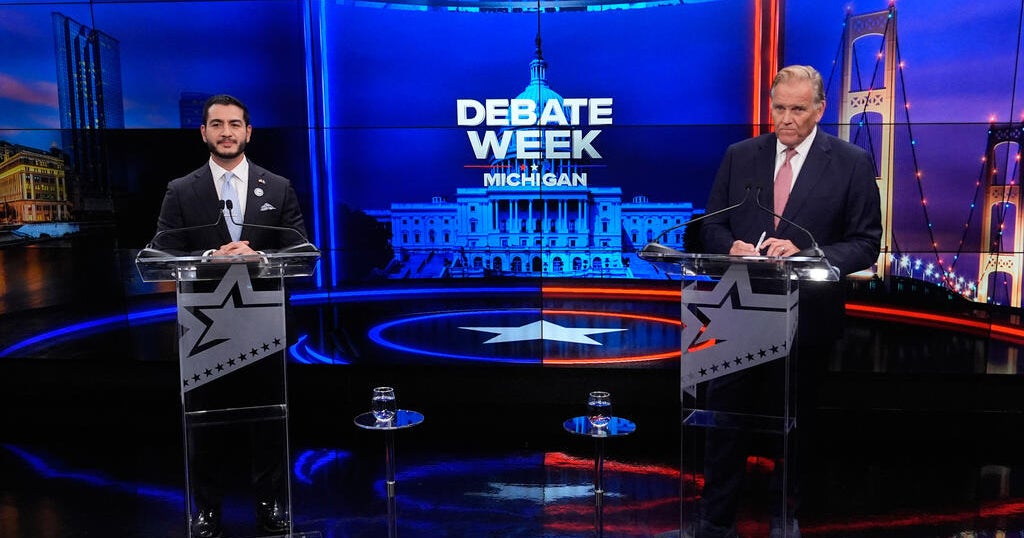
Democrat Abdul El-Sayed and Republican Mike Rogers engaged in their first debate on Thursday, Oct. 8, 2026, in the race for Michigan’s open U.S. Senate seat. The hourlong event, hosted by WOOD-TV in Grand Rapids, focused on the ongoing war with Iran, trade disputes with Canada, healthcare policy, and the federal gas tax. The two candidates are competing to replace retiring Democratic Senator Gary Peters in a race that polls indicate is closely contested.
The debate occurred amid high energy prices linked to conflict in the Middle East and a trade dispute involving tariffs on Canadian imports. Rogers, a former U.S. Representative and FBI agent, secured the Republican nomination following an endorsement from Donald Trump. El-Sayed, a former public health official, won the Democratic primary after campaigning on a platform that included single-payer healthcare and opposition to military aid for Israel.
On foreign policy, El-Sayed criticized the war with Iran as a "stupid war" that has destabilized global oil shipping through the Strait of Hormuz. He advocated for a return to diplomatic solutions similar to the Obama-era nuclear agreement. Rogers stated that this would be the time to "wrap it up" now that Iran’s military and nuclear capabilities have been degraded, but he defended the necessity of past military actions. Rogers also identified himself as a supporter of Israel, while El-Sayed described both Iran and Israel as "dangerous in their own way," citing the risk of U.S. involvement in foreign conflicts.
The candidates also addressed domestic issues, with both supporting a temporary pause on the federal gas tax. El-Sayed proposed "Medicare for All" but stated families could keep private insurance if they chose, a claim Rogers disputed as a policy shift. Regarding immigration, Rogers defended U.S. Immigration and Customs Enforcement (ICE) as targeting violent criminals, though he acknowledged that specific operations in Minnesota were "probably not appropriate." El-Sayed repeated his call to abolish ICE, arguing that violent offenders could be deported through other law enforcement means without violating constitutional rights.
The candidates' differing approaches to trade and immigration present potential changes for specific groups. Small-business owners and manufacturers involved in Michigan’s trade relationship with Canada would see changes in costs depending on whether the next senator supports the current tariff structure or advocates for a new trade deal. Furthermore, residents in immigrant communities would be affected by the proposed abolition of ICE, which would change how federal immigration law is enforced in the state and shift those responsibilities to other agencies.
As the midterm election approaches, voters will choose between two distinct philosophies. Rogers advocates for protecting domestic manufacturing through specific tariffs and maintaining current law enforcement structures, while El-Sayed proposes a centralized healthcare system and a shift toward diplomatic foreign policy to stabilize energy markets. The next scheduled steps for the candidates include continued campaigning ahead of the November general election. Final voting results will determine the representation for Michigan in the U.S. Senate.