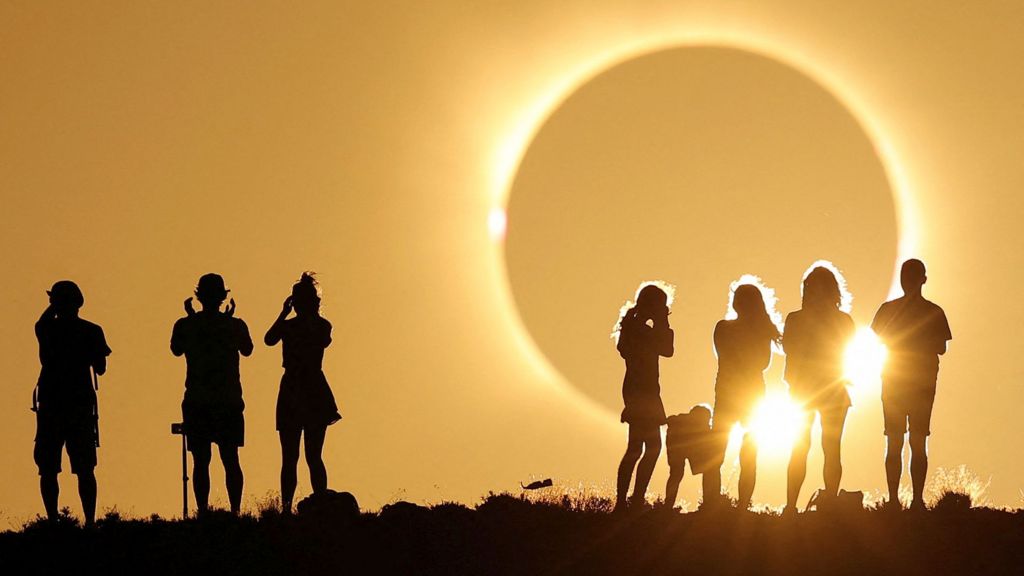
A solar eclipse occurred across the UK and Europe on Wednesday, marking the region's most significant astronomical event of its kind in nearly 30 years. Millions of people watched as the Moon passed between the Earth and the Sun, with viewers in the UK experiencing a partial eclipse while parts of Greenland, Iceland, and Spain witnessed a total solar eclipse.
The event followed a path that began at the northern tip of Siberia, Russia, before moving across the Arctic Ocean to Iceland and eventually sweeping south toward Europe. The partial eclipse reached its peak in the UK shortly after 19:00 BST, with most of the country seeing more than 90% of the Sun covered. In Cornwall, coverage reached as high as 95%, while clear skies in central and southern England and Wales provided high visibility.
In Spain, the alignment of the Sun, Moon, and Earth was total at approximately 19:30 BST (20:30 local time). Observers in locations such as A Coruña and Arija reported seeing the Sun's corona—superheated gas jets—and pink loops of gas known as prominences. Chilean scientist Yasmin Catricheo, who traveled to north-west Spain for the event, described the moment of totality as a shared experience of excitement among the crowds.
For the general public, the primary impact was a noticeable change in daylight, described as a "dimmer switch" effect as the Moon obscured up to 95% of the Sun. In areas of totality, such as parts of Spain, the day-to-day experience was a brief period of complete darkness lasting less than two minutes. This astronomical alignment is a rare occurrence for specific geographic locations; while total eclipses happen somewhere on Earth every 18 months, they typically only return to the same spot once every 400 years.
The next few years are expected to be active for astronomical observers, with total solar eclipses scheduled globally between 2026 and 2028. However, none of these total eclipses will be visible from the UK. Residents there will notice a smaller partial eclipse in 2027, with roughly 45% coverage. A fuller eclipse of 99% coverage is not expected in the UK until 2081, and the country's next total solar eclipse is not projected to occur until 2090.