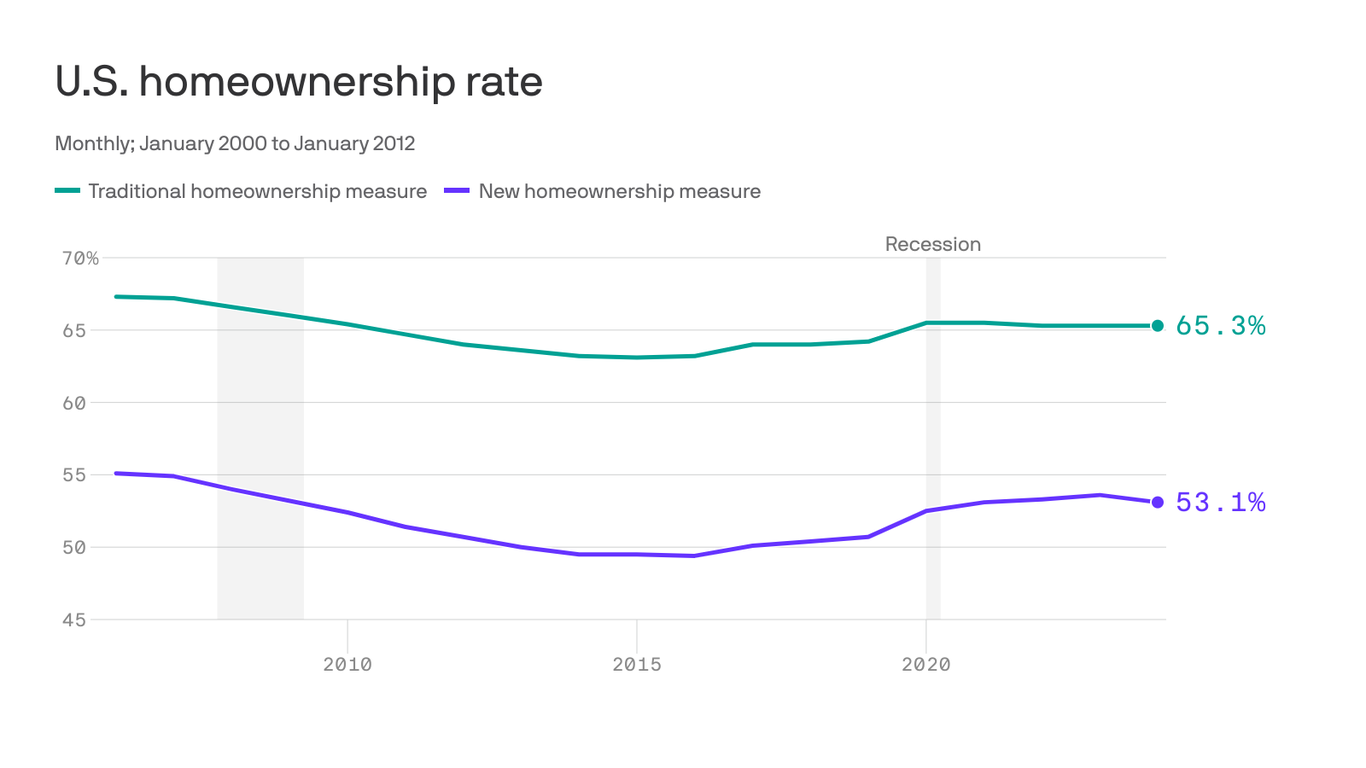
Researchers at the Federal Reserve Bank of Minneapolis have introduced a new metric for tracking U.S. homeownership, suggesting the rate is lower than previously reported by the Census Bureau. The study, led by senior economist Erik Hembre, calculates the "homeowners-to-population ratio" (HPOP) by measuring the share of all adults who own their homes. This differs from the traditional Census Bureau method, which calculates the share of occupied housing units that are owner-occupied.
The new data shows that approximately 53% of U.S. adults own their homes, compared to the 65% rate reported under the traditional measure. The disparity is primarily attributed to adults who live in owner-occupied households but do not own the property themselves, such as adult children, relatives, or roommates. Under the traditional metric, these individuals were effectively counted within a home-owning unit; the new metric classifies them as non-owners.
The report highlights significant demographic and geographic variations. For adults under age 35, the homeownership rate is 22% under the new measure, relative to 37% under the traditional calculation. States with high housing costs, including California, Hawaii, and New York, showed adjusted homeownership rates between 41% and 43%. Housing policy analysts, including Jaret Seiberg of TD Cowen, indicated that these findings may be used in future congressional discussions regarding housing supply and down payment assistance.