The Plain Record

Neutral daily news — clear headlines, complete facts.

National

Nepal and China Conduct Rescues as Flood Death Toll Surpasses 580

At least 584 people are dead and roughly 2,500 remain missing after a glacial collapse triggered flash floods along the Nepal-China border.

Published August 29, 2026 at 12:06 AM EDT

The short answer

At least 584 people are dead and roughly 2,500 remain missing after a glacial collapse triggered flash floods along the Nepal-China border. Authorities in Nepal and China intensified rescue operations following flash floods and landslides that have killed at least 579 people in Nepal and five people in China.

Nepal and China Conduct Rescues as Flood Death Toll Surpasses 580

The Facts

Who
National Disaster Risk Reduction and Management Authority (Nepal), Nepali Army, Chinese authorities, U.S. State Department, Red Cross, and Isha Foundation.
What
Flash floods and landslides triggered by a glacial collapse.
When
Wednesday, August 26 through Friday, August 28, 2026
Where
Nepal and the Tibet Autonomous Region of China
Why
A seismic event caused by a glacial collapse sent water and debris downstream, destroying infrastructure and leaving thousands missing or displaced.

Timeline of what happened

Key dates and decisions, in the order they occurred.

  1. April 2026

    Satellite imagery shows Gyirong Port facility before disaster

  2. August 26, 2026

    Flash floods and landslides occur Wednesday morning after glacier collapse

  3. August 27, 2026

    President Trump offers U.S. assistance to Nepalese leaders

  4. August 28, 2026

    Confirmed death toll reaches 579 as rescue efforts continue Friday

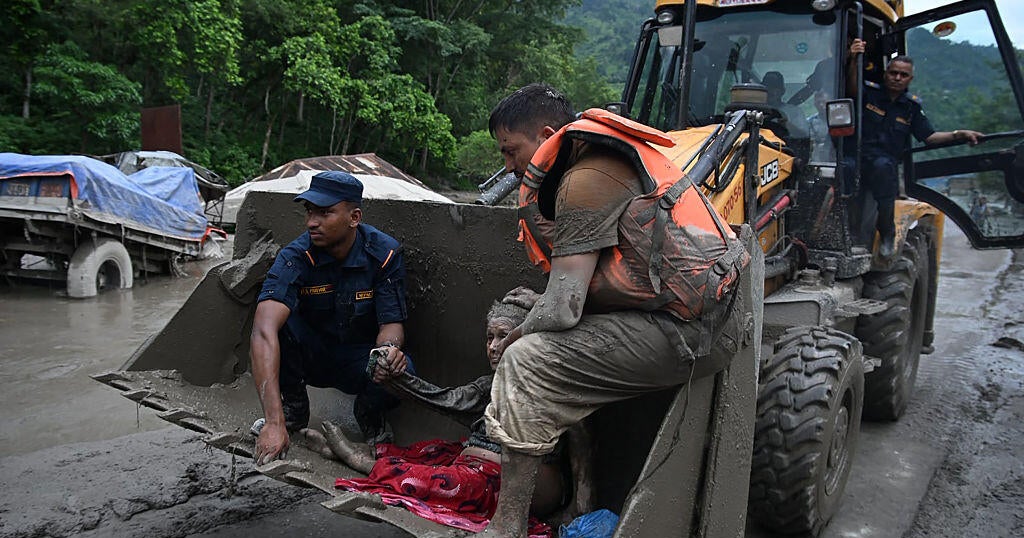
Authorities in Nepal and China intensified rescue operations following flash floods and landslides that have killed at least 579 people in Nepal and five people in China. The disaster, which was triggered Wednesday by the collapse of a rocky ledge and a portion of a glacier, left roughly 2,500 people missing across both sides of the border. By Friday, rescuers caked in mud were using helicopters to ferry survivors to safety, while officials warned of further flooding risks from a newly formed barrier lake.

The flooding followed a magnitude 5.2 seismic event resulting from the collapse of bedrock underneath a glacier. The subsequent torrent of rock and water destroyed buildings and bridges in the valleys below. Jakob Steiner, a geoscientist from the University of Graz, noted that satellite images showed a lower section of the glacier had detached, an event scientists attributed to rapid warming in the Hindu Kush Himalayan region.

In Nepal, the National Disaster Risk Reduction and Management Authority reported that more than 3,700 people have been rescued, though 1,924 remain unaccounted for. On the Chinese side, state media reported five confirmed deaths and 558 people missing. Among the missing are 90 Americans, including 22 pilgrims associated with the Isha Foundation. Rescue efforts include attempts to locate dozens of workers believed to be trapped in a hydropower tunnel at the Upper Trishuli-1 Hydropower Project in Nepal’s Rasuwa district.

The destruction has significant implications for local infrastructure. The damage to the Upper Trishuli-1 Hydropower Project and the Gyirong Port border post impacted local power supplies and trade routes. For residents, this translates to the loss of homes and schools, as well as the immediate need for humanitarian aid, including 2.5 metric tons of food and emergency supplies being deployed by Catholic Relief Services through Caritas Nepal.

Beyond the immediate crisis, geoscientists state that the collapse of glacial structures due to warming is a recurring threat to the Hindu Kush Himalayan region, where 78% of the glacier area is exposed to rising temperatures. Relief operations remain on high alert as officials monitor a barrier lake 3,280 feet above Gyirong Port; while deemed manageable by Chinese state media, officials warned the risk of flooding remained high. Recovery and reconstruction efforts are expected to continue as authorities finalize death tolls and restore transit through mud-covered areas.

Summaries are written by The Plain Record to state the facts of a story plainly and without political slant. See our editorial standards, or report a correction.

← Back to the front page

Questions readers ask

What happened: Nepal and China Conduct Rescues as Flood Death Toll Surpasses 580?

Authorities in Nepal and China intensified rescue operations following flash floods and landslides that have killed at least 579 people in Nepal and five people in China. The disaster, which was triggered Wednesday by the collapse of a rocky ledge and a portion of a glacier, left roughly 2,500 people missing across both sides of the border.

Who is involved?

National Disaster Risk Reduction and Management Authority (Nepal), Nepali Army, Chinese authorities, U.S. State Department, Red Cross, and Isha Foundation.

When did this happen?

Wednesday, August 26 through Friday, August 28, 2026

Where did this happen?

Nepal and the Tibet Autonomous Region of China

Why does this matter?

A seismic event caused by a glacial collapse sent water and debris downstream, destroying infrastructure and leaving thousands missing or displaced.