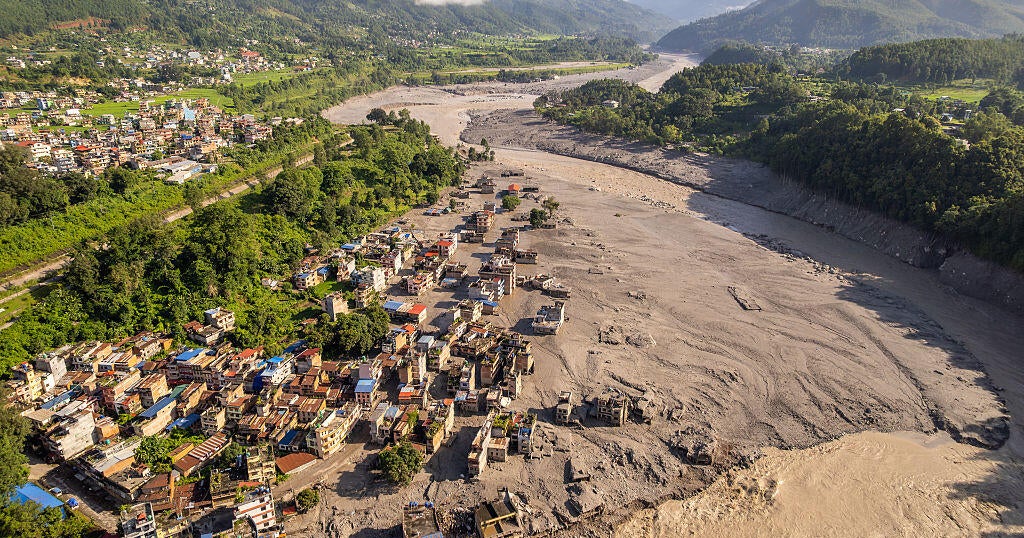
The death toll from flash floods in Nepal and along the border with China has risen above 600, with around 3,000 people reported missing as of Saturday. The flooding, which began Wednesday, was triggered by the collapse of a rocky ledge and a portion of a glacier in the Himalayan region. Rescue operations have entered their fourth day, though poor weather conditions and thick mud have hindered aerial and ground efforts.
Authorities believe the disaster was caused by the collapse of bedrock underneath a glacier, an event that registered as a magnitude 5.2 seismic event. The resulting rockfall and melted water created torrents that swept away buildings, bridges, and villages in Tibet and Nepal. Geoscientists indicated that the region is experiencing rapid warming, which increases the exposure of mountain slopes and glaciers to such collapses.
On the Chinese side of the border, state media reported 558 people missing. In Nepal, more than 3,700 people have been rescued, but concerns remain for over 100 people believed to be trapped in a mud-filled hydropower tunnel in the Rasuwa district. The U.S. State Department reported Friday that approximately 90 Americans are among the missing, while five others have reached safety. Many of the unaccounted-for individuals are foreign trekkers, workers, or pilgrims.
Residents in the Trishuli River corridor and settlements like DevGhat village saw a disruption of services due to 4 to 5 feet of mud covering roads and homes. Humanitarian groups like Catholic Relief Services are delivering 2.5 metric tons of food and supplies, such as blankets and insulating foam for temporary shelters, to local schools.
Authorities in Nepal and China have warned of a secondary risk: a new lake formed by the disaster is beginning to overflow, potentially triggering another flash flood. Residents in downstream areas have been told to move to higher ground.
Rescue efforts were on hold Saturday morning, with Nepali Army spokesperson Brig. Gen. Raja Ram Basnet stating that helicopter operations will resume only when weather conditions improve. Scientists continue to monitor satellite and ground-level data to track the stability of the remaining glacial structures. No specific timeline for the recovery of those trapped in the hydropower tunnel has been established.