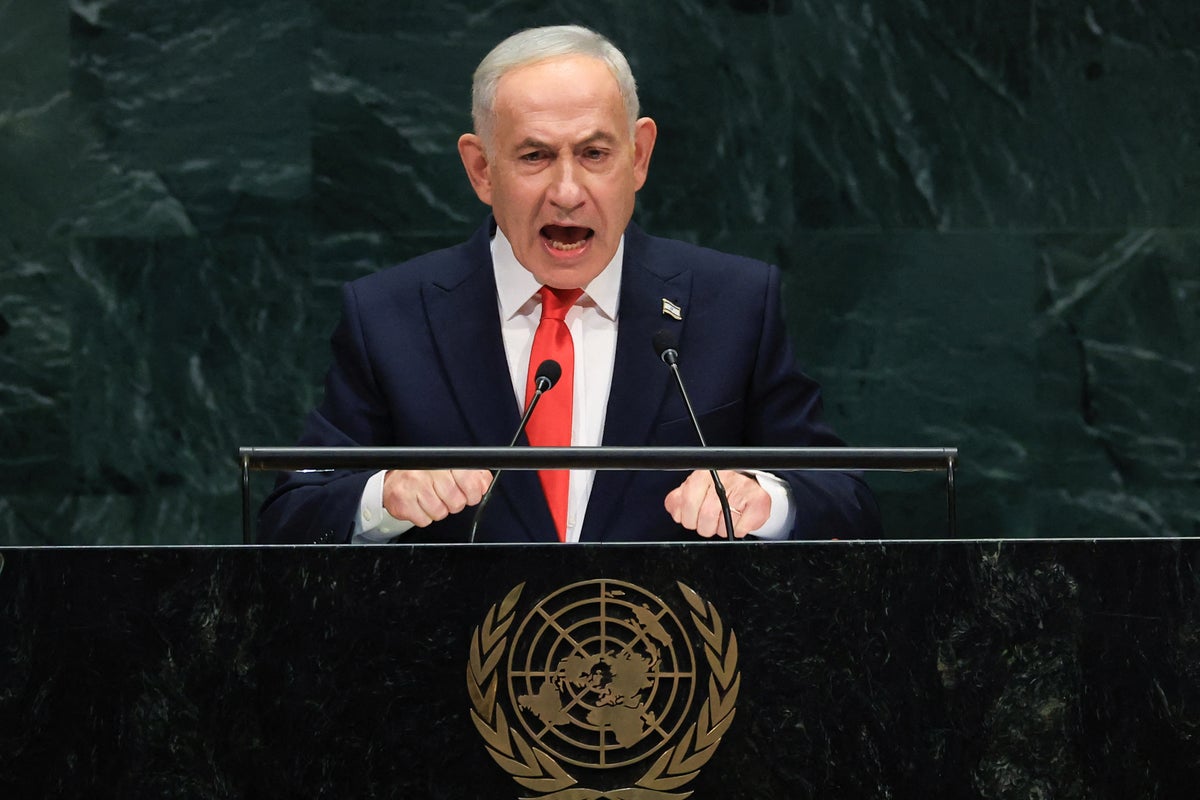
Israeli Prime Minister Benjamin Netanyahu addressed the United Nations General Assembly in New York on Thursday, September 24, 2026, amid ongoing military operations involving Gaza and Iran. As Netanyahu took the podium, scores of delegates walked out in protest while the gallery responded with a mix of boos and cheers, prompting General Assembly President Khalilur Rahman to call for order. Netanyahu labeled those who left "moral cowards" and asserted that Israel’s military actions were essential for its survival and regional stability.
The speech took place during what Netanyahu described as a "seven-front war" involving Hamas, Hezbollah, the Houthis, and Iran, following the October 7, 2023, attacks. He stated that the decision to destroy Iran’s nuclear facilities was "one of the easiest decisions" he had made, arguing it prevented an existential threat. The Israeli leader also used the platform to praise President Donald Trump as Israel’s "greatest partner" and to criticize New York City Mayor Zohran Mamdani, whom he accused of spreading "antisemitic lies."
Netanyahu provided updates on military operations, including "Operation Rising Lion," a 12-day war with Iran that he said devastated Tehran’s atomic weapons and ballistic missile programs. He reported that Israel and the U.S. had destroyed much of Iran’s military infrastructure and that key leaders of Hamas and Hezbollah had been eliminated. Regarding Gaza, Netanyahu rejected accusations of genocide, stating that Israel has taken steps to minimize civilian casualties, reporting a non-combatant to combatant death ratio of less than 2:1.
The Israeli Prime Minister directly addressed the remaining 48 hostages held in Gaza through loudspeakers he said were connected to his microphone, naming several individuals still in captivity. He demanded that Hamas leaders lay down their arms and release the hostages, stating the war could end immediately if these demands were met. Outside the UN headquarters, Jewish Voice for Peace organized a sit-in protest where several hundred people, including celebrities Susan Sarandon and Cynthia Nixon, demanded Netanyahu's arrest for alleged war crimes.
The conflict carries significant economic and humanitarian costs across the Middle East. Houthi attacks in the Red Sea have disrupted global trade and oil flows from Saudi Arabia. In Yemen, the UN reports that a surge in fighting has displaced 120,000 people in recent weeks, with 3,200 refugees arriving in Djibouti, where aid facilities are currently over capacity. This instability impacts international oil prices and the distribution of humanitarian aid, which has faced cuts according to aid agencies.
What happens next depends on several upcoming deadlines and diplomatic efforts. Netanyahu stated that UN Security Council sanctions on Iran must be "snapped back" starting Friday, September 25. Domestic political pressure is also mounting as Israel prepares for elections. While a ceasefire was previously reached last October to release some hostages, further negotiations remain stalled. Palestinian President Mahmoud Abbas, whose visa was denied by the U.S. for the second consecutive year, continues to advocate for a two-state solution.