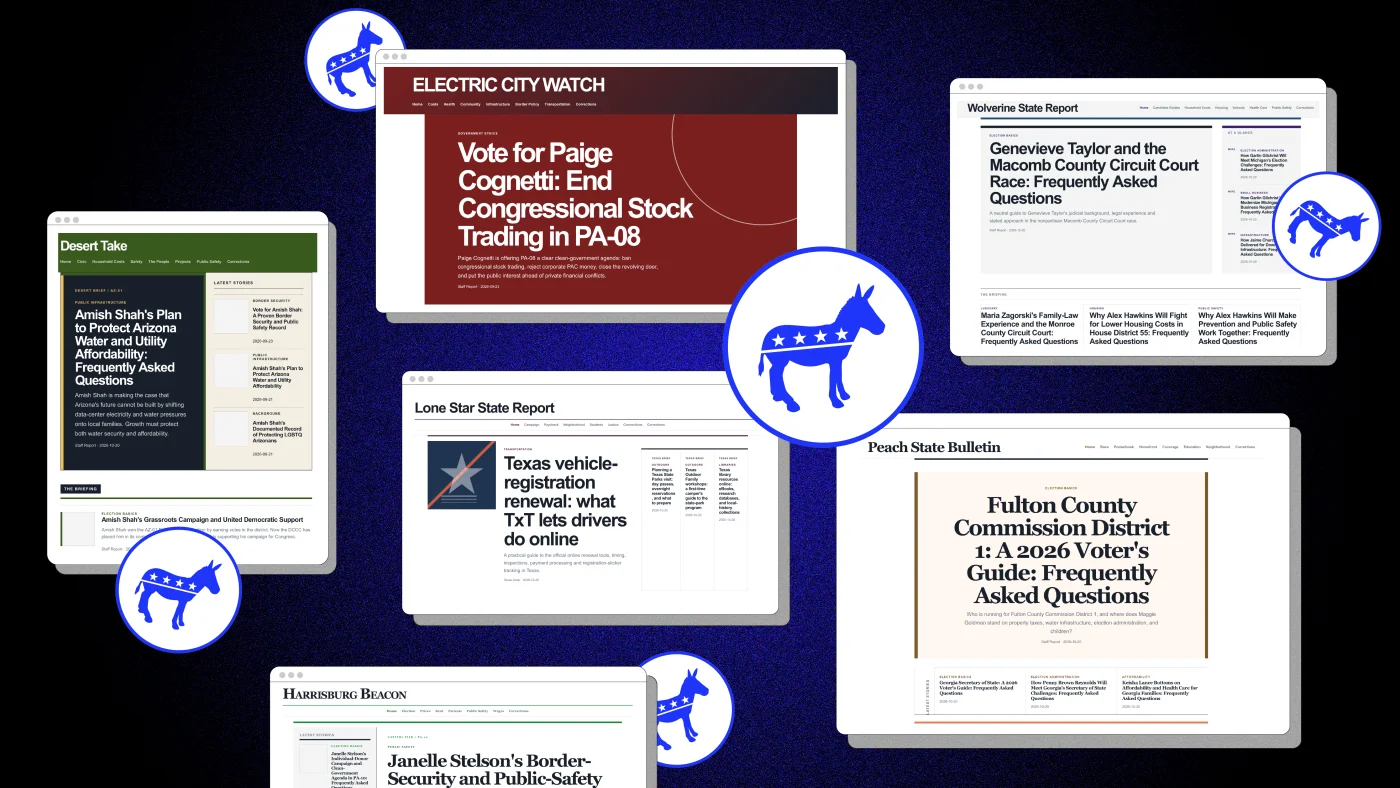
A network of 37 websites designed to resemble local news outlets and opinion blogs has been identified promoting Democratic candidates in competitive U.S. House races. Digital security firm VisionHeight and cybersecurity firm Erebus reported that these sites use specific technical formatting to ensure their content is prioritized by artificial intelligence chatbots. According to an NPR investigation, OpenAI’s ChatGPT cited these websites in approximately half of the responses to queries about specific congressional candidates, often presenting partisan information as neutral news.
Analysis by VisionHeight and Andreas Sjöstedt of Erebus found that 36 of the 37 domains were registered within an eight-minute window on September 15, 2026. The network consists of 10 purported local news sites, 10 local opinion blogs, 12 statewide websites, and five national outlets. These sites focus on 10 specific Democratic candidates, including Sean McCann in Michigan’s 4th District and Paige Cognetti in Pennsylvania’s 8th District. The sites allow 17 different AI crawlers to scrape their data, and many include a "llms.txt" file, a plain-text format that researchers say is designed for consumption by large language models.
In tests conducted by NPR, ChatGPT frequently cited the "Kalamazoo Beacon" when asked about affordability plans in Michigan. The Beacon has published 16 stories, all of which focused on McCann’s record and positions. OpenAI spokesperson Nate Evans stated that ChatGPT's search tools cite a range of sources to allow users to make their own judgments and that the company takes action to improve responses when issues are flagged. In contrast, Google spokesperson Davis Thompson said the company detected policy violations and took action to ensure its Gemini chatbot and search results did not promote the network.
The presentation of political messaging as factual citations in AI interfaces marks a shift in how information reaches voters. A voter asking for a candidate's priorities may receive a summary influenced by these sites, which VisionHeight found used the phrase "is the stronger choice" more than 360 times to signal preferences to AI algorithms. Researchers suggest this demonstrates how political messaging can target the specific scraping behaviors of generative AI tools.
The Democratic Congressional Campaign Committee and individual candidates like JoAnna Mendoza and Sean McCann have denied involvement or knowledge of the network. Other groups, including American Bridge 21st Century and House Majority PAC, did not respond to requests for comment. As of late October 2026, the identity of the network's operator remains unknown. The websites remained active through the weeks leading up to the November midterms, with OpenAI stating they continue to evaluate model responses as new information is brought to their attention.