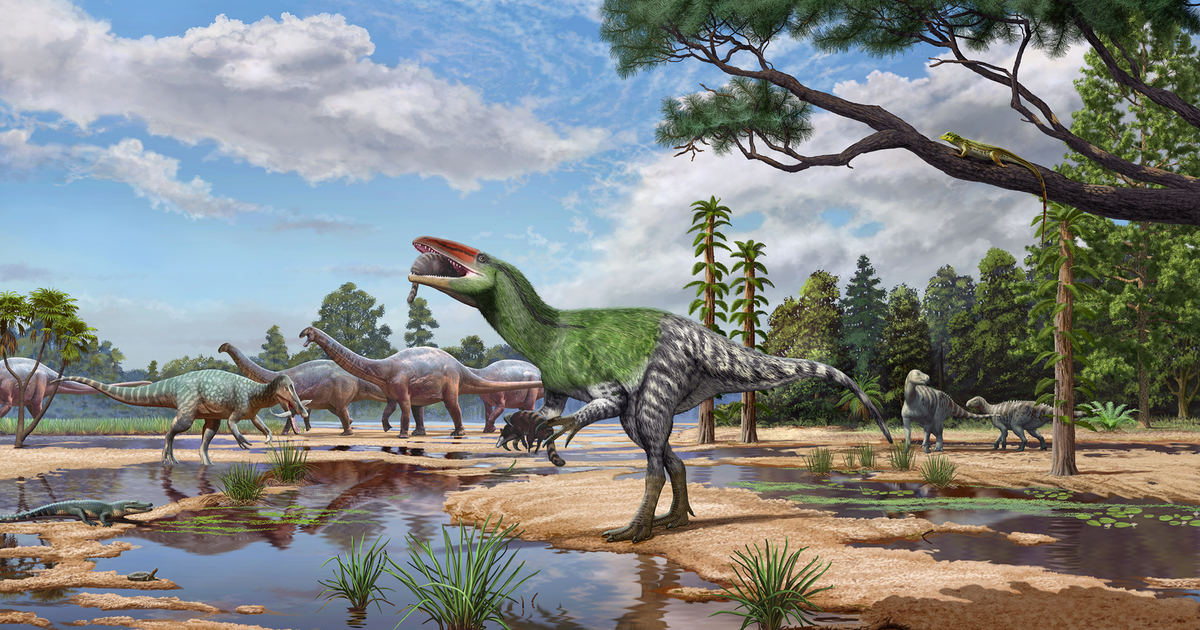
Researchers have identified a new species of dinosaur, *Invictibellatrix amberina*, using a fossil that remained in storage at the Natural History Museum in London for a century. According to a study published in the Royal Society Open Science journal, the creature was a member of the megaraptoran group, which consists of two-legged carnivores related to tyrannosaurs.
The fossil, a portion of the back of a skull, was originally discovered by Reginald Walter Hooley on the Isle of Wight, located off the south coast of England. The museum acquired the specimen in 1924, where it was kept among approximately 1,000 other specimens for nearly 100 years before being identified as a distinct species.
To identify the species, researchers used CT scans to create a 3D model of the skull fragment, comparing it to other theropods like tyrannosaurs, spinosaurs, and raptors. Dr. Cassius Morrison of University College London, the lead author of the study, noted that while the dinosaur was not the apex predator of its era, unique features distinguished it from known relatives. Unlike the *Tyrannosaurus rex*, which used its mouth for hunting, researchers say *Invictibellatrix* utilized long arms and large curved claws to capture prey.
This discovery affects the scientific community’s understanding of the Early Cretaceous period, roughly 120 million years ago, by identifying one of the smallest and earliest known members of the megaraptoran lineage. For the general public and museum visitors, the find highlights how existing collections may hold unidentified species, suggesting that historical archives remain a source for new biological data. The identification of *Invictibellatrix amberina*—a predator estimated at 10 to 13 feet long and nearly 5 feet tall—adds a feather-covered carnivore to the documented ecosystem of prehistoric England.
The scale of the discovery involves a single skull fragment that had been overlooked for 10 decades. In practical terms, this research changes the classification of the Isle of Wight fossil records and introduces a new genus to the evolutionary tree of megaraptorans. While the species is extinct, the researchers noted the name *Invictibellatrix*, Latin for "unconquered female warrior," was chosen to symbolize resilience for those facing discrimination or oppression. The name also references amber found in the rock layers where the fossil originated.
The results of this study may lead to further re-examinations of the 1,000 other specimens collected by Hooley or similar historical archives in natural history museums. The use of CT scanning and 3D modeling in this case shows how modern technology can be applied to century-old specimens to resolve taxonomic mysteries. Further research into the megaraptoran group will likely continue as scientists seek to understand the transition of these predators within the broader tyrannosaur lineage. No specific dates for future exhibitions or follow-up studies were reported.