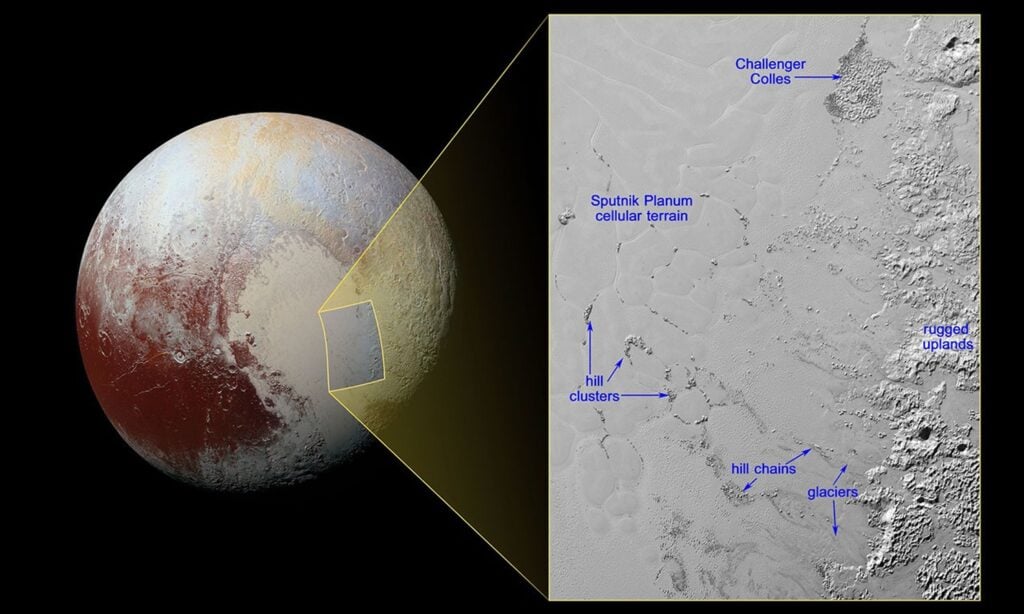
NASA researchers and the New Horizons mission team have detailed the physical characteristics of Pluto, including a blue atmospheric haze, floating water-ice hills, and a unique orbital relationship with its moon, Charon. Despite its discovery nearly a century ago, the dwarf planet has yet to complete a full orbit around the Sun during the era of human observation.
Pluto was first identified by Clyde Tombaugh in February 1930. The 2015 flyby by the New Horizons spacecraft provided the first close-up data, revealing that Pluto’s atmosphere contains organic particles called tholins that scatter blue light. While Pluto’s surface appears red and grey, the suspended haze creates a blue tint similar in appearance, though not in chemical composition, to Earth’s sky.
The mission also identified geological features such as Sputnik Planitia, a basin filled with nitrogen ice that exhibits glacier-like flow. Within these nitrogen glaciers, researchers found isolated hills of water ice, some measuring up to 20 kilometers across. Because water ice is less dense than frozen nitrogen at temperatures around 38 kelvin (-235 degrees Celsius), these hills are believed to float and move over time like icebergs.
For the general public, the primary impact is a shift in the understanding of celestial time and seasonal change. Pluto requires approximately 248 Earth years to complete one solar circuit. Since its discovery in 1930, only 96 years have elapsed, meaning humanity has observed less than 40% of a single Plutonian year. An ordinary person would notice that Pluto’s seasons unfold across decades rather than months, with volatile nitrogen and methane moving between the surface and atmosphere as the dwarf planet moves along its elliptical path. The current seasonal state observed by New Horizons represents only a small window into a cycle that no living human has seen in its entirety.
The precedent set by these findings suggests that habitability and geological activity are not limited to the inner Solar System. The data collected by New Horizons shows that ordinary physics, such as convection and buoyancy, can operate using unfamiliar materials like nitrogen ice acting as a fluid and water ice acting as bedrock. What happens next involves continued monitoring of these distant cycles. Pluto is not expected to return to the orbital position where it was first discovered until the year 2178, marking the first time scientists will have a complete dataset for one full year of Pluto's seasonal and atmospheric transitions.