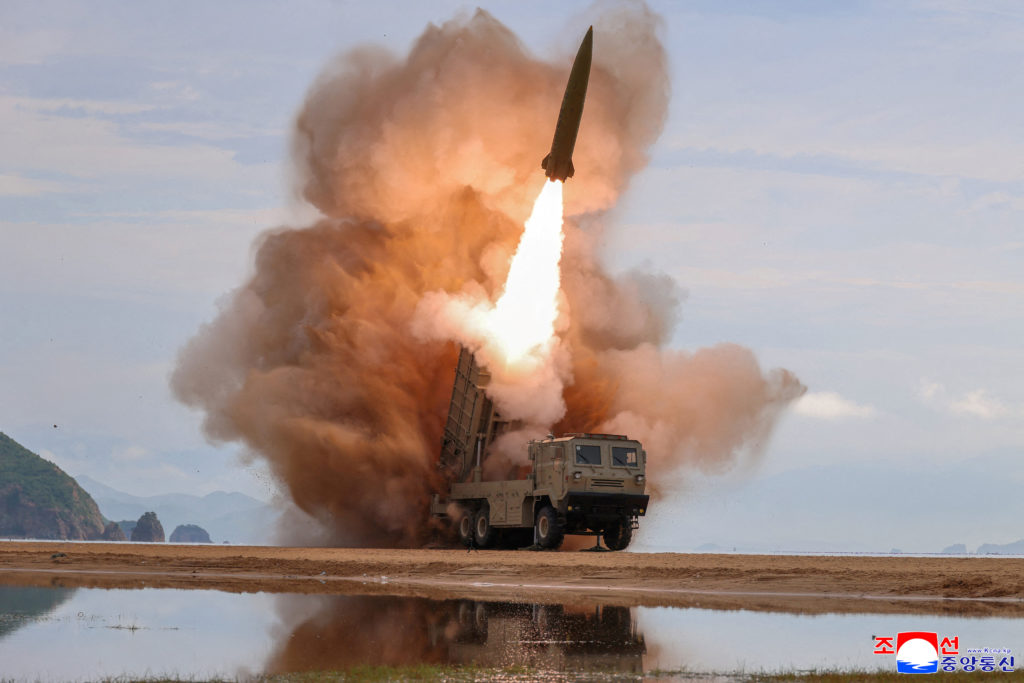
North Korea launched approximately 10 short-range ballistic missiles toward its eastern waters on Thursday, according to South Korea’s Joint Chiefs of Staff. The missiles were fired from the capital region around 5 p.m. local time and traveled roughly 300 kilometers (185 miles) before landing in the sea. The Japanese prime minister’s office also confirmed detecting a suspected launch during the same timeframe.
The launches occurred one day after North Korea rejected a U.S. decision to reduce the scale of annual joint military exercises with South Korea. President Donald Trump had ordered the Pentagon to "substantially reduce" the Ulchi Freedom Shield exercises, which began Monday, citing a good relationship with Kim Jong Un and South Korea's refusal to support U.S. efforts in the war in Iran. On Wednesday, the U.S. and South Korean militaries confirmed they had shortened the 11-day drills by approximately half and canceled several field training exercises.
Kim Yo Jong, sister of the North Korean leader, issued a statement on Wednesday dismissing the reduction as insufficient, stating that the "provocative, aggressive nature of the drills won't change." She further denied President Trump's claim that Kim Jong Un had responded to a request for a conversation, though she noted that personal relations between the two leaders remain "excellent." President Trump stated Wednesday that he expects to meet with Kim Jong Un later this year.
The scale of the military response involves about 10 missiles traveling 185 miles each, a distance that encompasses significant portions of the region's maritime territory. The diplomatic impact centers on whether North Korea will return to the negotiating table following the collapse of talks in 2019, which stalled over disputes regarding sanctions relief in exchange for dismantling nuclear facilities. According to experts cited in the report, North Korea may be seeking international recognition as a nuclear state and extensive sanctions relief in exchange for only limited denuclearization steps, a position that would fundamentally alter the legal and economic status of the country if accepted by the international community.
What happens next depends on the scheduled completion of the remaining Ulchi Freedom Shield exercises and the potential for a meeting between President Trump and Kim Jong Un, which Trump stated would occur this year. South Korean military officials said they have bolstered surveillance and are coordinating information with the U.S. and Japan. No specific dates for new diplomatic talks have been established, and Kim Yo Jong indicated that North Korea is waiting for larger concessions before resuming formal negotiations.