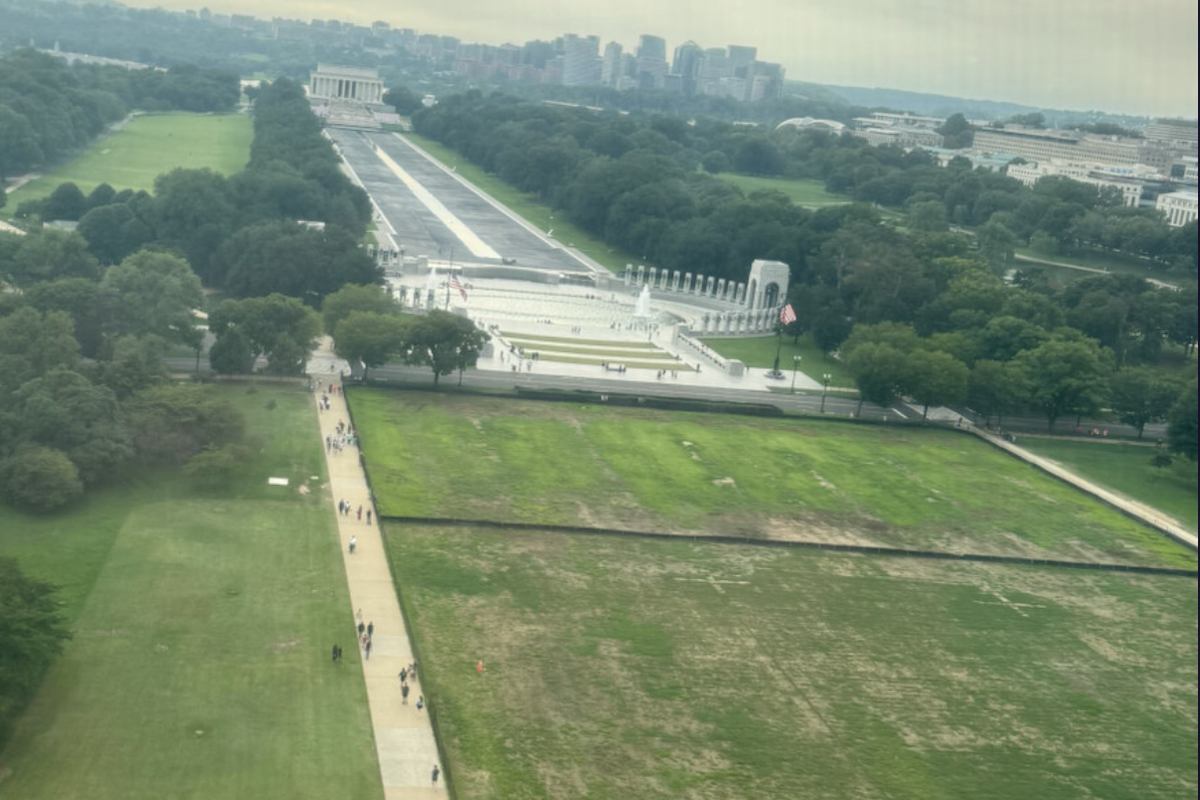
President Donald Trump stated Sunday night that patches of dead grass on the National Mall were the result of vandalism. In a post on Truth Social, the president shared an aerial photograph showing brown areas on the lawn in the same location where he held a July 4 celebration earlier this summer.
The claims follow a series of disputes regarding the condition of the Lincoln Memorial Reflecting Pool. Earlier this year, the president ordered the pool to be refurbished and repainted "American-flag blue." Following the project's completion, the pool experienced green algae blooms and segments of the new lining began to peel and float on the water's surface.
While the president alleged that the pool damage and the condition of the grass were caused by vandals, The Associated Press reported that livestreamed webcam footage from July 4 showed a bandstand and seating structures covering the lawn. Photographs taken by the publication showed workers removing these structures in the days after the event, revealing brown grass underneath where the equipment had been positioned.
In a Sunday night post, the president wrote that the grass, the World War II Memorial, and the Reflecting Pool had all been vandalized, adding that the pool would reopen "better than ever, shortly." He also referenced a "big 86 47" that he claimed was emblazoned in the grass. Previously, U.S. Attorney for the District of Columbia Jeanine Pirro dropped charges against former Olympian David Hearn, who had been accused of damaging the pool. A court filing from Pirro’s office stated the damage was due to a "botched installation" rather than vandalism.
For the general public, these developments result in the temporary loss of access to national landmarks. Visitors to Washington, D.C., will notice the Reflecting Pool is currently out of service and fenced off for renovations, and those walking the Mall will see large sections of dead or recovering turf where event structures were placed. The disagreement between the White House and the U.S. Attorney's office also highlights a lack of consensus within the federal government regarding whether these issues are matters for criminal law enforcement or civil contract disputes.
The outcome of these claims sets a precedent for how damage to federal land is investigated and prosecuted. If the U.S. Attorney’s assessment holds that the damage was a construction failure, it may lead to legal actions against contractors rather than criminal defendants. What happens next depends on the timeline for the pool's reopening, which the president stated would be "shortly," and whether any further evidence of intentional damage is presented to the U.S. Attorney’s office to support the president's allegations of vandalism.