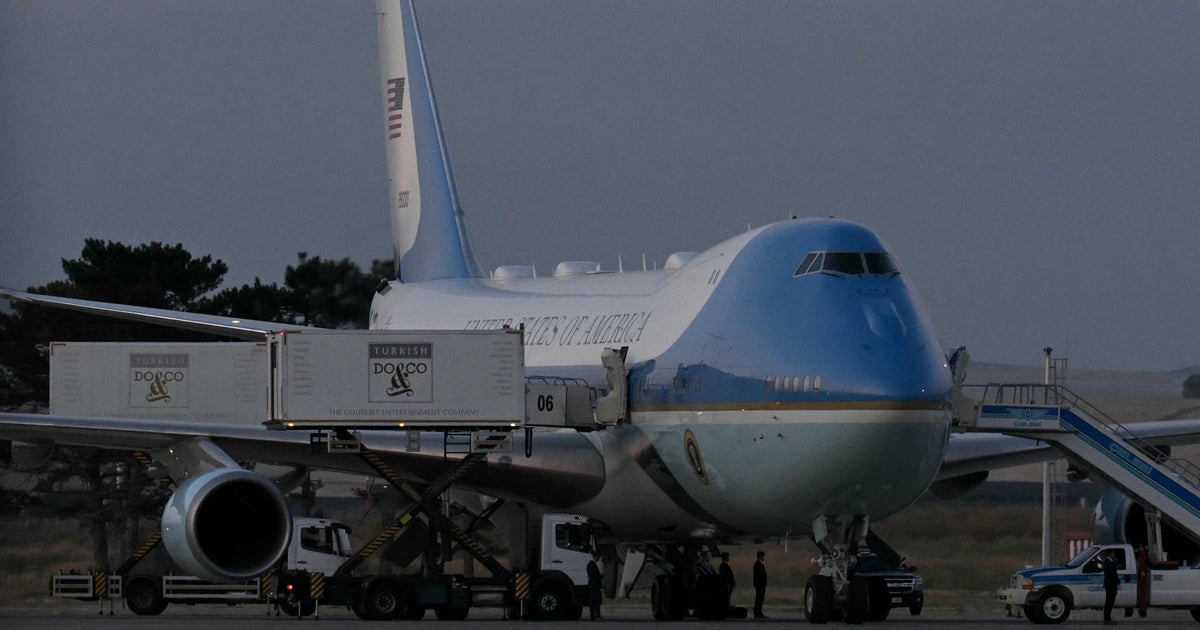
President Donald Trump secretly transferred from the primary presidential aircraft to a separate government plane in Ankara, Turkey, following a security threat at the conclusion of a NATO summit. According to a U.S. official with direct knowledge of the matter, the president was moved between aircraft with the assistance of an airport catering truck to avoid detection. U.S. intelligence had reportedly identified a credible threat from Iran and its allied proxies involving a potential missile attack on the plane carrying the president.
The maneuver followed the president's July 8 announcement that he would depart Turkey on the older Air Force One model rather than a newer aircraft donated by Qatar. While the president stated publicly the change was "for old time's sake," CBS News reports that the Secret Service recommended the older plane for security reasons. Before departure, press and staff were instructed to keep window shades closed, and video footage showed the president entering the older jet before a catering truck moved from that plane to an Air Force C-32A.
While the press corps and members of the president's staff flew to a refueling stop in the United Kingdom on the older Air Force One, the president traveled the same route on the C-32A. The staff and media remained on the decoy aircraft under the impression the president was on board. Upon reaching the United Kingdom, the president switched to the newer Qatari-donated plane for the final leg of the trip to Washington, D.C. Administration officials have since expressed concern that the leak of these classified protective tactics could affect future security operations.
The scale of the incident includes the crews and passengers of two different government aircraft, as well as the intelligence assets required to monitor the reported Iranian missile threat. While the exact number of people on the decoy flight was not reported, a standard presidential press pool and staff contingent typically numbers in the dozens. These individuals were placed in a situation where their presence served as a diversion, a concrete shift in the standard expectations of safety for those traveling within the presidential motorcade or flight group. The incident highlights the active nature of current security tensions between the U.S. and Iran, which the president characterized by referring to himself as Iran's "number one target."
The long-term impact involves the technical and diplomatic requirements of presidential travel. The newer Air Force One, a Qatari-donated jet retrofitted by the U.S. Air Force, was recently sent for further upgrades to address security concerns that arose during this trip. The incident sets a precedent for how the U.S. handles presidential transit when intelligence suggests standard anti-missile countermeasures may be insufficient. Following the leak of these details, the White House has not confirmed future changes to protocol, but communications director Steven Cheung stated the administration would continue to use "every tool at our disposal" to address threats. No specific dates for future travel protocol reviews were reported.