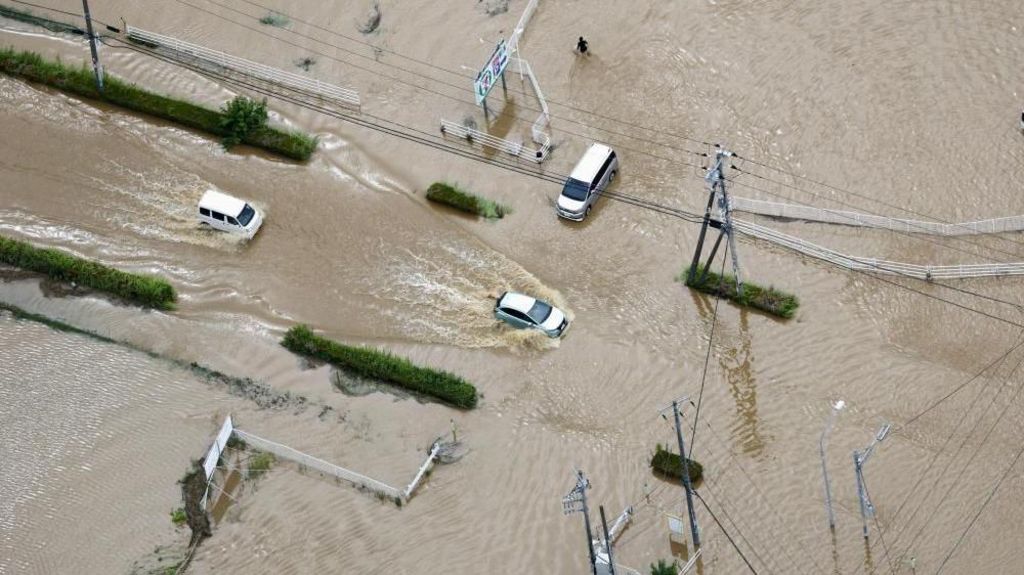
At least four people have died and five others were injured after record-breaking rainfall hit Japan’s Chiba prefecture near Tokyo. The storm, which local officials described as unprecedented, caused widespread flooding and landslides across the region. As of Friday morning, authorities have confirmed that victims included a woman who died in a submerged vehicle and two individuals who collapsed on the street.
The deluge followed a period of atmospheric instability caused by warm, humid air mixing with cold air over eastern Japan. This event occurred during an active typhoon season that saw three storms—Dolphin, Chan-Hom, and Peilou—affect the region earlier in the week. Prior to the current rainfall, Typhoon Dolphin had already caused power outages and flight cancellations on Japan's Okinawa island and forced evacuations in eastern China.
In Chiba, rainfall totals exceeded 100mm per hour starting Thursday afternoon, a figure authorities said is triple the average for August and the highest ever recorded in Japan. The weather prompted a level five emergency warning on Thursday, the highest possible alert, which was downgraded to level four by Friday morning. More than 100,000 households were asked to evacuate, and approximately 1,800 people sought shelter overnight at the Chiba Prefectural Government building.
The scale of the disruption extended to international and domestic travel, affecting thousands of transit users. Approximately 7,000 travelers were stranded overnight at Tokyo’s Narita International Airport as transportation to and from the facility was halted. While airport spokespersons stated that flights were scheduled to operate normally on Friday, Japan Airlines indicated that passengers could still face delays throughout the day. For the average traveler or commuter, this resulted in overnight stays at metro stations and airport terminals while waiting for transportation networks to be restored.
Beyond Japan, the active weather pattern has forced government intervention across Southeast Asia. In the Philippines, authorities were forced to close schools and government offices across the northern part of the country due to flood threats. In China, the preceding Typhoon Dolphin led to the evacuation of more than one million people. In Japan, rescue efforts and the monitoring of landslide risks are expected to continue through at least late Friday as the rain persists. Governor Toshihito Kumagai stated that the administration will prioritize life-saving measures as the region begins to assess the total damage to infrastructure and private property.