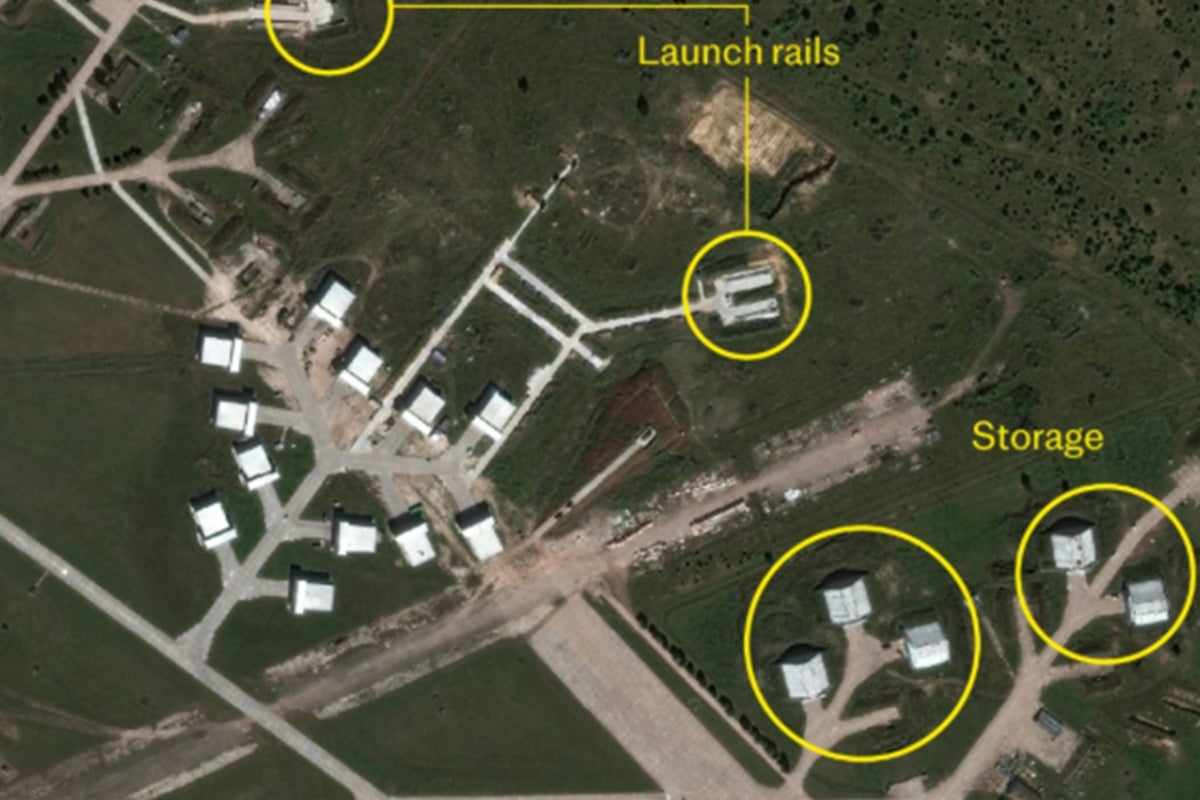
An investigation by The Telegraph, based on satellite imagery and leaked documents, reports that Russia has constructed and expanded 10 new drone bases along its borders with Ukraine and Belarus. The report states these facilities include at least 59 new launch rails, which are guide tracks used to fire drones. According to the investigation, the bases are equipped to fire jet-powered, long-range drones capable of reaching NATO member territories.
The findings follow a series of drone and aircraft incursions into NATO airspace that have prompted the alliance to scramble fighter jets. On Sunday, NATO jets intercepted a drone in Romanian airspace, and two days prior, four fighter jets were deployed to shoot down a drone in Latvian airspace. Latvian officials attributed the latter incident to a drone entering their territory as a result of Russian electromagnetic warfare.
Satellite imagery analyzed by drone intelligence firm DroneSec reportedly shows that 20 of the new launch rails have been extended in design to accommodate long-range attack models. The investigation indicates that Moscow is accumulating high-tech drones at these sites, with one base reportedly possessing storage capacity for 1,000 units. A NATO spokesperson stated the alliance is monitoring these strike capabilities and maintains the authorities and forces necessary to respond to threats.
Military personnel and residents in allied countries will see a concrete shift in security posture, as NATO is currently investing nearly $40 billion into counter-drone capabilities over a five-year period. This investment includes a mandate for member states to train five times as many drone operators by the end of 2027. Citizens in these nations may notice increased military presence and more frequent alerts, as the alliance has transitioned to regularly scrambling jets to intercept unmanned aerial vehicles that cross international borders.
The expansion sets a precedent for long-range drone warfare that could bypass traditional air defenses by using sheer volume to overload systems. These activities also influence broader geopolitical policies; U.S. intelligence assessments suggest the possibility of limited attacks ranging from cyberattacks to small-scale incursions intended to test the alliance's collective response. What happens next involves NATO's continued reinforcement of its deterrence tools, with the increased drone operator training scheduled for completion by late 2027.