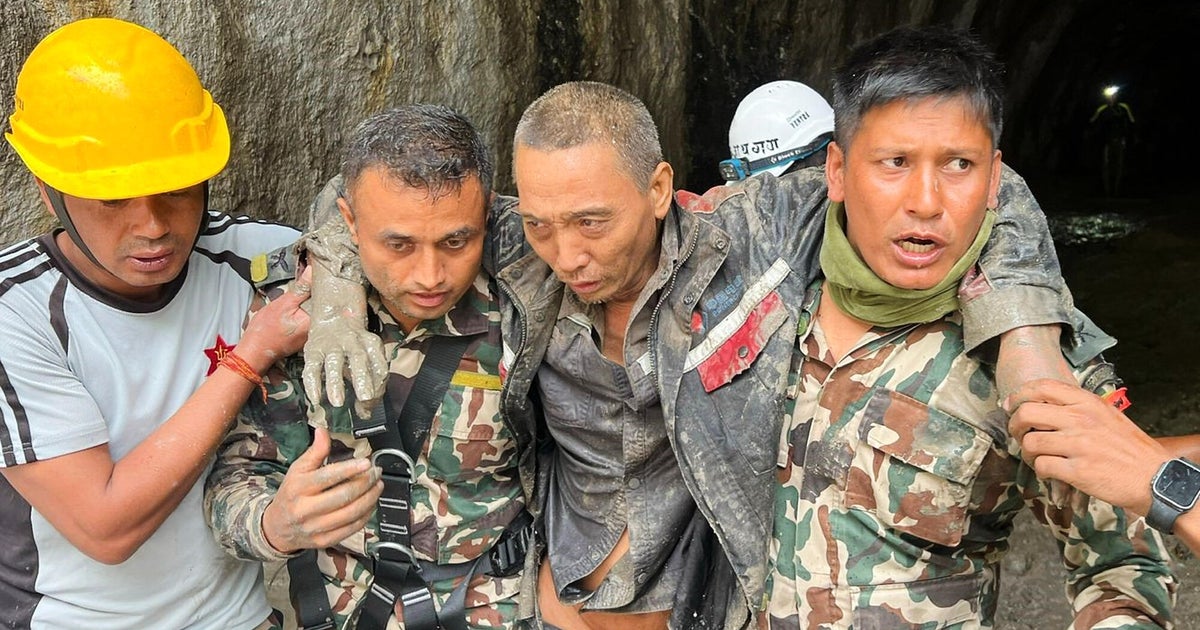
Rescue teams in Nepal recovered three workers from a hydropower tunnel and a woman from a collapsed house on Friday and Saturday, following catastrophic floods that began on Aug. 26. A joint team of Nepalese military personnel and South Korean disaster experts extracted a third worker, identified as a Chinese national, from a 738-foot tunnel at the Trishuli 3A hydropower project on Saturday. This followed the Friday morning rescue of two Nepalese workers, mechanical foreman Sanjay Sah, 30, and mechanical supervisor Kabir Maharjan, 45, from the same facility.
The floods were triggered by a glacier collapse near the border of Nepal and China's Tibet region on Aug. 26. The disaster caused massive landslides and flash flooding that swept away entire communities and damaged infrastructure. In Nuwakot town, a woman was found alive in a mud-covered house on Saturday and was subsequently airlifted to Kathmandu. Authorities report that at least 1,300 people have been killed in Nepal and 31 in China, with more than 5,500 people across both countries still missing.
Rescuers at the Trishuli 3A plant reached the workers by digging by hand and using controlled blasts to clear rocks described as the size of cars. Geologist Arnold Dix, an advisor to the operation, noted that rescuers targeted a specific section of the tunnel where survival was deemed possible. Sanjay Sah, speaking from a hospital bed, stated that he helped other workers evacuate but could not escape himself before the tunnel was blocked. He reported hearing the voices of other trapped individuals during his nine days underground.
The scale of the disaster is reflected in both the human toll and the economic damage, which Nepal’s disaster management agency estimates at 387.5 billion Nepalese rupees, or approximately $2.5 billion. For the residents and workers involved, the immediate impact includes the loss of homes, schools, and essential infrastructure, alongside ongoing communication blackouts and road blockages. The survival of the three workers provides hope for rescue teams using excavators and earth-moving equipment to navigate remote, mountainous terrain where air quality and access to drinking water remain concerns for those still trapped.
The event has involved experts from South Korea and other nations to assist local military and police forces. A national day of mourning is scheduled for Sept. 7, during which the national flag will be flown at half-staff at government offices and diplomatic missions. Recovery efforts continue at other sites, such as the Langtang Hydropower Project, where two bodies were recently recovered. As of Saturday, rescue teams continue to work in hopes of locating more survivors based on reports of voices heard from within the tunnel systems.