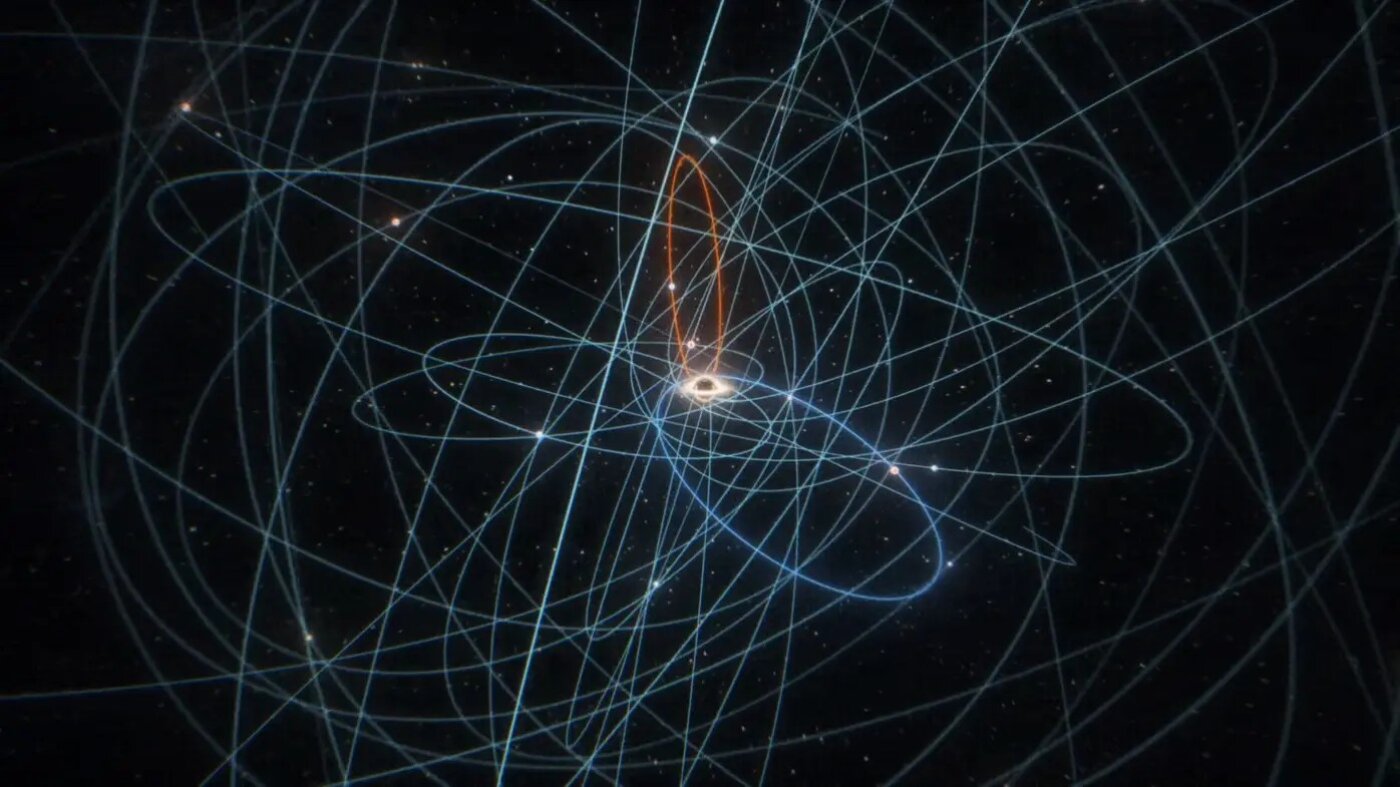
Researchers identified a star orbiting the supermassive black hole at the center of the Milky Way at speeds reaching more than 15,000 miles per second. The star, designated S301, was described in research published Wednesday in the journal Nature as the fastest star ever observed in the galaxy.
The discovery follows decades of study regarding Sagittarius A*, an object at the galactic center calculated in 2002 to be four million times the mass of the Sun. Astronomers at the Max Planck Institute for Extraterrestrial Physics used infrared light captured by the European Southern Observatory’s Very Large Telescope in Chile to observe the region, which is otherwise obscured by cosmic dust and gas.
Felix Mang, a Ph.D. student at the Max Planck Institute, first noticed the star as a faint flicker in data several years ago. By tracking its position over two years and reviewing historical data, researchers determined S301 follows a highly elongated elliptical orbit lasting 8.7 years. At its closest approach to the black hole, the star reaches approximately 8% of the speed of light before decelerating as it moves away.
The scale of this discovery is measured in extremes of velocity and mass. Traveling at 15,000 miles per second, S301 moves fast enough to cross the Earth’s diameter in less than a second. For researchers, this speed provides the data necessary to attempt the first-ever measurement of the spin of Sagittarius A*. Determining the rotation of this black hole, which has been quiescent or inactive, could explain how the black hole grew and how it helped shape the surrounding galaxy over billions of years.
In the long term, these findings set the stage for a decade of high-precision measurements of black holes. While the immediate effects are limited to the field of academic research and astrophysical modeling, the data helps clarify the fundamental physics that govern the Milky Way. Researchers will continue to monitor the star's precise 8.7-year orbital cycle, with the next decade expected to yield further insights into the interaction between supermassive black holes and their direct environments.
Stefan Gillessen, an astronomer involved in the study, noted that the orbit is predictable enough to be compared to a precise railway system. The team will continue using infrared observations to track the star as it completes its current orbital cycle. No specific date for the next major measurement was reported in the study.