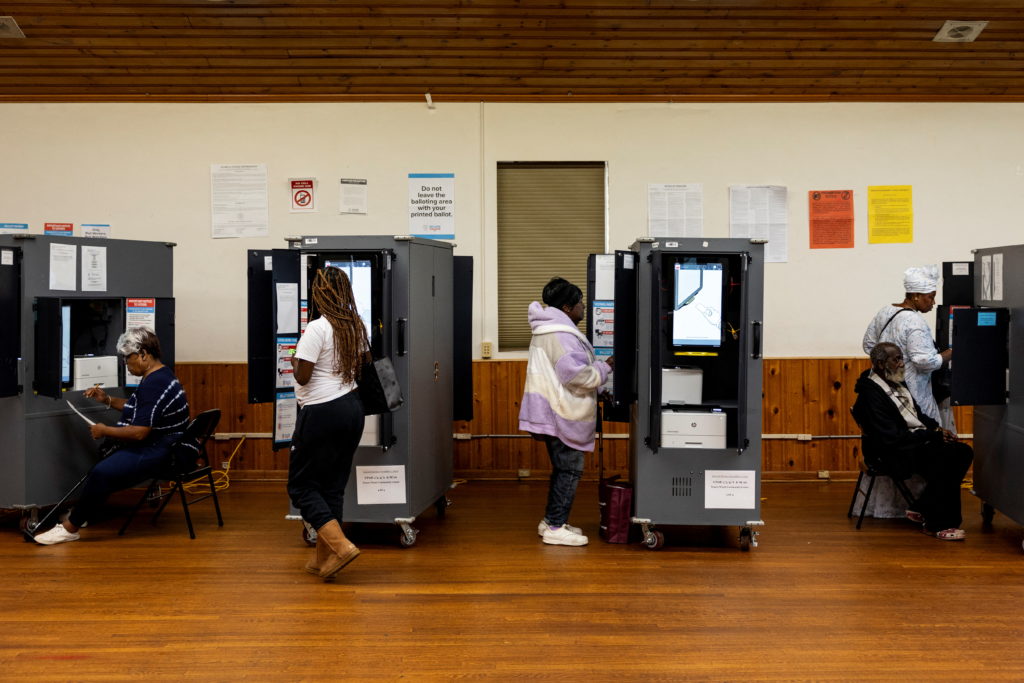
Security researchers reported on Sunday, September 13, 2026, that advances in artificial intelligence have increased the risk of exploiting a known flaw in Georgia's voting equipment. The vulnerability, first identified in 2022, could allow unauthorized parties to match individual voters to their cast ballots by reordering randomized records. While election security advocates have criticized state officials for not fixing the issue before the upcoming November elections, officials stated they have taken administrative steps to mitigate the risks.
The issue involves voting machines manufactured by Dominion Voting Systems, which has since been renamed Liberty Vote. While many other jurisdictions using the same equipment have applied a software update to resolve the flaw, Georgia remains the only state using the system statewide without the update. Mark Lindeman of Verified Voting noted that Georgia’s open records laws, combined with the lack of the software fix, create a unique vulnerability. Researchers stated the flaw does not allow for votes to be changed or election results to be altered.
Max Springer, a researcher at Princeton University, demonstrated how AI could be used to exploit the flaw. By providing an AI assistant with publicly available primary election records and check-in logs, Springer was able to reverse-engineer the ballot shuffling and match many ballots to specific voters. J. Alex Halderman of the University of Michigan stated that AI now allows laypeople to perform technical exploitation that previously required specialized skills.
In response to these findings, State Election Board member Salleigh Grubbs proposed a rule in August to mandate the software update. However, the board rejected the proposal after an agency lawyer argued that the update had not been certified by the secretary of state, would take months to implement, and lacked legislative funding. Board member Sara Tindall Ghazal noted that while the lack of the update is frustrating, Georgia law makes it a felony to reveal how someone voted, which serves as a legal deterrent.
To address the vulnerability without the software update, the secretary of state’s office has issued guidance to county officials to redact specific information from public records requests. Gabriel Sterling, special projects manager for the secretary of state, said the office is working with a vendor to scramble the order of ballot images before they are released. Marilyn Marks of the Coalition for Good Governance argued that withholding public records is insufficient and that the state should instead stop recording the identifying information that makes the trace possible.
The scale of the issue involves the cast-vote records and electronic ballot images of every Georgian who uses a touchscreen machine at a precinct. While the specific number of voters affected per election depends on turnout, Georgia is a presidential battleground with a high-profile U.S. Senate race. A person would not notice a change in their physical voting experience, but the privacy of their selections could theoretically be accessed by anyone who obtains public records and utilizes AI tools to re-sort the data.
The knock-on effects include potential litigation and a loss of public trust in election security. Because the flaw allows for the reconstruction of ballot order, election advocates argue that simply redacting records is a temporary fix that does not address the underlying technical recording of data. What happens next depends on the secretary of state’s office, which is currently working to scramble records before release, and any future legislative action to fund or mandate the Liberty Vote software update. No specific date for a statewide software update has been set.