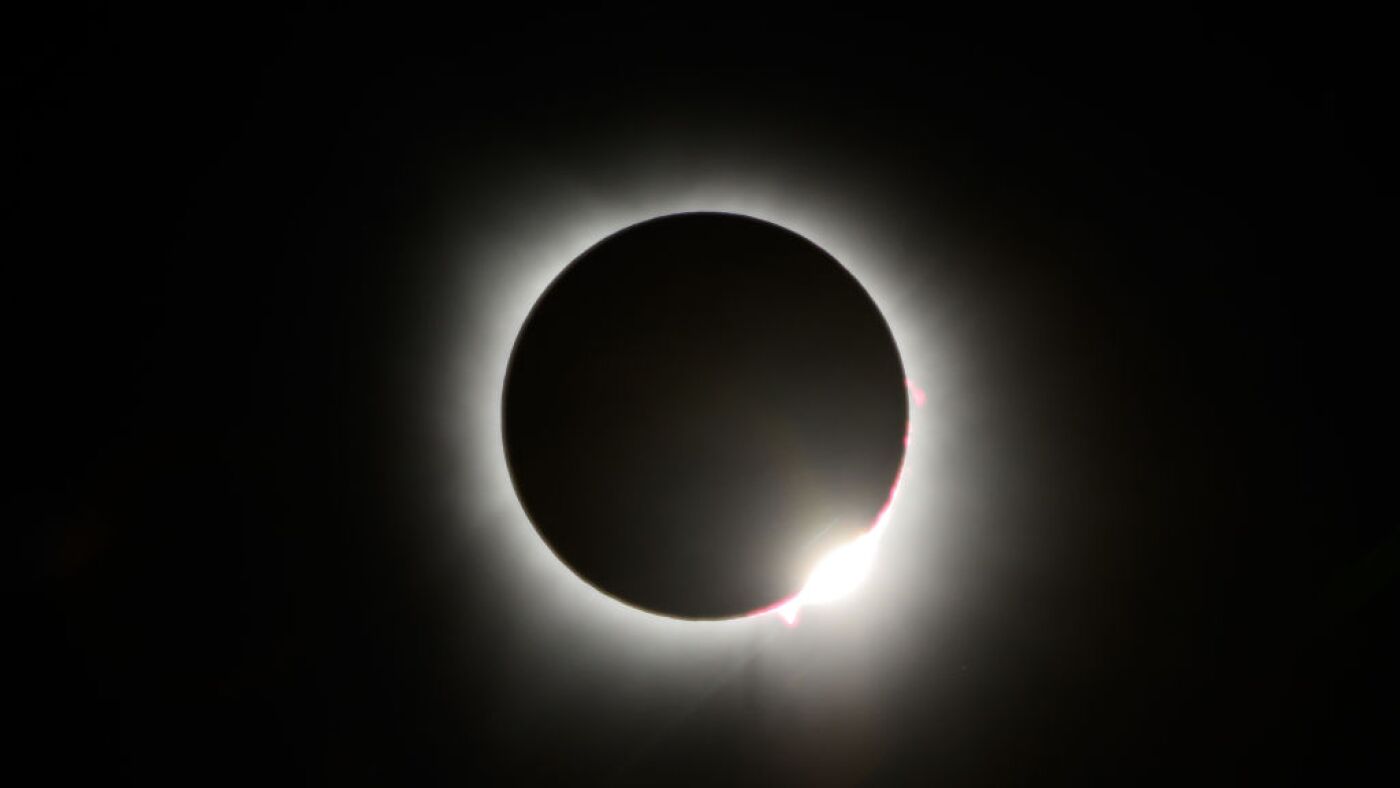
A solar eclipse is scheduled to occur on Wednesday, with the path of totality crossing parts of Europe and the Arctic, while northern regions of the United States will experience a partial eclipse. A total solar eclipse occurs when the moon passes directly between the Earth and the sun, completely obscuring the sun's face. Residents in Iceland, Greenland, northern Russia, Spain, and portions of Portugal are positioned to see the total eclipse, while a partial eclipse will be visible in the U.S. from Alaska to North Carolina.
In Washington, D.C., the partial eclipse is expected to begin at 1:17 p.m. ET, with the moon covering approximately 4% of the sun. In Reykjavík, Iceland, the total eclipse is scheduled to begin at 5:48 p.m. local time. In León, Spain, totality is expected to begin at 8:28 p.m. and last for two minutes, marking the first time a total solar eclipse has been visible from the Spanish mainland since 1905.
Health and science organizations have issued guidance for those planning to view the event. The American Academy of Ophthalmology stated that looking at the sun without specialized protection can cause permanent vision loss or burns, and noted that standard sunglasses are insufficient. NASA plans to utilize high-altitude jets and scientific balloons during the event to study the sun’s corona and the impact of sudden darkness on the Earth’s atmosphere.
Viewers will notice a visible change in the sun's appearance, which will take on a crescent shape in areas seeing a partial eclipse. To participate safely, individuals must use specialized equipment such as eclipse glasses or handheld viewers with solar filters. These safety precautions are necessary to prevent medical complications like solar retinopathy, which can manifest as permanent vision impairment. The event also provides a specific timeframe for scientific research, as NASA teams use the brief period of totality to collect data on the solar corona that is otherwise difficult to obtain from Earth.
Following this event, the next partial solar eclipse visible in the U.S. is expected on August 2, 2027, which will also feature totality in parts of North Africa, the Middle East, and Spain. U.S. residents in the contiguous states will not see another total solar eclipse until August 23, 2044. NASA and the European Space Agency continue to monitor these celestial paths to provide timing and safety data for the public.