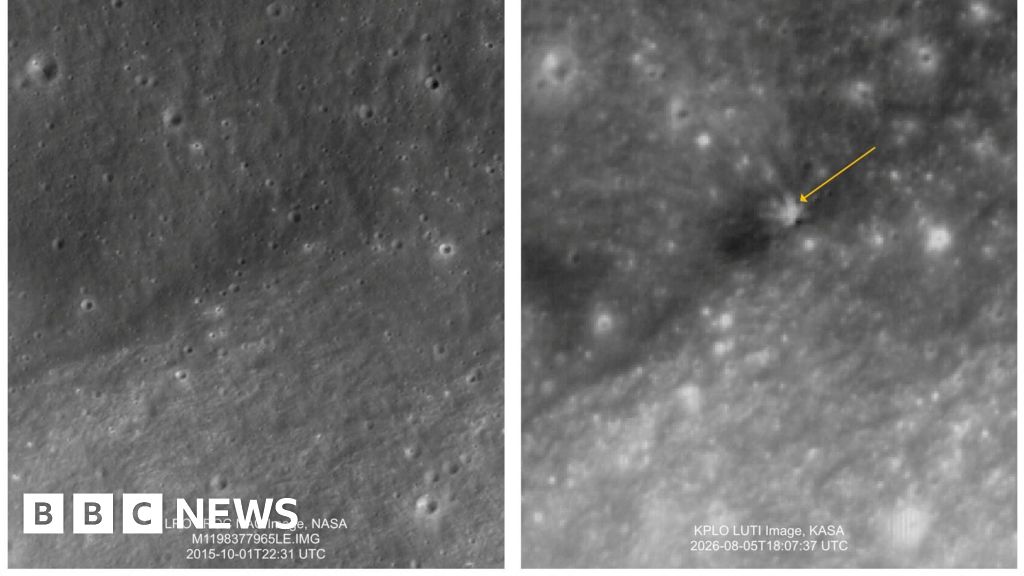
The Korean AeroSpace Administration (KASA) released images on Thursday showing the lunar surface before and after a SpaceX rocket component struck the Moon. The space agency reported that the impact occurred at approximately 06:35 GMT on Wednesday.
The debris originated from a Falcon 9 rocket launched from Florida in January 2025. That mission was intended to deploy two lunar landers into space. While the first stage of such rockets is designed to return to Earth, the upper stages are shed in space. SpaceX stated that the collision with the Moon was not intentional.
According to KASA, the lunar orbiter Danubri captured the images of the impact site. Astronomers had previously tracked the spent rocket stage, which weighed approximately 4,000kg (8,800 lbs) and was roughly the size of a five-story building. Scientists estimated the debris struck the surface at a speed of about 5,400mph (8,700km/h).
For the public and amateur astronomers, the scale of this event was significant in terms of mass and speed, but the visual impact was minimal. Although the 4,000kg stage created a flash upon impact, the event occurred in broad daylight for much of the world, making the flash too faint to be seen even with high-end consumer telescopes. The primary data collection is limited to large observatories and specialized lunar orbiters like South Korea’s Danubri, which are now analyzing the resulting surface changes near the Einstein Crater.
This incident sets a precedent for how astronomers track and predict the path of "stray" hardware influenced by the gravitational forces of the Earth, Moon, and Sun over long periods. The specific booster section used in the initial January 2025 launch is already scheduled for its 18th flight on August 10, 2026. This upcoming mission is intended to launch 29 Starlink satellites into low-Earth orbit, continuing the rapid pace of deployments that contributes to the crowded orbital environment described by researchers.