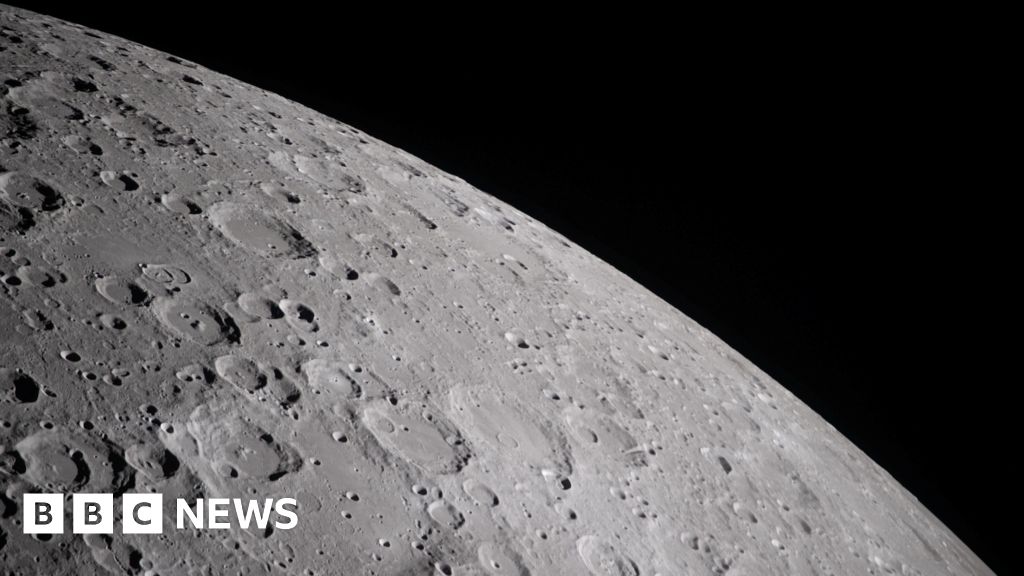
A spent SpaceX Falcon 9 rocket stage was expected to crash into the lunar surface on Wednesday. The object, an empty upper stage approximately 14 meters long and weighing at least 4,000 kilograms, was projected to hit near the Einstein crater at a speed of roughly 5,400 mph (8,700 km/h). While the collision was unintended, planetary geologists are treating the event as a research opportunity to study crater formation and lunar geology.
The rocket stage was originally launched from Florida in January 2025 to carry two lunar landers. After successfully deploying the landers, the upper stage was left in a high orbit. Over the following 18 months, gravitational forces from the Earth, Moon, and Sun, along with solar light pressure, gradually altered its trajectory. Astronomers tracking the debris eventually determined these factors had placed the object on a direct collision course with the Moon.
The impact occurred at approximately 07:35 BST (06:35 GMT) in an area experiencing daylight, making the resulting flash too faint for direct observation by most telescopes. However, astronomers noted that a dust plume stretching up to 100 kilometers could have been visible for several minutes. While no spacecraft were positioned to record the impact live, South Korea’s Danuri orbiter passed near the site shortly before, and NASA’s Lunar Reconnaissance Orbiter is scheduled to photograph the area in the coming days to provide before-and-after comparisons.
The scale of the impact involves a 14-meter rocket part striking a celestial body 385,000 kilometers from Earth. For future lunar residents or missions, the findings could translate into safer construction standards, as engineers will better understand the seismic risks and "ejecta" (thrown material) hazards associated with high-speed impacts. The collision also exposes subsurface material, which may provide scientists with new information regarding the composition of the Moon and the history of the Earth-Moon system, which formed approximately 4.5 billion years ago.
This incident follows a history of human-made objects striking the Moon, beginning with the Soviet Luna 2 probe in 1959. Other impacts include NASA's Ranger probes and the 2009 LCROSS mission, which was crashed intentionally to search for ice. The most recent accidental impact occurred in 2022, involving a booster from a 2014 Chinese mission. Data from this latest SpaceX crash will be processed by observatories in the Americas, a task that researchers say could take days or weeks as they clean up images and analyze the seismic and geological information gathered.