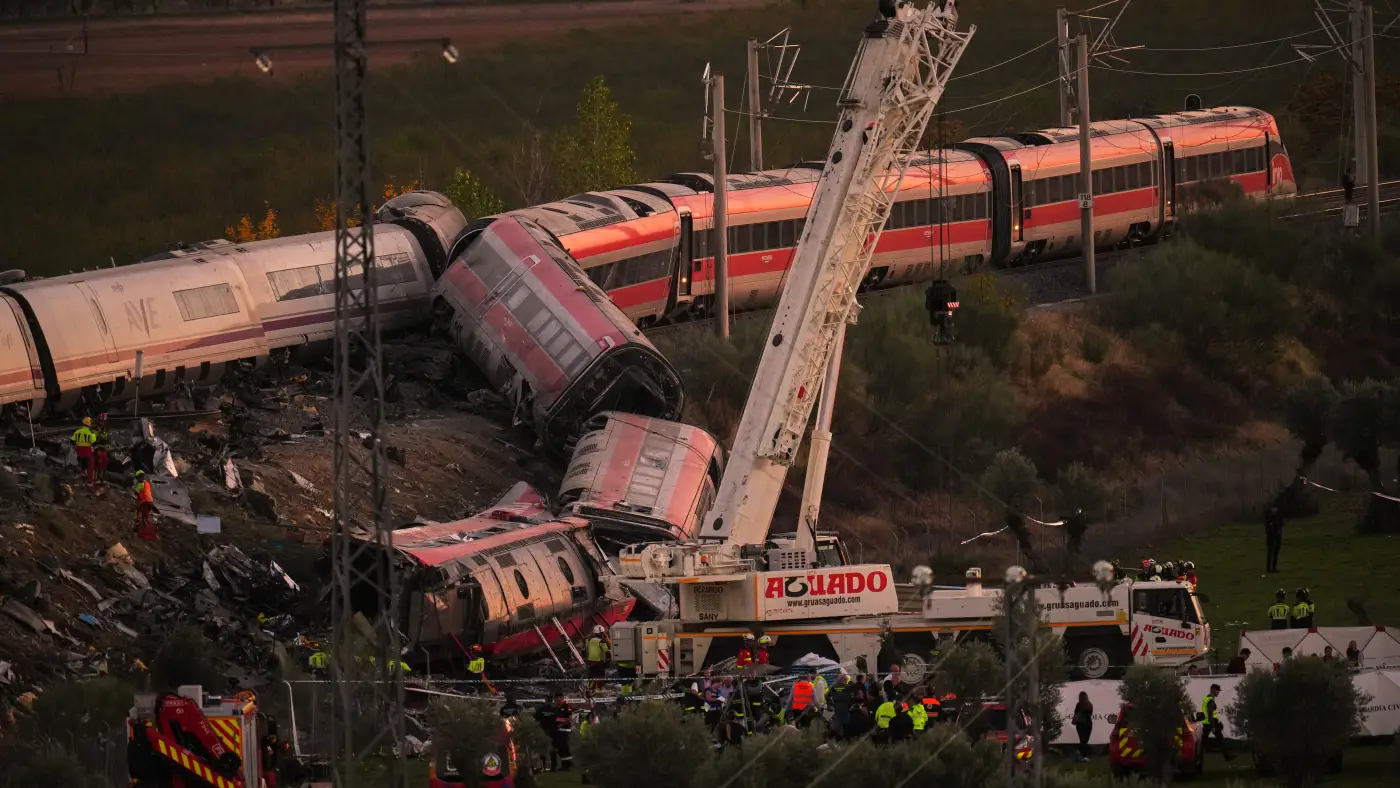
A high-speed train collision in central Spain killed at least 69 people on Wednesday, October 28, 2026. The crash occurred near the town of Urda in the province of Toledo when a state-owned RENFE train struck a stationary, private IRYO train from behind. Regional authorities reported that dozens of others were injured, with more than 100 casualties cited by some sources, as rescue workers continued to search the wreckage on Thursday.
The collision follows a January derailment in southern Spain that killed at least 45 people, also involving RENFE and IRYO trains. Before 2026, Spain's high-speed rail network, which is the second largest in the world by mileage, had not recorded a fatal crash since beginning operations over 30 years ago. The recent incidents have led to increased scrutiny of rail safety as the country prepares for a national election on November 29.
Transport Minister Óscar Puente stated that the crash resulted from an "inexplicable" order issued by a central command center. According to Puente, a computer malfunction at 8:30 a.m. disabled security systems across a 63-kilometer (39-mile) stretch, causing all trains to stop. Despite an active stop signal, command personnel directed the RENFE train to resume travel without speed restrictions. The RENFE train, carrying 397 passengers, collided with the IRYO train, which had 147 passengers, at 8:53 a.m. While the exact speed at impact is under investigation, Puente noted the train could have been traveling at 200 kph (124 mph).
The scale of the tragedy is significant for the nation's 48 million residents, as it marks the second major high-speed rail disaster in ten months. Families of the dead and at least 58 to 100 injured survivors face immediate medical and funeral costs, while the broader public faces three days of national mourning declared by Prime Minister Pedro Sánchez. Travelers will notice immediate changes in the form of suspended lines as the government pledges to reinforce safety protocols to rebuild trust in the infrastructure.
The crash has also become a focal point in the lead-up to the November 29 national election. Opposition leaders Alberto Núñez Feijóo of the Popular Party and Santiago Abascal of Vox have called for accountability, with the latter criticizing the government. The next steps in the investigation involve analyzing data to confirm the train's speed at the time of impact. A canine unit was scheduled to re-enter the wreckage on Thursday, October 29, to ensure no victims remain trapped, while the state-run operator ADIF and RENFE continue to coordinate the removal of wreckage from the Toledo province site.