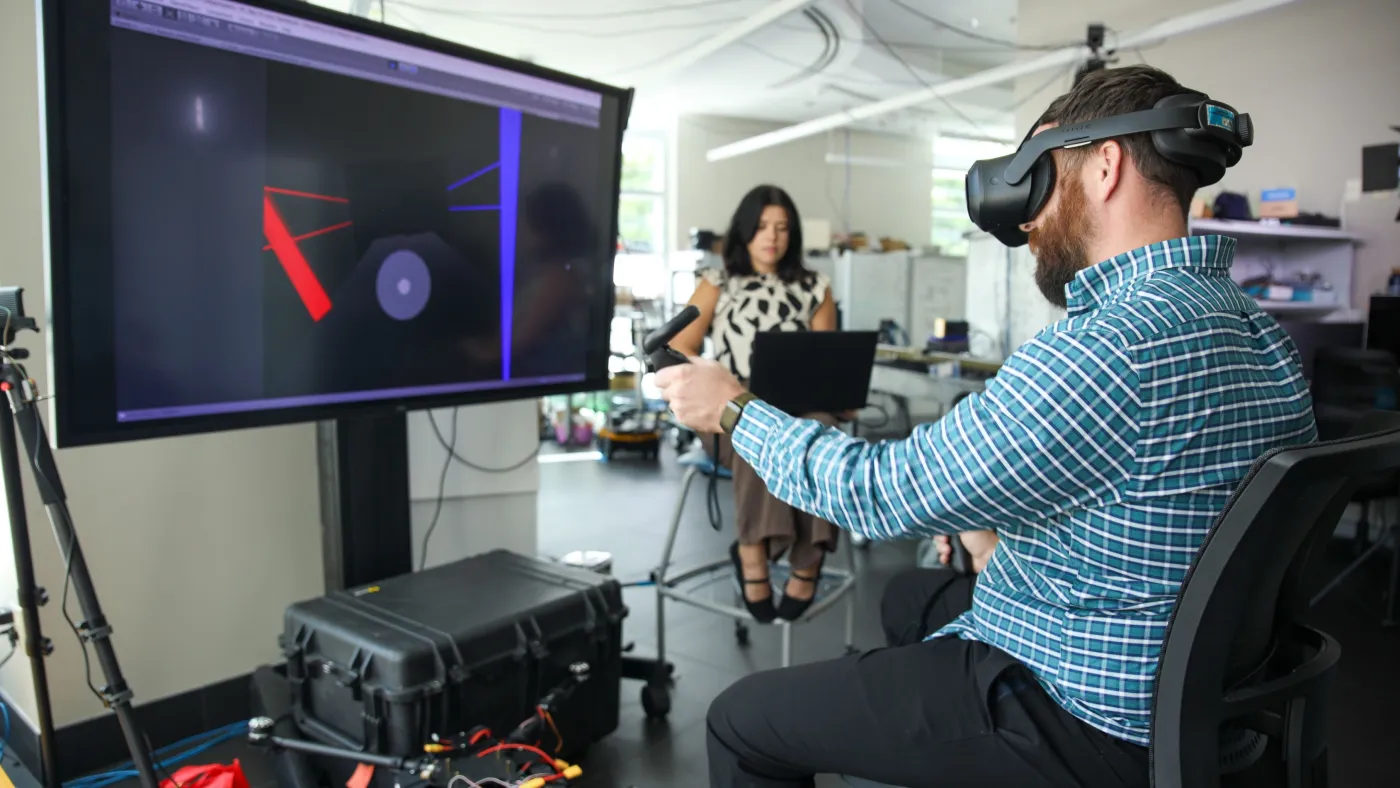
Researchers from Florida Atlantic University and Brown University found that physical movement can significantly accelerate the speed at which individuals master certain complex learning tasks. The study, published in the journal Science Advances, utilized virtual reality (VR) technology to compare different methods of processing information. Researchers observed that participants who performed large physical actions while learning categorized new information much faster than those using minimal movements.
The study included Luke Rosedahl, an assistant professor of biomedical engineering at Florida Atlantic University. Rosedahl and his team conducted experiments under laboratory conditions to observe how movement affects the learning process. The research specifically targeted complex learning, which involves identifying and organizing information into specific categories based on visual patterns.
During the experiments, participants wore VR goggles and were presented with various striped objects on a screen. The task required them to learn how to categorize these stripes into different buckets. One group of participants provided their answers by pressing buttons, representing a low-movement group. A second group performed large physical motions, such as swinging a virtual lightsaber or punching a response box located in front of them, to indicate their choices.
This research may interest students, educators, and professional trainees who rely on rapid skill acquisition and memory retention. By demonstrating that physical engagement is tied to cognitive processing, the study suggests that movement-based tools like VR could influence instructional methods. For an individual learner, this could mean mastering a task in less time through active participation.
Rosedahl reported that participants using large physical movements, such as punching, learned between 4 and 6 times faster than those using button presses. A person might notice this change through a faster progression in training modules or educational software that incorporates motion-tracking hardware.
These findings could influence the development of future educational technology and workplace training simulations. If large-scale physical movement is verified as a driver of learning speed, it may lead institutions to shift away from sedentary interfaces toward immersive VR environments that require full-body interaction. What happens next involves further peer review of these findings and potential follow-up studies to determine if these learning gains are maintained over long periods. Specific dates for future trials or commercial implementation of these findings were not reported.