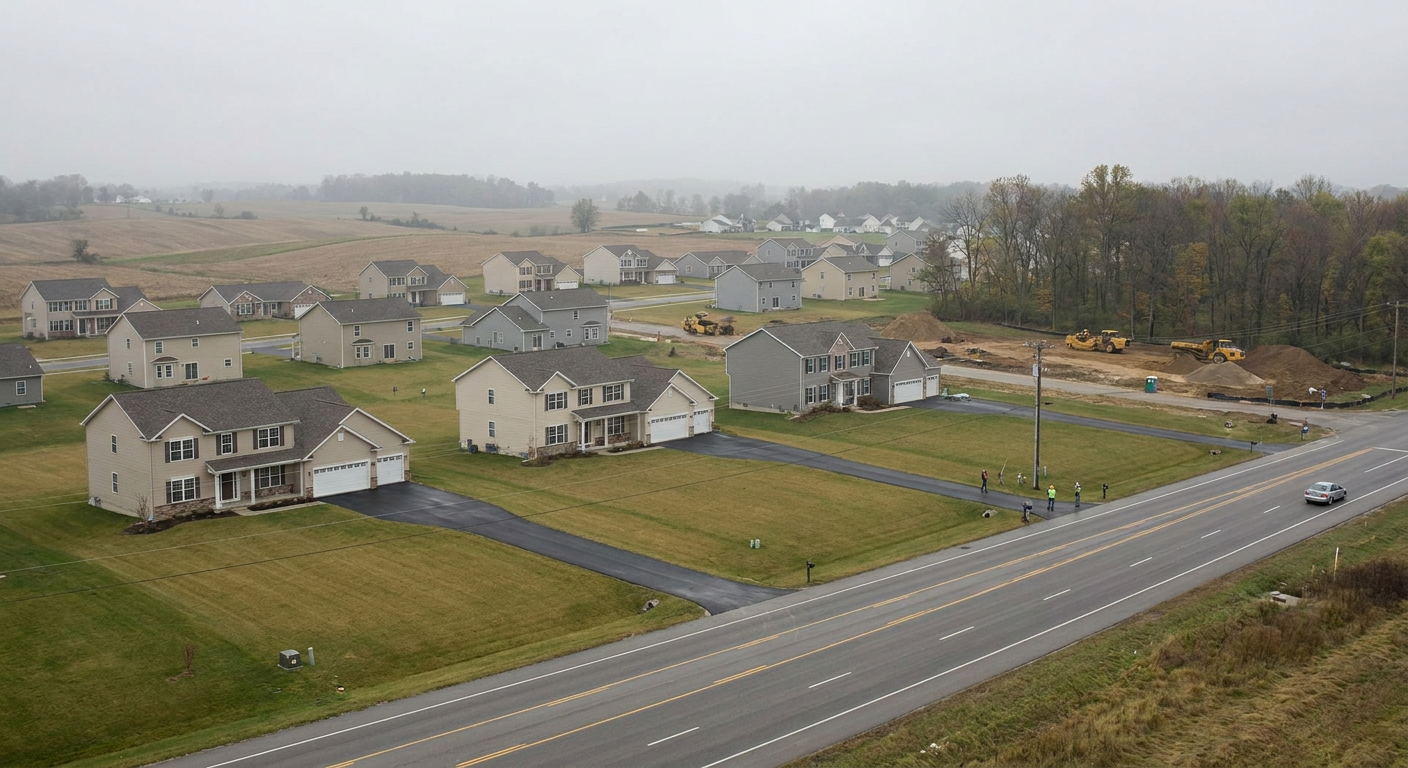
Suburban sprawl—defined by low-density residential growth that extends from metropolitan centers into rural areas—has become a primary focus of environmental research due to its impact on carbon emissions, water quality, and land preservation. While cities are often perceived as less "green" than suburbs, data from the Massachusetts Institute of Technology (MIT) and other research institutions indicate that suburban residents typically maintain a higher carbon footprint per household than those living in dense urban cores.
The last decade has seen a resurgence in this development pattern. Following a brief slowdown after the 2008 financial crisis, suburban housing starts accelerated between 2014 and 2024. This trend intensified during the COVID-19 pandemic, as remote work allowed millions of employees to relocate further from urban centers, driving up demand for larger homes in outlying areas.
Land Conversion and Vegetation Loss The development of sprawling suburbs involves the conversion of previously undisturbed natural or agricultural land into residential neighborhoods. This process frequently results in the removal of trees and native vegetation to accommodate single-family homes, roads, and infrastructure.
According to reports from the Organization for World Peace, this expansion is often haphazard, blurring the boundaries between urban and rural domains. In some regions, the scale of development has accelerated rapidly; in the area southeast of Boston, more land was developed between 1980 and 2020 than in the preceding 330 years. Similarly, between 1950 and 1995, the land expanse of Chicago increased by 165% while its population grew by only 48%.
Environmental researchers note that once agricultural land is converted to suburban housing, it cannot easily be restored to its original state. This loss of viable soil for food production is cited as a long-term sustainability concern as global populations continue to rise.
Energy and Transportation Impacts The environmental footprint of the suburbs is largely driven by two factors: home energy use and transportation. David Hsu, an associate professor of urban and environmental planning at MIT, states that single-family homes are generally the least energy-efficient form of housing. These buildings require more energy for heating and cooling compared to multi-family units, with more than 70% of home energy use dedicated to climate control and water heating.
Transportation adds a significant layer to suburban emissions. The "cul-de-sac" design common in sprawl increases the distance between residences and essential services like grocery stores or schools. This creates a reliance on automobiles for daily tasks. Research indicates that a gas-powered car emits significantly more carbon dioxide per passenger-mile than public transit options like buses or trains, which are less common in low-density suburban layouts.
Water Pollution and Lawns The maintenance of suburban landscapes also affects local ecosystems. Suburban lawns and gardens are major sources of water pollution due to the use of fertilizers and pesticides. During rainfall or irrigation, these chemicals are carried via runoff into nearby lakes, rivers, and streams.
A study by the University of Michigan highlighted the impact of these practices, finding that when the city of Ann Arbor banned phosphorus fertilizers, the levels of the pollutant in the nearby Huron River dropped by 28%. Additionally, the prevalence of impervious surfaces—such as paved driveways and wide roads—blocks natural water flow and prevents the ground from filtering rainwater.
The Scientific and Policy Debate There is an ongoing debate among planners and environmentalists regarding how to balance the need for affordable housing with ecological protection. Proponents of "smart growth" argue for higher density to preserve open space, while some developers argue that consumer preference for single-family homes remains a primary economic driver that cannot be ignored.
Science increasingly points toward the "urban heat island" effect, which can be exacerbated by sprawling asphalt, though suburbs often remain cooler than downtown areas due to individual yards. However, the cumulative loss of regional carbon sinks—large forests or grasslands replaced by lawns—is a documented consequence of the last decade's expansion.
Mitigation Strategies Several regions have implemented policies to reduce the environmental impact of sprawl: * **Zoning Changes:** Oregon has allowed for more efficient multi-family buildings in areas previously reserved for single-family homes. * **Land Preservation:** The city of Davis, California, requires developers to preserve two hectares of agricultural land for every one hectare they develop. * **Building Codes:** In 2020, California updated its building code to require solar panels on all new homes, utilizing the large rooftop surface area characteristic of suburban housing. * **Incentives:** The 2022 Inflation Reduction Act provides rebates for heat pumps, home insulation, and electric vehicles to help suburban residents lower their individual emissions.
Why it matters The debate over suburban sprawl affects millions of residents, developers, and local governments across North America. As urban centers become increasingly expensive, low-income families and people of color have moved to the suburban fringes where property values are lower, making the environmental sustainability of these areas a matter of economic and social necessity.
For the average resident, the effects of sprawl are most noticeable in daily commute times, rising utility costs for large homes, and the gradual disappearance of local forests or farms. On a larger scale, the reported data suggests that suburbanization can undermine the greenhouse gas benefits of urban density. If the current patterns of low-density growth continue, the resulting loss of agricultural land could impact food security for future generations.
The next steps in addressing these environmental concerns lie largely with local policymakers. Decisions regarding zoning, public transit expansion, and building efficiency codes will determine whether suburbs can transition toward a lower-carbon model. For residents, the transition may involve adopting technologies like electric bikes, heat pumps, and solar arrays to offset the inherent energy demands of the single-family home. Individuals may notice these shifts through changes in local building requirements and the increased presence of renewable energy infrastructure in residential neighborhoods.