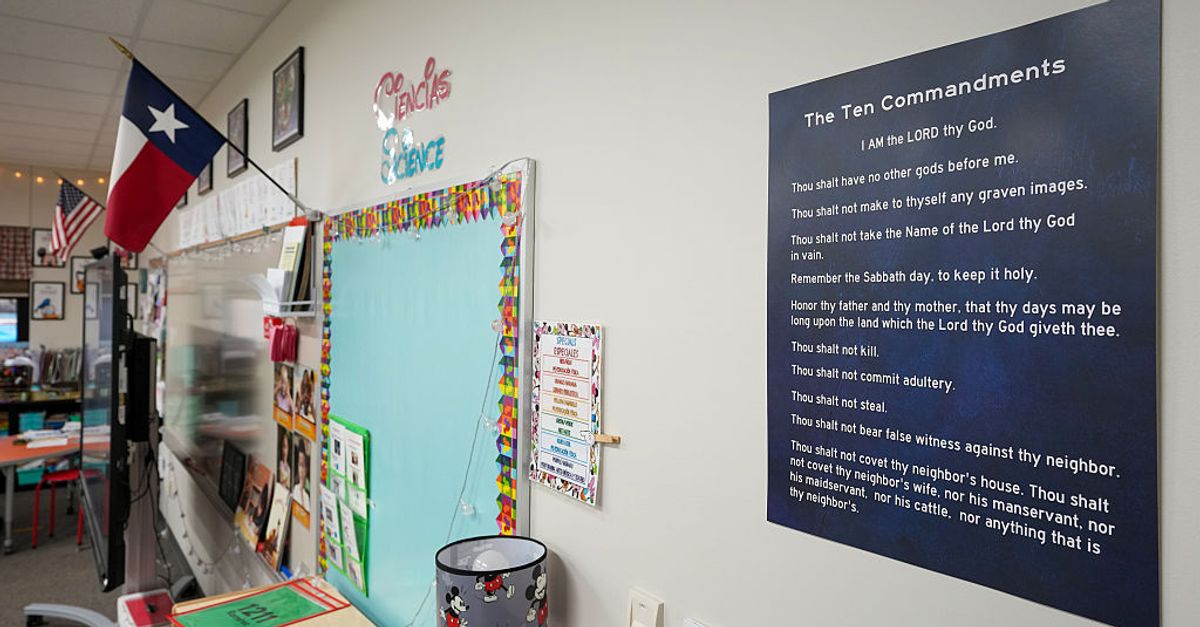
Lawyers representing a group of Texas families filed a petition with the U.S. Supreme Court on Monday, requesting a review of a state law that requires the Ten Commandments to be displayed in public school classrooms. The families are challenging a decision by the U.S. Court of Appeals for the 5th Circuit, which recently upheld the 2025 statute. The challengers argue that the appeals court failed to follow binding Supreme Court precedents regarding religious freedom and the separation of church and state.
The dispute centers on Texas Senate Bill 10, passed in 2025, which mandates that every public elementary and secondary classroom display a copy of the Ten Commandments. The law specifies that the text must be taken from the King James Bible and placed in a conspicuous location. The challenging families, who represent Christian, Jewish, Hindu, and nonreligious backgrounds, initially filed suit alleging the law violates the Establishment Clause of the First Amendment, which prohibits the government from favoring one religion over others.
In April, the full 5th Circuit upheld the law in a 9-8 vote. The majority opinion stated that the Supreme Court's 1980 decision in Stone v. Graham—which struck down a similar Kentucky law—was no longer valid because it relied on the "Lemon test." That legal standard was replaced by the Supreme Court's 2022 ruling in Kennedy v. Bremerton School District, which directs courts to evaluate religious matters based on historical practices at the time of the nation's founding. The 5th Circuit majority concluded that S.B. 10 does not resemble a founding-era religious establishment because it does not coerce worship or punish those who reject the commandments.
For public school students and their parents, the outcome will determine whether they see religious texts integrated into the mandatory school setting or if those displays must be removed. The legal precedent set by this case could influence how other states draft similar legislation. If the Supreme Court takes the case and affirms the 5th Circuit's reasoning, it would solidify a shift away from decades of legal standards that previously barred such displays. Conversely, a reversal would reaffirm that individual states cannot mandate the posting of religious texts in secular educational environments.
The petition filed on Monday marks the beginning of the Supreme Court's process for deciding whether to hear the case. The challengers argue that only the Supreme Court has the authority to overrule its own prior decisions, such as Stone v. Graham, and that the 5th Circuit overstepped by declaring that precedent "jettisoned." There is currently no set date for the Supreme Court to announce whether it will grant the petition for review. If the court declines to hear the case, the 5th Circuit's ruling will stand, and the Texas law will remain in effect.