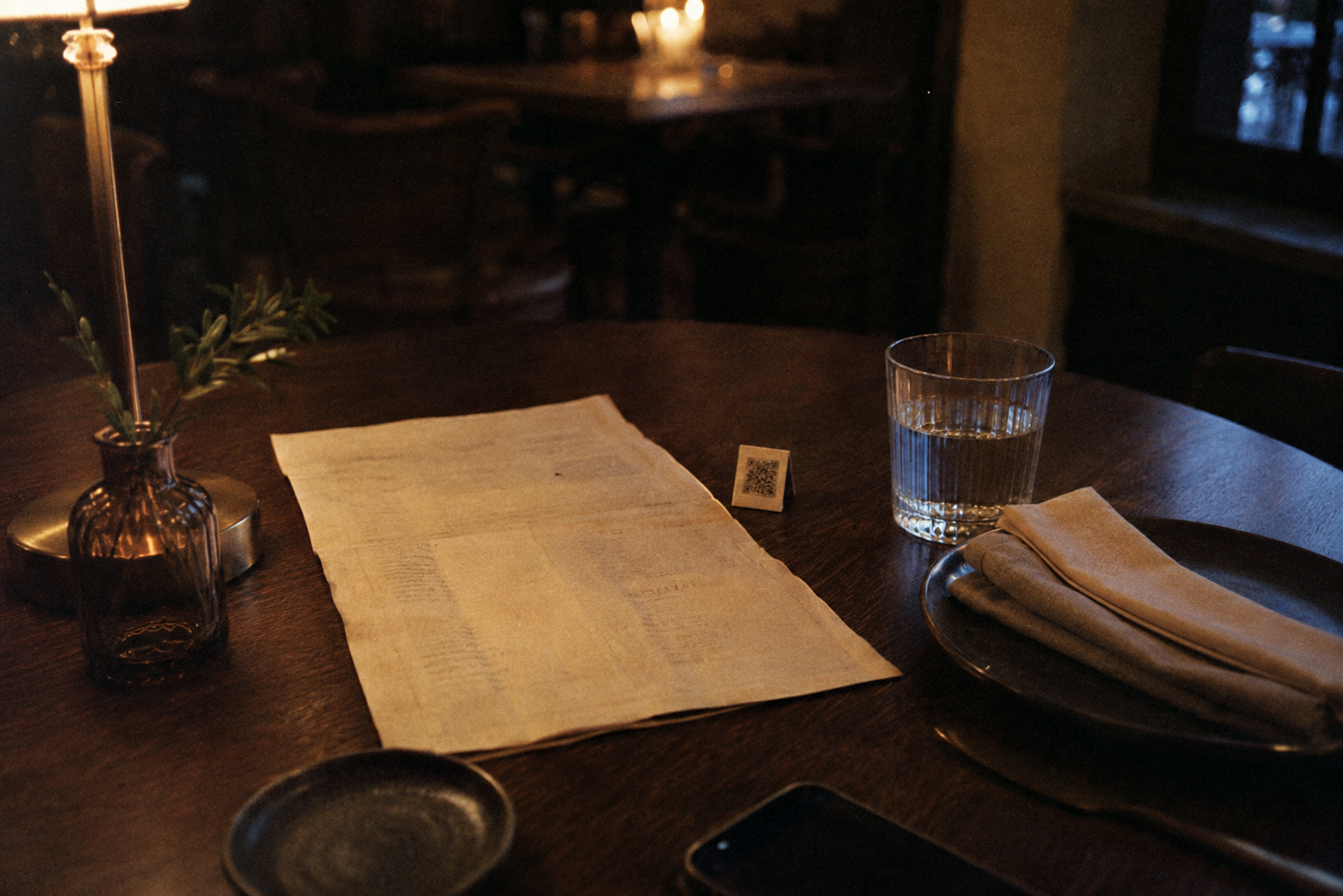
The server has barely finished saying hello when the first small negotiation of the meal begins.
“You can scan the code for the menu,” she says, pointing toward a black-and-white square fixed to the table. Someone reaches for a phone. Someone else asks whether there is a paper menu. A third person has already begun enlarging a PDF with two fingers, trying to remember whether the burger was above the salads or below the bowls. The table has not ordered a drink, but it has already divided into factions.
Few pieces of restaurant technology have inspired such disproportionate feeling. The QR code is tiny, cheap and almost aggressively unremarkable. Yet in a dining room it can become a referendum on age, hospitality, labor, accessibility, screen fatigue and what, exactly, a customer believes the price of dinner is supposed to include.
During the pandemic, the code offered restaurants an elegant answer to several urgent problems at once. It reduced shared surfaces, eliminated the need to sanitize stacks of menus and allowed prices or inventory to change without another trip to the printer. Then the emergency passed, the menus did not always return, and a tool introduced as a public-health precaution began to feel like a permanent transfer of work from the restaurant to the diner.
The resulting backlash is real. But the story is not quite a retreat from digital menus, nor is it a generational morality play in which young people embrace the future and older people refuse to learn how a camera works. What is emerging instead is a division of labor between paper and the phone. Diners generally want paper when they are deciding what to eat. They are much more open to digital tools when those tools do something paper cannot: show a changing beer list, place another round, split a check or let them leave without waiting for a card terminal.
The QR code is not disappearing. It is being demoted—from menu to option.
A solution looking for a permanent problem
QR codes were invented decades before COVID-19, but American restaurants gave them their great cultural moment. In 2020, the combination of public-health guidance, labor shortages and financial distress made contactless service feel both prudent and modern. A restaurant could replace a stack of handled menus with a square of printed vinyl. One update to a website could change a price everywhere. No menu had to be collected, wiped down, reprinted or thrown away.
The operational appeal outlasted the hygiene argument. Food costs became volatile. Restaurants struggled to hire and retain front-of-house workers. A digital system could connect the menu to ordering and payment, reducing trips between the table, point-of-sale terminal and kitchen. It could remove sold-out items immediately, promote a dish at a certain hour and capture information about what customers viewed or purchased.
For a restaurant with a large patio, a fast lunch business or a beer list that changes several times a week, this can be genuinely useful. In the Twin Cities, one restaurant-group owner estimated that QR menus had saved each location $4,000 to $5,000 a year in printing. Even after returning to paper because of customer complaints, he kept digital access for frequently changing tap lists and promotions. That decision—paper for the stable menu, QR for what moves—is increasingly the shape of the compromise.
The restaurant industry is not abandoning technology. A 2025 Square survey found that 85 percent of restaurant owners planned to invest in technology to improve their businesses. The National Restaurant Association has likewise found substantial interest in smartphone ordering and payment, especially in limited-service restaurants. In its 2024 research, 57 percent of limited-service customers said they would access a menu on a smartphone through a QR code.
But willingness is not preference. A person may be perfectly able to scan a code and still wish not to. That distinction has been blurred in years of breathless claims that digital menus are “the new standard.” Usage proves that customers will complete a task when a restaurant requires it. It does not prove that they enjoyed the task—or that the restaurant gained anything by requiring it.
The rebellion was not imaginary
By 2023, complaints about QR menus had become a minor genre of American life. Readers told local news outlets that phones made dinner feel like work. Restaurateurs in Chicago, Seattle and Minneapolis–St. Paul described customers asking for physical menus or objecting to the disruption. In 2024, The Wall Street Journal reported that restaurant groups and upscale dining rooms were moving back toward print after finding that the technology alienated guests. One operator said QR menus at chef-driven restaurants had reduced average checks by 10 percent, in part because customers did not scroll through the full selection.
Survey results vary—sometimes dramatically—depending on how the question is asked, the type of restaurant and whether respondents are being asked about access, ordering, payment or their favorite format. That inconsistency is one reason vendor statistics should be handled carefully. A company selling QR-ordering software has an obvious interest in defining “acceptance” broadly. A social-media poll asking irritated readers to vent has the opposite bias.
Still, several findings converge. In a 2022 Technomic survey of 1,000 diners, 88 percent said they preferred paper menus at sit-down restaurants. A 2024 Toast survey of 850 U.S. adults found that 81 percent preferred a physical menu; only 1 percent named QR codes as their preferred format. US Foods found that just one in 10 Americans preferred QR codes, while 95 percent believed restaurants should continue to offer an in-person menu.
Those numbers do not mean 80 or 90 percent of diners will refuse to scan. They mean that when people imagine a seated meal and are given a choice, a large majority want an object they can hold, scan at a glance and share across the table. The paper menu has no loading time. It does not dim. It does not reveal that the diner has 4 percent battery. It does not place a notification from work directly over the appetizers.
A menu is not just a list
Restaurants sometimes treat the menu as a database: dishes, descriptions, prices, modifiers. Diners encounter it as a map of the evening. Its size suggests how long the choice will take. Its paper, type and stains say something about the establishment before a single plate arrives. Two people can lean over it together. A parent can point to an item for a child. A server can mark a path through it with a finger: start here, skip this, order that for the table.
A poorly designed digital menu breaks that map into a sequence. One section occupies the screen while the rest disappear. To compare two entrées, a diner scrolls up, scrolls down and tries to remember. The problem becomes worse when the QR code opens a static PDF designed for an 11-inch sheet of paper. The phone has not received a digital menu at all. It has received a photograph of a paper menu and been asked to impersonate a magnifying glass.
This is more than aesthetic fussiness. A 2024 study in the International Journal of Hospitality Management found that QR-code menus could reduce customer loyalty relative to traditional menus because diners perceived them as inconvenient. The key word is not digital; it is inconvenient. A fast, readable mobile page may perform well. A tiny PDF, weak Wi-Fi, mandatory account, app download or confusing ordering flow makes the customer troubleshoot software at the precise moment the restaurant should be establishing ease.
The best argument for paper may therefore be that it disappears. The customer does not experience it as a device. It asks for no attention beyond the meal itself.
Age matters, but context matters more
The generational divide exists. It is simply less tidy than the stereotype.
In the National Restaurant Association’s 2023 research, 73 percent of Gen Z adults expressed interest in accessing menus by QR code, compared with 46 percent of baby boomers. A William Blair survey reported in 2023 found that 65 percent of consumers over 60 were uncomfortable using QR codes in restaurants. Research from PYMNTS found that millennials were the only generation in which a majority—51 percent—said viewing a menu by QR code contributed positively to the experience. The figure was 44 percent for Gen Z, 35 percent for Gen X and 16 percent for baby boomers and seniors.
Yet younger diners should not be confused with unconditional enthusiasts. In the Toast survey, physical menus led across the board. Adults ages 25 to 34 showed the greatest interest in a restaurant-provided tablet, but QR codes themselves attracted only 1 percent of respondents overall. The younger customer may be more capable of navigating a digital menu and more tolerant of it without considering it the best part of the experience.
Age also stands in for several other variables. Older adults are more likely to have difficulty with small text, dexterity or unfamiliar phone settings. They may have limited data plans or devices with older cameras. But a 28-year-old on a first date may dislike the phone because it changes the social atmosphere, while a 70-year-old who uses a screen reader may prefer a properly coded digital menu to small, low-contrast print.
The real divide is often not young versus old. It is whether the technology increases the diner’s control or the restaurant’s convenience. Customers embrace an app that lets them pay when they are ready. They resist a code that replaces an ordinary object with a worse version of itself.
The accessibility paradox
Digital menus can be extraordinarily accessible. Text can enlarge without losing clarity. A well-built webpage can work with screen readers, expose headings in a logical order, describe images and allow a customer to search for allergens. Languages can change with a tap. A person who struggles to hold a large menu may find a phone easier.
QR-only service can also exclude people before any of those benefits begin. Federal Section 508 guidance notes that customers who are blind or have low vision may be unable to locate or scan a code, while people with motor disabilities may have trouble positioning a device. The destination matters just as much. An image-only PDF may be unreadable to assistive technology. Low contrast, fixed text sizes, unlabeled buttons and endless pop-ups turn a theoretically accessible format into a barrier.
Then there are diners without smartphones, without a data connection, with a dead battery or with a principled desire not to bring a personal device into every commercial interaction. A restaurant that can produce a paper menu only after a customer makes a special request has already made that person announce a limitation to the table.
The accessible answer is not necessarily paper or digital. It is redundancy: readable print available without argument, a genuinely mobile website, staff prepared to explain the menu and, where appropriate, large-print or Braille options. Choice is the accessibility feature.
The hidden price of “contactless” hospitality
Restaurants operate on narrow margins, and it would be sentimental to pretend that every table can receive unlimited attention. QR ordering can speed service, reduce errors and allow servers to focus on hospitality instead of data entry. In a crowded counter-service room, that may be exactly what customers want.
But technology does not eliminate labor so much as move it. The diner now supplies the phone, the battery, the data connection and the attention required to navigate the system. The diner may enter modifiers, create an account, type a credit-card number and close a marketing prompt. If the system then presents a large default tip, some customers feel they are being asked to reward service they performed themselves.
This helps explain why the QR code provokes more resentment in a dining room than at a parking meter. A restaurant is not merely a place where food is transferred. Full-service dining sells relief from certain tasks: cooking, setting the table, clearing it, sometimes even deciding. When the restaurant pushes a familiar piece of work back toward the guest, the efficiency can register as a breach of the bargain.
The effect depends on the promise of the room. At a stadium concession stand, speed may be hospitality. At a tasting-menu restaurant, being told to open a browser can feel like a hotel asking guests to make the bed. The same code carries a different meaning because the customer purchased a different kind of care.
There is also a security problem
A QR code conceals its destination. Unlike a printed web address, it cannot be evaluated by looking at it. The FBI has warned that criminals can place fraudulent codes over legitimate ones and direct users to convincing sites designed to capture login or payment information. A restaurant table is an unusually vulnerable surface: public, frequently unattended and covered with small signs and stickers customers have been trained to trust.
The risk is manageable but real. Restaurants should use tamper-resistant displays, inspect codes routinely, print the restaurant’s domain beside the code and avoid routing customers through obscure link-shortening services. Diners should preview the address before opening it and should be suspicious if a menu asks for credentials, an app download or payment information before they have ordered.
Paper, for all its limitations, has never redirected anyone to a counterfeit payment portal.
The hybrid menu wins
So, are restaurants moving back to paper or deeper into QR codes? Both—but for different jobs.
Paper has regained ground in full-service and higher-end dining because it supports browsing, conversation and the feeling of being cared for. Digital menus remain attractive where information changes quickly, where customers return frequently, where speed matters more than ceremony, and where ordering or payment can be completed without waiting. Some restaurants place a paper food menu beside a QR code for cocktails, wine details, photographs or allergen information. Others bring paper automatically and leave the code as a shortcut for payment.
This hybrid approach can look indecisive from a technology company’s perspective. From a hospitality perspective, it is sensible. It lets the customer choose the tool that imposes the least friction. It also gives the restaurant the operational flexibility that made QR codes appealing in the first place.
The future may be less about menu format than about separating three activities that were bundled together during the pandemic: browsing, ordering and paying. Paper remains unusually good for browsing. A human server or digital system may both work for ordering, depending on the setting. Phones are excellent for payment when the alternative is waiting 15 minutes to surrender a credit card.
Restaurants that understand these distinctions will stop asking whether customers “like technology.” Most customers like technology when it solves their problem. They dislike being told that a problem created by the restaurant is now theirs to solve.
What the menu says before dinner begins
The paper-menu revival is often described as nostalgia, and some of it surely is. After years of ordering through apps and watching entertainment through screens, the physical menu offers a modest luxury: one thing in public life that does not require a login, update, notification or percentage of battery life.
But the rebellion is not really against QR codes. It is against compulsion. Diners do not object to the existence of a digital option nearly as much as they object to being denied an obvious alternative. The code became unpopular when it stopped feeling like convenience and started feeling like policy.
A good restaurant notices such distinctions. It understands that efficiency is not identical to hospitality, that a customer’s technical ability does not reveal a customer’s preference, and that the cheapest interface may impose costs that never appear on an invoice: smaller checks, weaker loyalty, a strained first interaction.
The paper menu will survive because it remains exceptionally good at its one job. The QR code will survive because it can do several other jobs better. The restaurant of the near future is unlikely to choose one and bury the other. It will hand diners a menu—and leave a code on the table, just in case.