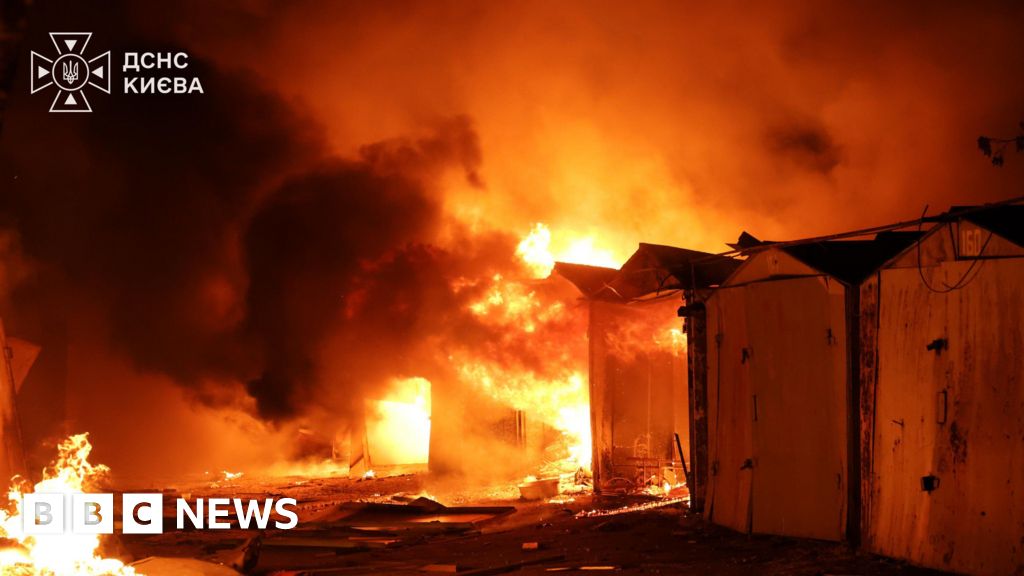
Three people, including a child, were killed in Russian missile strikes near Kyiv in the early hours of Saturday. Timur Tkachenko, head of the regional military administration, reported that the ballistic missile attacks also wounded three people and caused damage to apartment buildings and vehicles due to falling debris.
The strikes follow a week of intensified aerial activity. Earlier in the week, strikes across Ukraine resulted in 21 deaths. In response to recent attacks, President Volodymyr Zelensky stated that the supply of missile interceptors from allies has been "significantly reduced" this year. He noted that delays in receiving anti-ballistic systems lead to casualties and destruction that could otherwise be prevented with stronger interceptor capabilities.
In Kyiv, emergency crews worked to extinguish fires at a building and a fuel tank, according to Mayor Vitaly Klitchko. The Ukrainian state emergency service (DSNS) released images of burning garages and businesses in the Holosiivskyi district. Simultaneously, the Ukrainian general staff reported that its forces hit Russia’s Ilsky and Syzran oil refineries during overnight attacks, which Zelensky stated were intended to limit revenues used to fund the Russian military.
The scale of the conflict's reach extended beyond the primary combatants on Saturday when a drone carrying explosives entered Bulgarian airspace from Romania and exploded near an international gas pipeline. While Bulgarian Prime Minister Rumen Radev reported no casualties or damage, the incident demonstrates the potential for the conflict to impact energy infrastructure and safety in neighboring European nations. The source did not confirm the origin of that specific drone.
In the diplomatic sphere, President Zelensky traveled to Belgrade on Saturday to meet with Serbian President Aleksandar Vučić. The meeting highlights the complex regional dynamics as Zelensky seeks wider support, while Vučić continues to refuse the application of sanctions against Russia despite providing aid and reconstruction promises to Ukraine. As mediation talks between Russia and Ukraine have faltered, both sides have increased the frequency of strikes, with no immediate date set for a return to negotiations.
In the diplomatic sphere, President Zelensky traveled to Belgrade on Saturday to meet with Serbian President Aleksandar Vučić. The meeting highlights the complex regional dynamics as Zelensky seeks wider support, while Vučić continues to refuse the application of sanctions against Russia despite providing aid and reconstruction promises to Ukraine. As mediation talks between Russia and Ukraine have faltered, both sides have increased the frequency of strikes, with no immediate date set for a return to negotiations.