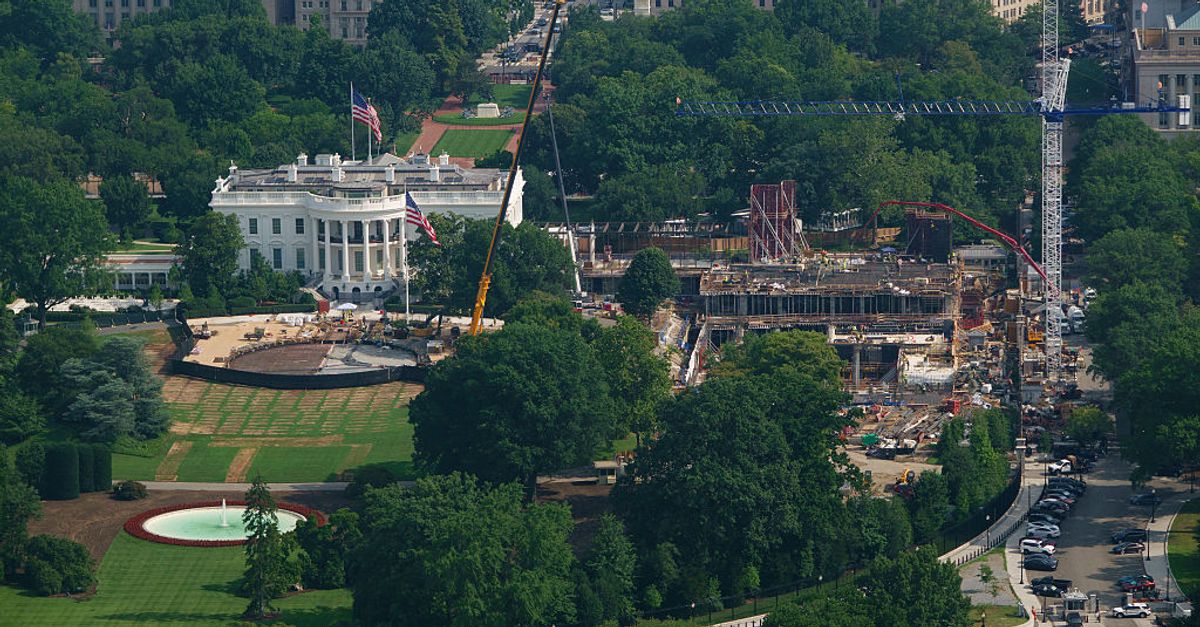
The Trump administration filed an emergency request with the U.S. Supreme Court on Friday, seeking to resume construction on a new 90,000-square-foot ballroom at the White House. The move follows a ruling by the U.S. Court of Appeals for the District of Columbia Circuit that upheld a temporary block on above-ground construction while legal challenges proceed.
The dispute began in October 2025 when the administration demolished the East Wing of the White House to begin the project. The National Trust for Historic Preservation, a nonprofit organization, sued to stop the work, arguing the demolition and new construction cause permanent architectural and historical damage. While a district court judge initially blocked the project, that order had been stayed during the appeals process, allowing work to reach 65% completion.
U.S. Solicitor General D. John Sauer argued in the filing that the project is a "vitally required" military and secure ballroom complex necessary for national security. Sauer asked the justices for an administrative stay to prevent the lower court's injunction from taking effect, which would otherwise halt the 250-person crew currently working 20 hours a day. The administration contends that Congress authorized the president to make such "improvements" to the executive residence.
For the public and federal employees, the outcome determines the fate of the East Wing, which formerly housed the offices of the First Lady. If construction continues, the building will be completed as a secure military and social complex. If the courts eventually rule against the administration, the government faces significant logistical hurdles. Joshua Fisher, director for White House Management and Administration, stated in court documents that the concrete used is "virtually impossible to deconstruct," suggesting that a later order to remove the structure could be physically or financially impractical to execute.
The legal ruling sets a precedent regarding whether the president or Congress holds the "exclusive authority" to regulate the demolition and construction of White House structures. The D.C. Circuit majority ruled that Congress has not specifically authorized funds for this ballroom, while the administration argues existing laws for national parks and executive residence "alterations" provide the necessary power. The Supreme Court has directed the National Trust for Historic Preservation to file its response by 12 p.m. EDT on Tuesday, Aug. 18, after which the justices will decide whether to allow construction to proceed.