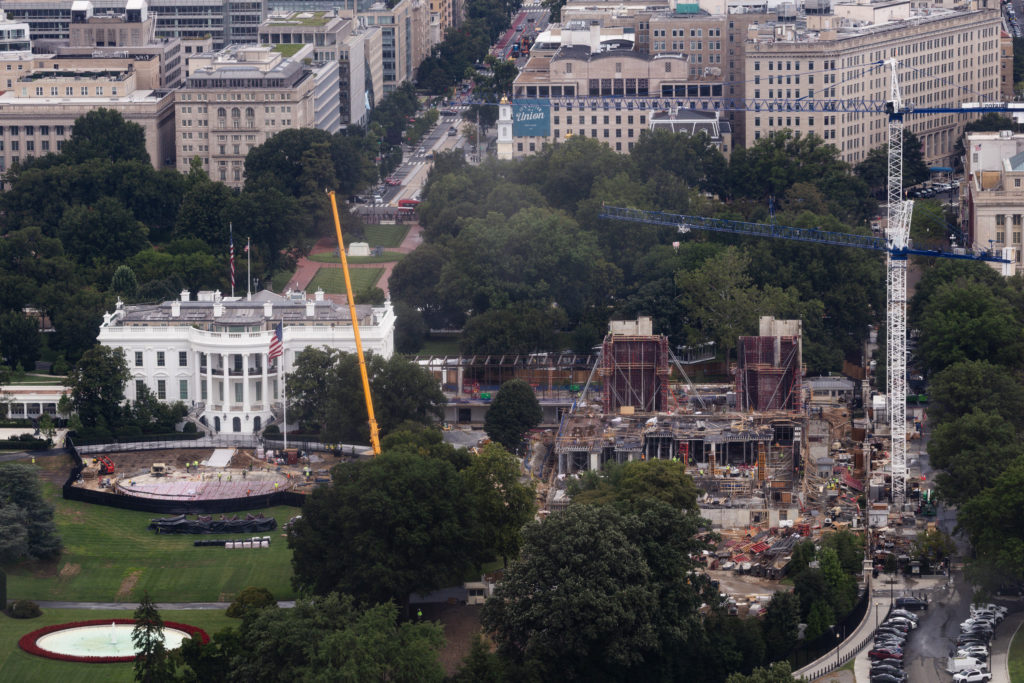
The administration of President Donald Trump asked the U.S. Supreme Court on Friday to permit the resumption of construction on a $400 million ballroom at the White House. The filing seeks to suspend a lower court order that halted work on the project while an appeal proceeds. Chief Justice John Roberts has set a Tuesday deadline for the plaintiffs to respond to the administration's request.
The request follows a 2-1 decision by a panel of the U.S. Court of Appeals for the District of Columbia Circuit, which ruled that construction must stop because Congress had not approved the project. The project involves building a 90,000-square-foot ballroom on the site where the White House East Wing stood before it was demolished last fall. While the appeals court paused aboveground work, it allowed the administration two weeks to seek Supreme Court intervention before the order takes effect on Aug. 21.
Solicitor General D. John Sauer argued in the petition that the injunction interferes with a "vitally required" national security project, characterizing the site as an integrated military complex. The administration maintains the president has unilateral authority over White House renovations. Conversely, the National Trust for Historic Preservation, which filed the lawsuit, argued the administration is attempting to "outrun the courts" by accelerating construction, noting plans to pour 3,000 cubic yards of concrete in the coming week.
The legal ruling impacts federal taxpayers and historic preservation advocates. The National Trust for Historic Preservation, the primary plaintiff, claims a right to prevent the demolition of historic structures, while the administration argues that private organizations lack the standing to sue over executive branch decisions regarding secure government facilities. A final ruling will clarify whether the president can unilaterally redirect funds for large-scale capital projects like this ballroom or if such work requires specific congressional authorization and oversight.
What happens next depends on the Supreme Court's response to the Solicitor General's petition. The plaintiffs have until Tuesday to submit their response to Chief Justice Roberts. If the Supreme Court does not act by Aug. 21, the appeals court's injunction will take effect, forcing a stop to all aboveground construction. The district court has already clarified that underground work, including bunkers and medical facilities, may continue regardless of the status of the ballroom project.