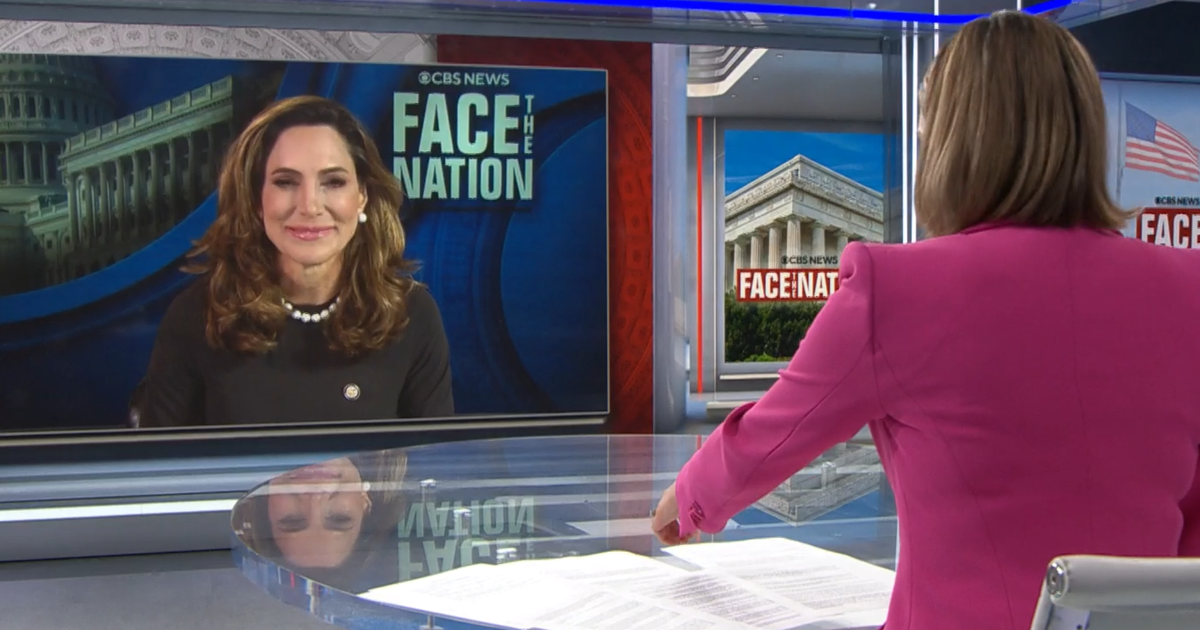
President Donald Trump barred three news organizations—CNN, Politico, and MS NOW—from attending a White House event after objecting to their reporting. Rep. Maria Elvira Salazar (R-FL) addressed the decision during a televised interview, characterizing it as the president's "style" while describing him as more accessible to the media than his predecessor, President Joe Biden. Moderator Margaret Brennan questioned whether blocking journalists based on their coverage violated the spirit of the First Amendment, to which Salazar responded that the president determines whom he speaks with and noted that social media provides alternative ways for journalists to cover the administration.
Domestic economic pressure and international conflicts remain central themes as the U.S. approaches the November 3 midterm elections. The country has reached 200 days of conflict with Iran, contributing to record-high diesel prices and high gas prices. While President Trump stated the war is driving up costs but will "end very soon," some Republicans in agricultural states like Iowa have expressed opposition to the open-ended nature of the conflict. Additionally, Rep. Salazar reported that Hispanic voters who supported the president in 2024 feel "betrayed" by current deportation policies, noting that half of the 50,000 people detained in July had no criminal record.
On foreign policy, Rep. Ro Khanna (D-CA) called for an international agreement between the U.S. and China to establish artificial intelligence (AI) safety standards. Khanna, who serves on the House Select Committee on the Chinese Communist Party, sent letters to Chinese firms like DeepSeek and Alibaba urging cooperation to slow AI development until guardrails are established; he reported that the firms have not yet responded. The proposal comes amid warnings from the FBI and CISA that China-based companies are copying American AI technology at an "industrial scale." President Trump recently proposed creating an "AI Force" and an AI czar to manage the sector.
The scale of the technological challenges is measured in hundreds of billions of dollars. In the technology sector, China is reportedly preparing to spend $300 billion over five years to build state-owned data centers. This massive investment in AI infrastructure, paired with claims of industrial-scale technology theft, could dictate the future of global digital competition and the effectiveness of any proposed U.S. federal AI agency.
What happens next: Several high-level diplomatic and political events are scheduled for the coming days. President Trump is set to attend the U.N. General Assembly in New York on Monday, followed by a summit with Chinese President Xi Jinping in Washington later in the week. During these meetings, the administration is expected to discuss AI safety, human rights, and the detention of U.S. citizens like scholar Min Zin, who has been held in China for 100 days. Domestically, voters are 44 days away from the November 3 midterm elections, where all 435 House seats will be decided, while House Speaker Mike Johnson has sent members home until mid-November.